

What factors should I consider when selecting the appropriate formulation for high temperature powder coating to ensure optimal performance and longevity in my industrial application?
Select a high temperature powder coating formulation by matching its continuous and peak service-temperature capability to the application, then assessing the metal substrate, thermal cycling, chemical exposure, corrosion risk and required finish. Confirm that the formulation’s curing requirements suit the component and that its performance has been validated under the specific operating conditions, as excessive heat or repeated temperature changes can affect adhesion, appearance and coating life.
The appropriate high temperature powder coating formulation is the one whose resin, pigments, additives and film characteristics remain stable in the complete operating environment, not simply the one with the highest quoted temperature rating. Selection should therefore consider heat exposure alongside mechanical loading, coating thickness, appearance, electrical requirements, application equipment and the likely changes in performance over the component’s service life.
Start with the resin chemistry. High temperature powders commonly use silicone-based technology, silicone hybrids or other specialist resin systems developed for heat-resistant applications. These chemistries do not provide identical properties. A formulation designed for sustained heat may differ from one intended for intermittent exposure, while a product optimised for temperature resistance may offer less flexibility, impact resistance or chemical protection at lower temperatures. The resin should be selected according to the balance of properties required, rather than treated as a generic high-temperature product.
Assess the complete formulation, not only the resin. Pigments, fillers, curing agents and performance additives can influence heat stability, colour retention, gloss, hardness, flexibility and adhesion. Dark and highly saturated colours may behave differently from lighter shades when exposed to prolonged heat, and some pigments can lose colour or alter the appearance of the film. Fillers may improve hardness, dimensional stability or cost control, but can also affect flexibility and thermal expansion. Request technical data for the specific colour and finish being considered, because performance should not automatically be assumed to be identical across a product range.
Define the required mechanical performance at operating temperature. A coating can retain its appearance while becoming brittle, soft or more susceptible to abrasion. For components that are handled, clamped, vibrated or exposed to impact, check hot hardness, flexibility, abrasion resistance and resistance to cracking. If the coating is applied to thin sections, edges, threaded areas or moving interfaces, the formulation must also tolerate the stresses created by the component’s geometry. A formulation suitable for a stationary enclosure may not be appropriate for a fabricated part subject to vibration or repeated handling.
Specify the film build carefully. Film thickness affects coverage, edge protection, appearance and the way heat reaches the metal. Excessive build can increase the risk of trapped gases, cracking, loss of detail or uneven curing, while insufficient build may leave weak coverage at edges and difficult-to-coat areas. The selected formulation should have a practical application window that suits the component and the coating equipment. Where dimensional tolerances are tight, establish acceptable film-build limits before production rather than relying only on a nominal target.
Consider thermal conductivity and insulation requirements. Some components need the coating to tolerate heat without affecting heat transfer, whereas others require electrical insulation or dielectric protection. A formulation containing particular fillers or pigments may alter electrical or thermal behaviour. These properties should be confirmed against the finished coating system, including the specified film thickness, rather than inferred from the powder’s resin type alone.
Check compatibility with the underlying metal and any existing treatment. The formulation must work with the chosen pretreatment and be suitable for the metal’s surface condition. Castings, weld zones, galvanised parts and porous substrates can introduce different risks, including gas release, surface contamination or local adhesion problems. If the part has an existing coating, sealant, masking material or conversion layer, confirm that it will not soften, react or contaminate the new film during application and curing.
Match the powder to the manufacturing process. Important practical factors include the required electrostatic charging behaviour, reclaim arrangements, spray equipment, colour change procedure and curing method. Powder intended for one application technique may not produce consistent coverage with another. Consider whether the component can be heated uniformly, whether concealed areas will receive adequate coating and whether the formulation’s cure response suits the available oven and production sequence. A technically capable powder is unsuitable if the process cannot apply and cure it consistently.
Review finish and appearance requirements over time. Gloss, texture and colour may change as the coating experiences heat. If appearance is important, ask for data from the exact formulation, colour and finish rather than relying on a general product description. For functional parts, visual change may be acceptable if adhesion and protection remain satisfactory; for visible architectural, automotive or equipment components, colour shift, chalking and loss of gloss may be critical selection criteria.
Use application-specific evidence before approving the formulation. Technical data sheets provide a starting point, but laboratory results may not represent the geometry, substrate, film build and heating pattern of a production component. A representative trial can assess coverage, appearance, adhesion, hardness and any defects after exposure to the intended operating conditions. Where failure would be costly, agree acceptance criteria in advance and retain the powder batch information, application settings and curing records for traceability.
For a sound specification, document the resin system, colour, finish, target film build, substrate, pretreatment, curing method, mechanical demands, electrical or thermal requirements and evidence used for approval. This gives the applicator and end user a defined formulation to evaluate and reduces the risk of selecting a powder solely on a broad heat-resistance claim.
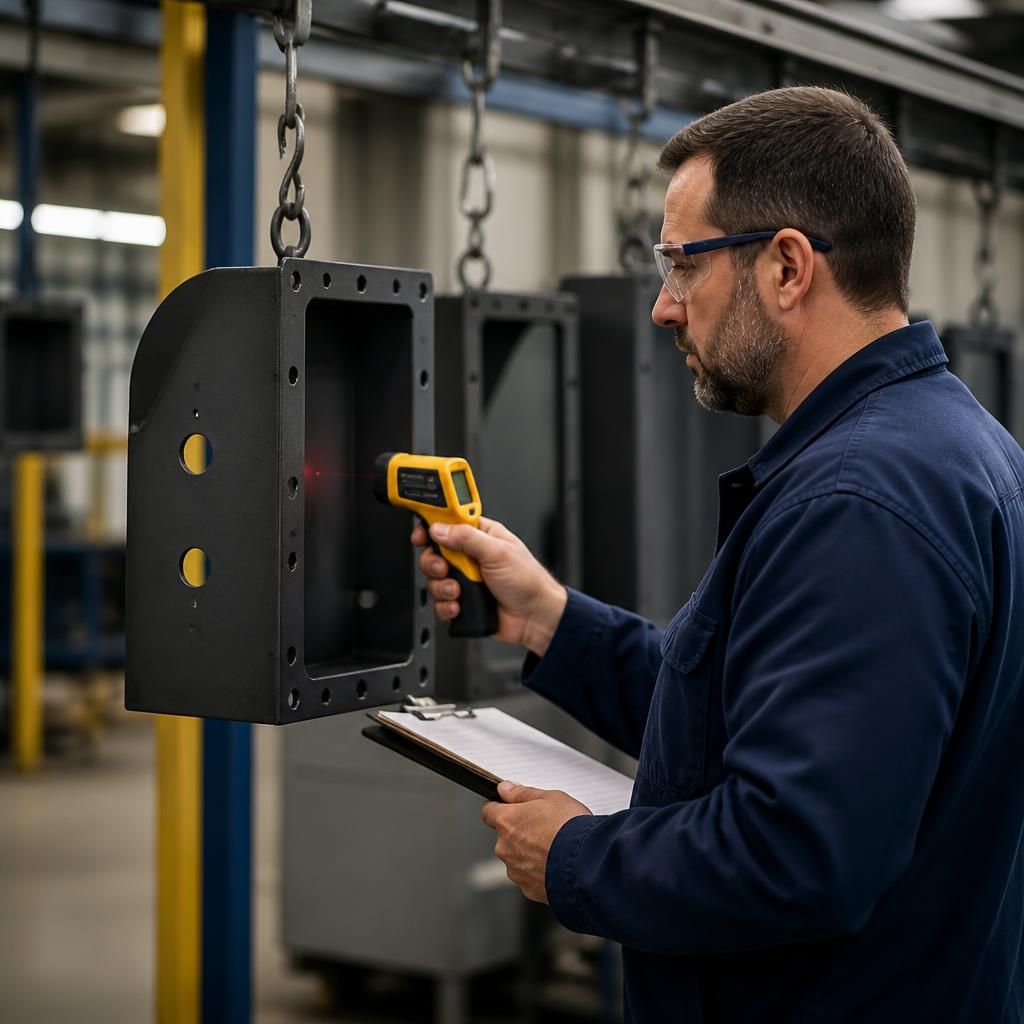
A critical selection step is to base the formulation on the temperature actually experienced by the coated surface, rather than relying solely on the surrounding air temperature or the equipment’s stated operating temperature. Metal components can develop local hotspots where they are close to heat sources, exposed to radiant heat, enclosed by insulation or affected by restricted airflow.
Measure or estimate temperatures at representative points across the component, including edges, joints, enclosed sections and areas near heat sources. Record normal operating conditions as well as start-up, shutdown and process interruptions. This temperature profile helps identify whether the coating must withstand brief local peaks, sustained heat or uneven heating, allowing the formulation to be assessed against the real component rather than a simplified nominal rating.