

What common pitfalls should be avoided when applying polyester powder coating to ensure optimal results?
Common polyester powder coating pitfalls include inadequate cleaning or pretreatment, contamination, incorrect film thickness, poor earthing, unsuitable application settings and incomplete or excessive curing. Control the process by preparing the metal correctly, keeping surfaces and equipment clean, checking coating thickness, masking critical areas accurately and confirming that the oven reaches the specified curing conditions for the powder system.
Optimal polyester powder coating results depend on more than correct spraying and curing. The main risks are choosing an unsuitable powder system, overlooking the component’s design and substrate, failing to control colour and finish consistency, and damaging the coating during handling or assembly. These issues should be addressed during specification and production planning, not after defects appear.
Do not select the powder by colour alone. Polyester powders are available for different exposure conditions and performance requirements. A finish intended for sheltered internal equipment may not be appropriate for prolonged sunlight, moisture, chemicals or industrial pollution. The specification should identify the expected environment, required durability, gloss level, texture, colour reference and any resistance requirements before the coating system is selected. Choosing a finish solely because it looks similar to an existing component can result in avoidable differences in weathering or service life.
Account for the component’s design. Deep recesses, narrow gaps, enclosed sections, sharp corners and complex profiles can affect powder access, drainage and visual uniformity. Hollow fabrications may also require suitable venting so that trapped air or gases do not create defects during processing. Designers should identify drainage points, lifting locations and areas where coating could interfere with assembly. Without these allowances, the finished part may have inaccessible areas, uneven appearance or dimensional problems.
Allow for coating build in functional areas. Threads, bores, bearing seats, sliding faces, electrical contact points and close-tolerance joints may not accept the additional thickness of a cured coating. These areas need to be identified on the drawing and protected or finished to the agreed requirement. A common mistake is to treat powder coating as purely cosmetic when it can also affect fit, movement, earthing or the connection between assembled parts.
Check that the substrate and other materials are compatible. Steel, aluminium, galvanised components, castings and previously coated parts can behave differently during processing and may require different controls. Mixed-metal assemblies should be reviewed before coating, particularly where their surfaces, thermal behaviour or pretreatment requirements differ. Welded areas, cast surfaces and repairs can also produce variations in appearance if their condition is not considered in the specification.
Do not mix up colour consistency with simple colour matching. The same nominal colour can appear different when applied over different substrates, at different gloss levels or with different textures. Part orientation, component geometry and the production sequence can also influence the perceived finish. Where several parts will be assembled together, they should be planned as one colour-critical group rather than coated independently without an agreed reference. Retaining an approved sample or reference panel helps provide a consistent basis for inspection.
Avoid uncontrolled changes between batches. Switching between powder types, finishes or suppliers without checking compatibility can create visible differences and may affect performance. Powder should be stored and identified in accordance with its technical documentation, with stock rotation and batch traceability maintained. Mixing materials or using unidentified residual powder makes it harder to investigate a defect and can compromise the consistency of the finished work.
Plan for the part after coating. Freshly coated components can be marked by unsuitable hooks, separators, slings, pallets or packaging. Contact points should be designed so that they do not scratch prominent faces or leave impressions. Parts should be supported securely, kept apart where surfaces could rub, and protected from impact during movement. Care is also needed during assembly: forcing coated parts together, dragging them across benches or tightening fasteners against the finish can cause chips and exposed edges.
Do not accept appearance without checking function. Inspection should cover the agreed visual standard as well as relevant practical requirements. Depending on the application, this may include colour, gloss, texture, coverage, adhesion, edge condition, concealed areas and dimensional fit. Inspection lighting and viewing distance should be consistent, since textured or metallic finishes can look different under changing conditions. Any non-conformance should be recorded by component, batch and location so that recurring causes can be identified.
Define rework rules before production starts. Small blemishes, handling damage and assembly marks should not be corrected with an incompatible touch-up material simply because it matches visually. The repair method must suit the polyester system and the service conditions, and the affected area may need to be assessed for adhesion, appearance and protection. For critical components, it is better to agree what constitutes an acceptable repair, reject or complete recoat before work begins.
For industrial components, the most reliable approach is to issue a clear coating specification with the substrate, intended environment, colour and finish, functional exclusion zones, dimensional limits, inspection criteria, packaging method and rework procedure. This prevents the common mistake of judging the coating only after production, when design or handling problems may be expensive to correct.
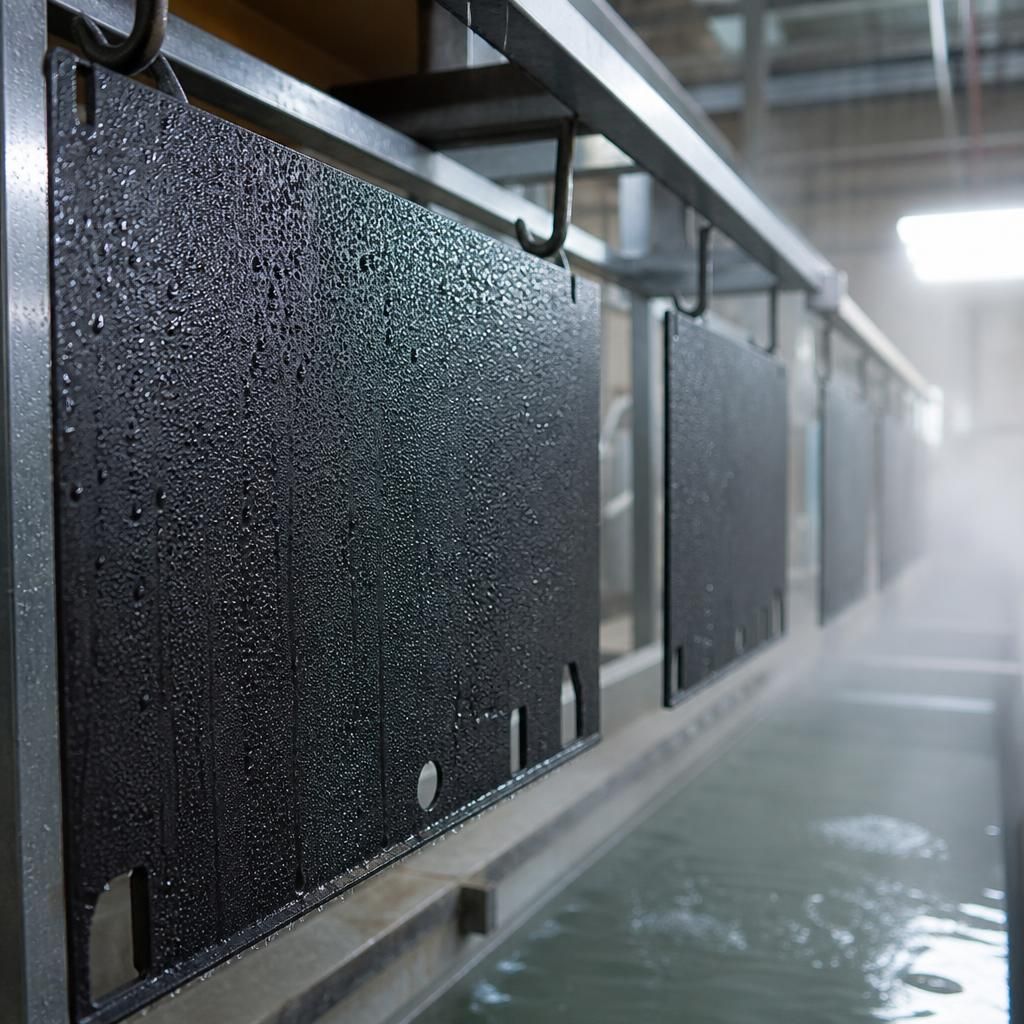
Moisture and temperature-related errors can undermine polyester powder coating even when the surface has been correctly prepared. If a metal component is colder than the surrounding air, condensation may form on the surface and interfere with powder adhesion. Damp compressed air can also introduce moisture during application, contributing to uneven transfer, surface defects or poor finish development.
Before spraying, components should be allowed to reach suitable processing conditions and checked for visible moisture, particularly after storage or transport in changing temperatures. The compressed-air supply should be clean and dry, with filtration and drainage maintained as part of the application process. Controlling these conditions helps prevent defects that might otherwise be incorrectly attributed to the powder or oven cycle.