

What are the performance differences between polyurethane, PVDF, and Rilsan coatings in terms of impact resistance, flexibility, and environmental durability for different industrial sectors?
Polyurethane generally provides the best combination of impact resistance and flexibility, while PVDF is preferred for demanding weathering, UV and chemical-exposure conditions. Rilsan, a polyamide 11 thermoplastic coating, offers strong impact resistance, flexibility and corrosion protection, making it suitable for components exposed to mechanical wear and harsh environments.
Performance differences between polyurethane, PVDF and Rilsan coatings depend on the type of loading, exposure and service temperature involved. Polyurethane is often selected where elasticity and resistance to repeated mechanical contact are important; PVDF is primarily suited to prolonged outdoor and chemical exposure; and Rilsan, a polyamide 11 coating, is well suited to components requiring a tough, resilient barrier against impact, abrasion and corrosion. The most suitable option is therefore determined by the failure risk in the finished component rather than by coating type alone.
Impact resistance
Impact resistance describes how well a coating absorbs a sudden blow without cracking, chipping or separating from the metal beneath it. This matters for fabricated parts that are handled, assembled, transported or exposed to occasional knocks in service.
- Polyurethane: Its resilient film can accommodate local deformation and repeated contact, helping it cope with components that are flexed or subjected to moderate impact. The precise result depends on the formulation, film build and cure, since an excessively thick or poorly bonded film can fail even when the coating chemistry is suitable.
- PVDF: PVDF is generally chosen for surface retention and exposure resistance rather than for the highest level of mechanical abuse. It can provide an effective protective finish, but the design should account for sharp impact, edge damage and the possibility that a rigid substrate movement may stress the coating.
- Rilsan: Rilsan coatings are tough and can absorb significant mechanical shock. Their resistance to chipping and wear makes them useful on pipework, handling equipment, valves, brackets and other parts that may be knocked or rubbed during operation.
Impact performance also depends on what happens at the point of contact. Rounded edges, adequate pretreatment and good adhesion reduce the chance of a blow lifting the coating from the substrate. A coating that withstands a laboratory impact test may still be vulnerable where the metal has sharp corners, weld spatter, contamination or inadequate surface preparation.
Flexibility and movement
Flexibility is relevant where a metal part is bent after coating, where the substrate expands and contracts, or where the component experiences vibration. A flexible coating can follow limited movement without developing visible cracks, but flexibility should not be confused with softness. A soft surface may deform readily while offering less resistance to scratching or abrasion.
- Polyurethane: Polyurethane can provide a useful combination of elastic movement and surface protection. It is worth considering for formed components, guards, fixtures and parts exposed to vibration, provided the selected grade is compatible with the expected temperature and chemicals.
- PVDF: PVDF retains its protective properties under demanding external exposure, but its suitability for post-coating forming or repeated flexing must be checked for the particular system. Components normally need to be designed and formed so that the coating is not subjected to severe deformation after application.
- Rilsan: Rilsan has good flexibility for a thermoplastic coating and can tolerate movement, impact and handling without behaving like a brittle, glass-like film. This supports its use on parts where toughness and resilience are more important than an exceptionally hard decorative surface.
For all three materials, the coating should normally be applied after the final forming, drilling and welding operations. Bending or machining a coated part can create stresses, expose bare metal or damage the film at edges. Where post-coating forming cannot be avoided, the applicator should assess the bend radius, coating thickness, adhesion and direction of deformation before production work begins.
Environmental durability
Environmental durability covers more than resistance to rain. It includes ultraviolet exposure, temperature cycling, humidity, salt, industrial chemicals, cleaning agents, oils, fuels and contact with other materials. The environment may affect the coating itself, its adhesion, its colour and gloss, or the metal underneath.
- PVDF: PVDF is particularly valuable where long-term colour and surface stability in sunlight and weather are priorities. It is frequently considered for architectural metalwork, external enclosures, façade-related components and equipment installed in exposed locations. Its chemical resistance can also make it appropriate for selected industrial atmospheres, although the exact chemical, concentration and operating temperature must be checked.
- Rilsan: Rilsan provides a non-metallic barrier that can isolate steel and other substrates from moisture and corrosive agents. It is relevant to water-handling equipment, industrial components, transport-related parts and applications exposed to salt, oils or general chemical contamination. Its value is strongest where environmental exposure is combined with abrasion or impact.
- Polyurethane: Polyurethane can perform well in industrial and external settings when the correct grade is selected, but its resistance is more formulation-dependent. Prolonged ultraviolet exposure, strong solvents, aggressive cleaners or elevated moisture and heat may require specific confirmation from the coating specification rather than an assumption based only on the word polyurethane.
Temperature cycling deserves separate consideration. Metal expands and contracts as its temperature changes, and repeated cycles can test the bond between coating and substrate. A coating that remains intact at a constant temperature may perform differently when exposed to alternating heat, cold and moisture. Rilsan and polyurethane can be advantageous where some movement is expected, while PVDF is often selected when outdoor weathering and surface retention dominate the specification. The full temperature range, heating rate and duration should be assessed for the actual component.
Suitability by industrial sector
- Construction and architectural fabrication: PVDF is usually considered where exterior appearance, UV exposure and resistance to weathering are central requirements. Polyurethane may be appropriate for items requiring a more resilient surface during handling or installation, while Rilsan can suit exposed components that also face abrasion or corrosive contamination.
- Manufacturing and general fabrication: The choice depends on whether the main threat is repeated contact, outdoor exposure, chemical contamination or corrosion. Polyurethane can suit moving or handled parts, Rilsan can protect robust industrial components, and PVDF can be justified for equipment installed in a visibly exposed or chemically demanding location.
- Automotive and transport-related applications: Rilsan can be considered for components exposed to stone impact, abrasion, moisture and road contaminants. Polyurethane may suit parts subject to vibration or repeated contact. PVDF is more likely to be evaluated where external weathering and retention of appearance are more important than severe mechanical abuse.
- Water, chemical and process equipment: Rilsan can provide a durable insulating barrier on suitable components, particularly where corrosion and mechanical wear occur together. PVDF may be preferred for selected chemical exposures, but compatibility must be confirmed against the specific medium and temperature. Polyurethane should likewise be checked against the process chemicals and cleaning regime.
How to make a reliable comparison
A coating specification should record the substrate, preparation method, required film thickness, operating temperature, likely impact energy, movement or flexing, chemical contacts, UV exposure and cleaning method. It should also identify whether appearance, electrical insulation, abrasion resistance or corrosion protection is the primary objective. These factors can change the preferred material even within the same industrial sector.
Laboratory data should be treated as comparative guidance rather than a guarantee of field performance. Impact, flexibility, adhesion, abrasion, weathering and chemical-resistance tests use defined conditions that may not reproduce the combination of stresses found in service. For a critical component, sample panels or representative parts can help confirm adhesion, finish, edge coverage and resistance to the actual operating environment before a full batch is coated.
In practical terms, select polyurethane when controlled flexibility and resilient handling performance are central, PVDF when prolonged weathering and surface stability lead the specification, and Rilsan when toughness, corrosion isolation and resistance to mechanical wear need to work together. Final selection should be based on the complete exposure profile and on the coating system’s application requirements, not on the resin name in isolation.
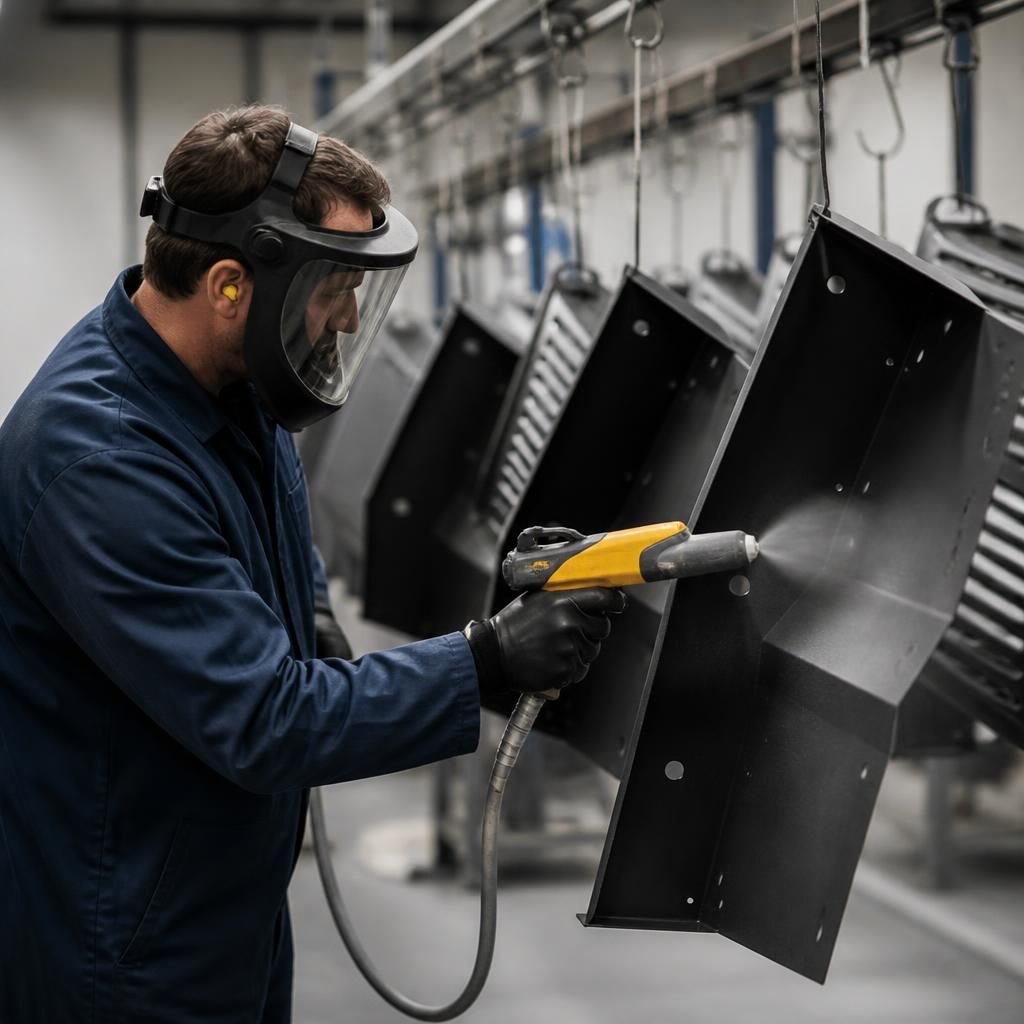
Coating performance can change significantly with service temperature, so impact resistance and flexibility should be assessed under the temperatures the component will actually experience. At low temperatures, a polymer coating may become less able to accommodate sudden deformation; at elevated temperatures, it may soften and provide less resistance to indentation, abrasion or handling damage.
This is particularly important for automotive parts, process equipment and external components exposed to repeated heating and cooling. Polyurethane, PVDF and Rilsan should therefore be compared using data relevant to the operating temperature, substrate movement and exposure conditions, rather than by relying on a general ranking of the three materials.