

What are the cost considerations when selecting protective and corrosion-resistant powder coatings for large-scale projects?
Protective and corrosion-resistant powder coating costs for large-scale projects depend on the metalwork’s size and condition, preparation requirements, coating specification, part geometry, batch quantities, handling and any collection or delivery needed. A meaningful quotation should therefore assess the complete process rather than compare coating price alone, particularly where specialist finishes or additional corrosion protection are required.
Protective powder coating costs for a large-scale project are best assessed as a total project cost rather than a coating-only rate. The most useful comparison includes the selected protection system, quality-control requirements, packaging, documentation, programme coordination and the financial consequences of premature failure or rework.
Material selection affects both initial and lifecycle cost
Powder coating materials vary in price and in the level of protection they are intended to provide. A standard finish may be suitable for a relatively controlled indoor application, whereas external, corrosive or chemically exposed equipment may require a more specialised system. The least expensive material is not necessarily the most economical choice if the coated component will be difficult to access, costly to remove or critical to production.
Where a project requires a primer, topcoat or another multi-layer arrangement, the quotation should identify each layer and its purpose. It should also state whether the proposed system is intended to provide barrier protection, improved chemical resistance, greater durability in outdoor conditions or a combination of these functions. Comparing two prices without comparing the protection level can produce a misleading result.
Quality assurance can be a significant project cost
Large contracts may require more than a visual inspection. Depending on the application, the specification may call for coating-thickness checks, adhesion testing, cure verification, sample panels, inspection records or batch traceability. These activities support consistent results across a substantial quantity of components, but they also require inspection time, equipment and documentation.
It is important to establish the required acceptance criteria before work begins. A quotation that excludes testing or certification may appear lower while leaving the client to arrange those activities separately. Conversely, testing that is unnecessary for the application can add cost without improving the finished component. The appropriate level should reflect the operating environment, contractual requirements and consequences of a coating failure.
Masking and post-coating requirements should be priced clearly
Some metal components need areas left uncoated for electrical contact, earthing, welding, assembly or dimensional control. Other projects may require protective caps, removable plugs, controlled coating around apertures or additional attention to mating surfaces. These requirements affect consumables and labour, and they can also influence inspection after coating.
Post-coating work may include removing masking, checking critical interfaces, replacing plugs, trimming unwanted material or preparing parts for assembly. If these tasks are not identified in the specification, they may become variations later. Providing drawings with marked exclusion zones and dimensional tolerances helps distinguish essential requirements from optional finishing work.
Packaging and protection after coating matter
A correctly applied coating can still be damaged during storage, loading or installation. The required packaging depends on the shape, weight and sensitivity of the finished parts, as well as the length and complexity of the supply chain. Separators, wrapping, edge protection and suitable labelling may be needed where coated surfaces could rub against one another.
Packaging should be considered alongside the project’s installation sequence. If components are delivered in the wrong order or cannot be identified easily, additional handling and inspection may be required on site. Clear part references, packing lists and agreed delivery groupings can reduce avoidable disruption, particularly where a project involves many similar items.
Programme and coordination influence the final cost
Large-scale coating work often forms one stage within a wider manufacturing or construction programme. Delays caused by incomplete drawings, late design changes, missing components or uncertain approval requirements can create storage, administration or reprocessing costs. Agreeing the information needed before production starts helps limit these risks.
Any change after coating has begun should be assessed carefully. Altering a colour, masking instruction, component identification or acceptance requirement may affect material use, inspection and the treatment of parts already processed. A written change-control process makes it easier to identify which costs are included in the original quotation and which arise from a revised requirement.
Rework and failure risk should be included in the assessment
The cost of a coating problem is rarely limited to recoating. It may also involve removing and returning components, replacing damaged items, repeating inspections, delaying assembly or arranging access to installed equipment. This is why an appropriate specification and clear quality checks can be more valuable than selecting the lowest initial price.
Ask whether the quotation explains how defects, transport damage, specification changes and non-conforming parts will be handled. The commercial terms should make clear what is included in any correction and what would be treated as additional work. This is particularly relevant when the coated parts are part of a larger production run or construction schedule.
How to compare quotations accurately
- Check that each quotation describes the same coating system and required protection level.
- Confirm which masking, inspection, documentation and packaging activities are included.
- Identify any assumptions about drawings, tolerances, colour, finish and component condition.
- Check whether collection, delivery, storage or special packing is priced separately.
- Ask how variations, rework and damaged parts will be assessed.
- Consider expected service life and maintenance exposure, not only the initial invoice value.
For a tailored assessment, supply component drawings, quantities, material information, environmental conditions, required finish, inspection requirements and the intended delivery arrangements. This gives the coating provider enough information to separate essential protection from optional requirements and produce a quotation that is easier to compare on a like-for-like basis.
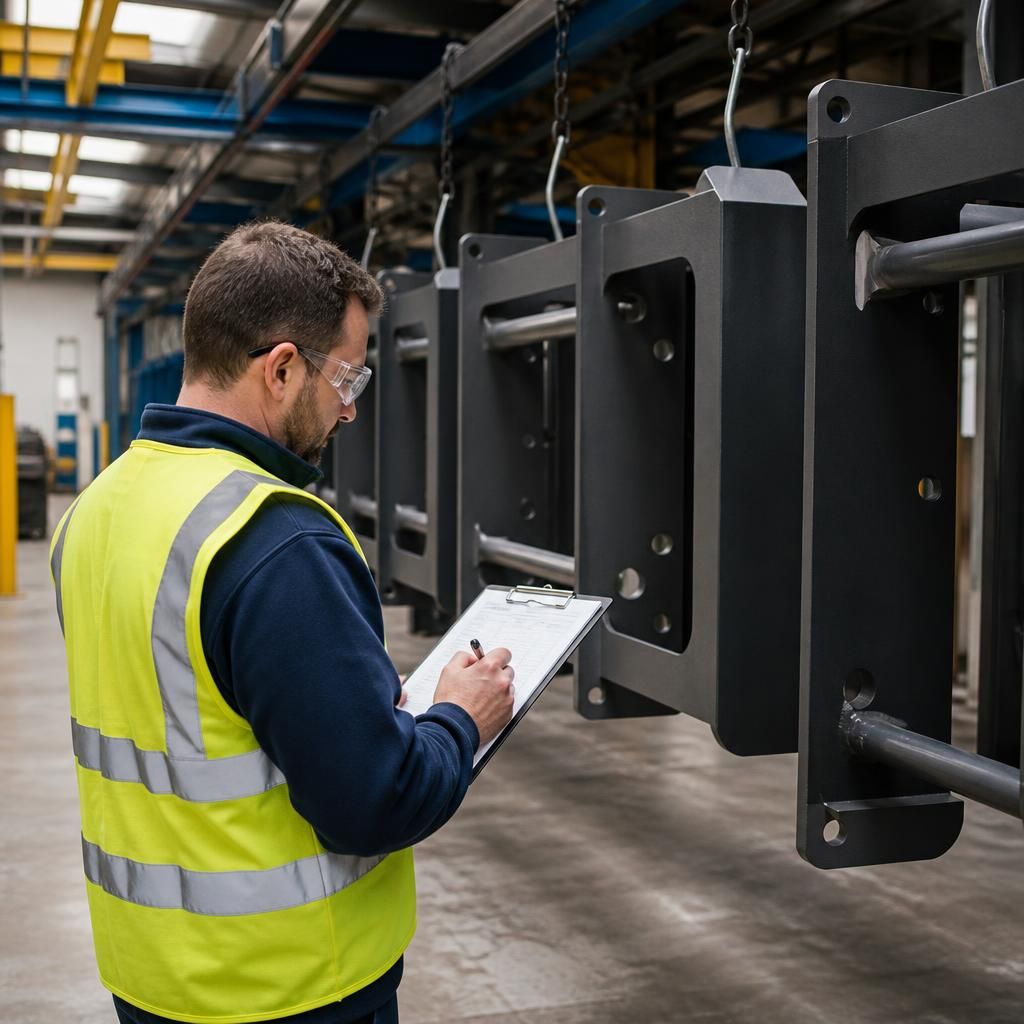
Component geometry can affect powder coating cost even when two items use the same material and finish. Large surface areas increase powder consumption, while deep recesses, enclosed sections, narrow edges and complex profiles can require more careful positioning and inspection to achieve consistent coverage.
Parts must also be supported and presented correctly during coating and curing. Awkward shapes may need additional hanging points, specialist fixtures or separate processing arrangements, particularly where contact marks must be limited. Supplying accurate drawings, dimensions and photographs helps the coater assess these requirements and include the associated handling in the quotation.
Request a tailored quote for your large-scale powder coating project
Provide your component drawings, quantities, material details and project requirements for a quotation based on the complete protective coating process. This allows the specification, preparation, inspection and handling requirements to be assessed accurately.