

What are the advantages and limitations of different powder coating finishes for vehicles, and how do they impact performance and maintenance?
Different powder coating finishes for vehicles balance appearance, durability and practical performance: smooth or gloss finishes are easier to clean, while matt, satin and textured finishes can disguise minor marks but may require more careful cleaning. All offer a hard, corrosion-resistant surface when correctly specified and applied, but powder coating can be vulnerable to impact damage, unsuitable pretreatment and harsh chemicals, so finish selection should reflect the component’s exposure, use and maintenance requirements.
The best powder coating finish for a vehicle depends on the component’s exposure, temperature, movement, required appearance and tolerance for visible wear. Gloss, satin, matt, textured and effect finishes can all be suitable, but the visible finish is only one part of the specification: resin type, film thickness, pretreatment and curing have a major influence on service performance and maintenance.
Gloss finishes produce a relatively reflective, uniform appearance and are often selected where colour depth and ease of inspection matter. Their even surface makes it straightforward to identify contamination, stone chips or corrosion beginning at a damaged area. Gloss can, however, make fine scratches, sanding marks and application irregularities more noticeable. It is therefore dependent on good preparation and consistent spraying, particularly on large or visually prominent vehicle components.
Satin finishes provide less reflection than gloss while retaining a relatively smooth surface. This can be a practical compromise for wheels, brackets, trims and fabricated components where a subdued appearance is preferred without the more pronounced surface character of a textured coating. Satin is not a separate measure of durability by itself; its performance still depends on the powder chemistry, preparation and exposure conditions.
Matt finishes minimise reflected light and can create a modern, understated appearance. They may be appropriate for selected body accessories, trim parts and ancillary components, but their surface should not be judged solely on appearance. Some matt systems can show polishing, burnishing or uneven sheen if repeatedly rubbed or cleaned with unsuitable materials. Local repairs may also be more difficult to blend invisibly because a small area with a different level of sheen can be apparent from certain angles.
Textured and wrinkle finishes add surface character and can be useful where a more technical or functional appearance is required. The texture can reduce the visual prominence of very small surface variations, but it also makes uniform film build and complete coverage more demanding. Deep profiles may hold road film or residue in the surface, so cleaning may require more time and a soft brush rather than relying only on a cloth. These finishes can also be harder to match if a component later needs partial refinishing.
Metallic, pearlescent and other effect finishes introduce visual variation through metallic flakes or special pigments. They can provide a distinctive appearance, but consistency between separate batches can be more challenging than with a standard solid colour. The orientation of effect particles, application technique, film thickness and viewing angle can all influence the result. For components that may need replacement or future repair, retaining the coating specification and identifying the original system is particularly useful.
Resin chemistry affects performance. An exterior-grade polyester powder is generally more suitable for vehicle parts exposed to sunlight than a coating intended primarily for indoor use. Epoxy-based systems can provide useful chemical and corrosion protection in sheltered or enclosed applications, but they are not normally the first choice where long-term ultraviolet exposure is a principal concern. Hybrid systems sit between these uses, so the correct selection requires consideration of the component’s actual environment rather than choosing by colour or sheen alone.
Finish selection also affects practical vehicle performance in less visible ways:
- Heat: the coating must be suitable for the component’s operating temperature. The coating process itself uses elevated curing temperatures, which may require care with heat-treated aluminium, seals, bearings or assembled parts. Brake, engine-bay and exhaust-adjacent components need particularly careful specification.
- Movement and fit: coating thickness can affect threads, mating faces, sliding interfaces, bearing seats and close-tolerance assemblies. These areas may need masking before coating, followed by inspection before the part is returned to service.
- Electrical continuity: a powder coating is electrically insulating. Earth points, contact faces and bonding locations therefore need to remain clear or be restored correctly during assembly.
- Impact and abrasion: no decorative finish removes the risk of damage from stones, tools, fasteners or contact with other parts. Components exposed to repeated rubbing may need a different coating specification, protective design detail or an alternative treatment.
- Corrosion protection: the finish cannot compensate for contamination, poor edge preparation or corrosion left beneath the coating. Welds, seams, recesses and sharp edges deserve particular attention during preparation.
Maintenance should match the chosen finish and the component’s use. Routine washing with clean water and a mild, compatible detergent helps remove road salt, mud and traffic film before they remain on the surface. A non-abrasive cloth or soft brush is preferable, especially for textured coatings. The part should be rinsed thoroughly and dried without aggressive rubbing. Abrasive pads, cutting compounds, strongly acidic or alkaline cleaners and solvents not confirmed as coating-compatible can alter the appearance or weaken the surface.
Inspection is more important on wheels, suspension parts, underbody brackets and other components exposed to impact or trapped moisture. Check edges, bolt holes, joints and areas around fasteners for chips, lifting or rust staining. Damage should be cleaned and assessed rather than simply covered with a cosmetic product, because moisture can travel beneath a compromised film. Where a component is safety-critical, any damage affecting a mounting face, brake-related area or structural part should be evaluated by a suitably qualified professional.
For vehicle work, the most suitable finish is therefore a balance between visual preference, environmental exposure, temperature, dimensional requirements and the way the part will be cleaned. A coating specialist can assess the substrate, intended use and masking requirements before recommending a powder system and finish that are compatible with the component, rather than treating gloss level as the main specification.
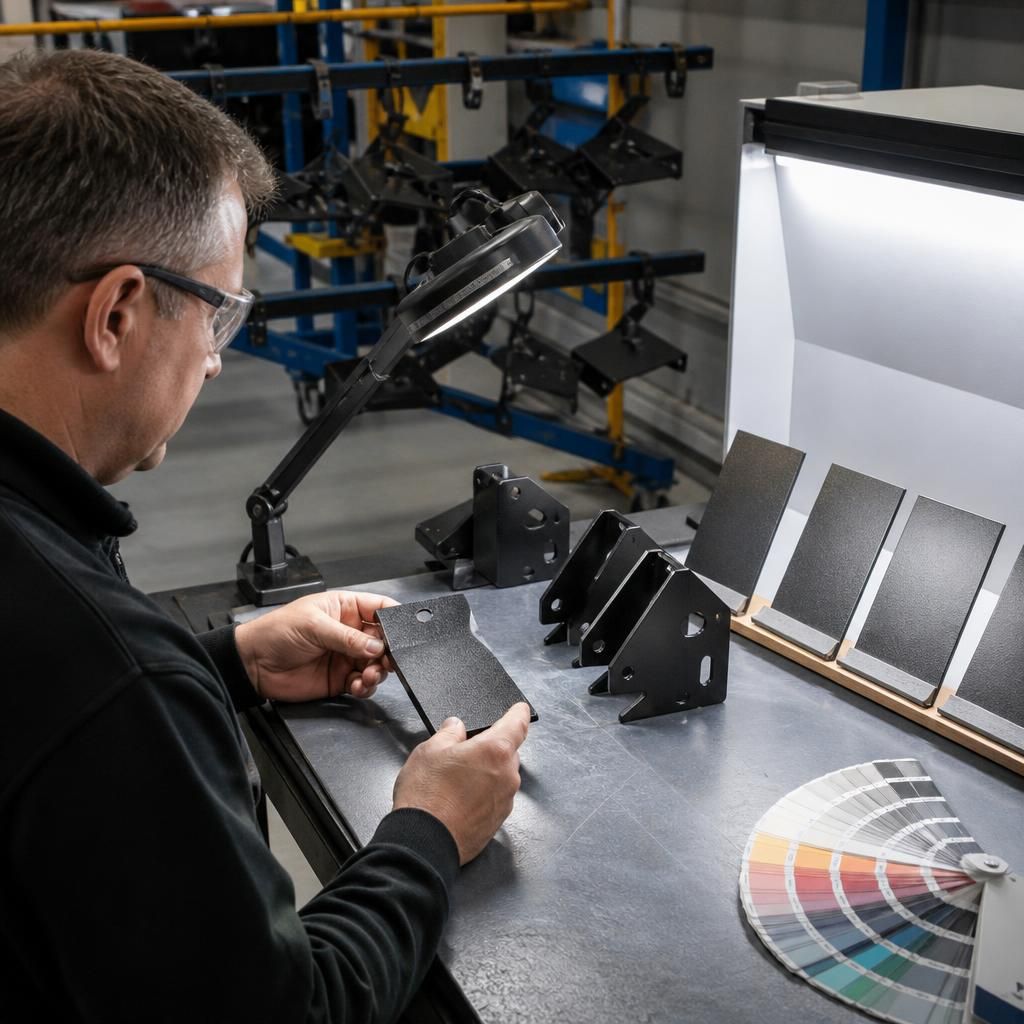
For vehicle components where appearance must be consistent, approve a representative sample before coating the full batch. The sample should be assessed on the same substrate and, where practical, with comparable edges, recesses and formed sections, because surface geometry can change how colour, texture and sheen are perceived. Reviewing it under more than one type of lighting also helps identify differences that may not be obvious in the coating area.
Record the agreed colour reference, gloss or texture level and coating system with the job information. This creates a clearer standard for future components and makes it easier to distinguish an intentional finish variation from an application issue. It is particularly useful when several vehicle parts need to appear visually coordinated but are processed at different times.
Discuss the Right Powder Coating Finish for Your Vehicle Parts
Contact Powder-coatings.co.uk to discuss the finish required for your vehicle components, including the intended use, exposure and appearance. Providing component details at the outset helps identify a suitable coating specification and any preparation or masking requirements.