

How does the choice of powder coating materials impact the longevity and performance of coated components?
The powder coating material determines key properties such as corrosion resistance, UV stability, chemical resistance, flexibility and hardness, so it has a direct effect on how long a coated component performs in service. Selecting the resin system, additives and suitable film thickness for the component’s operating environment helps prevent premature fading, cracking, wear or loss of adhesion.
The powder coating material affects a component’s service life by determining how the finished film responds to movement, impact, abrasion, temperature, moisture and contact with other substances. The most suitable choice is therefore based on the component’s operating conditions rather than appearance alone. Resin chemistry, curing behaviour, pigmentation, fillers and the intended film build all influence whether the coating remains intact and functional throughout its working life.
Thermoset and thermoplastic materials behave differently. Thermoset powders form a cross-linked film during curing. Once cured, they provide a stable surface with a defined balance of hardness and toughness. Thermoplastic powders melt and form a film without the same chemical cross-linking process. They can produce a relatively thick, resilient coating that is useful where impact absorption, repeated handling or resistance to wear is important. Nylon coatings are one example of a specialist thermoplastic finish used for components exposed to demanding physical contact.
Common thermoset resin systems have different performance profiles:
- Epoxy-based systems are valued for their strong adhesion and resistance to many industrial service conditions, but their suitability must be assessed where the coated part receives prolonged outdoor exposure or direct sunlight.
- Polyester systems are commonly selected for components used outdoors because their formulation can be designed to retain appearance and film integrity under external exposure.
- Hybrid systems combine epoxy and polyester characteristics and may be appropriate for interior components where a balance of finish quality, application performance and general protection is required.
- Polyurethane systems can be specified where a smooth decorative finish and particular resistance to handling or surface marking are important, subject to the conditions of use.
These categories are broad rather than interchangeable product specifications. Two powders based on the same resin family can perform differently because of their formulation, pigment package, curing schedule and intended use. A material that is suitable for an indoor enclosure may be unsuitable for an agricultural component, plant equipment or an exposed architectural part, even if both require a similar colour and gloss level.
Mechanical demands are a major factor in material selection. Parts that are assembled with fasteners, flex during operation or experience vibration need a coating that can tolerate strain without losing adhesion or developing stress-related defects. Components that are dragged, stacked or repeatedly handled may need greater resistance to scuffing and abrasion. Conversely, an extremely hard film is not automatically the best option: excessive hardness can reduce the coating’s ability to accommodate impact or movement. The required balance between hardness, toughness and elongation should reflect how the part is handled and used.
Temperature also affects long-term performance. The coating must remain stable at the component’s normal operating temperature and during short-term temperature excursions. Heating can accelerate ageing, alter gloss and affect the bond between the coating and substrate, while repeated heating and cooling can create movement at the interface. If a part is exposed to ovens, engines, exhaust systems or other heat sources, the powder specification should be checked against the complete temperature profile rather than a single nominal operating temperature.
Additives and pigments can change the behaviour of the finished film. Flow agents influence the smoothness of the surface, matting agents alter appearance and texture, and fillers can affect density, hardness and flexibility. Pigments may also affect colour stability and the way the coating absorbs or reflects heat. A formulation chosen for a low-gloss appearance, textured surface or special electrical property may require different application controls from a standard smooth finish.
The substrate and component design matter as well. Sharp edges, recesses, welds, threaded areas and assembled interfaces can make it difficult to achieve an even, defect-free film. Powder chemistry cannot compensate for unsuitable preparation, contamination or poor curing. The material specification should therefore be considered alongside the substrate, pre-treatment, component geometry and curing capability. Where the part contains dissimilar metals or areas likely to retain moisture, the coating system needs to be assessed as a complete combination rather than as powder in isolation.
Film thickness must match the material and the service requirement. Too little material may leave high points and edges inadequately covered, while excessive build can affect dimensional tolerances, obscure detail, reduce flexibility or create curing problems. Thickness is particularly important on mating faces, hinges, threads and close-fitting assemblies. The correct range should be established from the powder manufacturer’s technical information and verified on representative parts, rather than selected solely by visual appearance.
Curing is another determinant of service life. The powder needs sufficient heat exposure for the resin to develop its intended properties throughout the film. Under-cured material may remain softer or less chemically stable than specified, whereas excessive heat can affect colour, gloss and the substrate. The relevant assessment is the metal temperature reached by the component and the time held at that temperature, not simply the set point displayed on the oven. Parts with different masses or wall thicknesses may require particular attention because they heat at different rates.
For a reliable specification, assess the component against the following points:
- indoor or outdoor use and the expected exposure conditions;
- contact with oils, detergents, solvents, fuels or process chemicals;
- impact, sliding contact, abrasion, vibration and assembly movement;
- normal and peak temperatures, including repeated temperature cycling;
- required surface texture, gloss, colour and tolerance on coated dimensions;
- substrate type, geometry, edge condition and pre-treatment requirements; and
- the curing capability available for the component’s size and mass.
Representative testing can confirm whether the selected material is appropriate before a large batch is processed. Useful checks may include visual inspection, film-thickness measurement, adhesion assessment, impact or abrasion testing, and exposure to the chemicals or cleaning methods encountered in service. Testing should reproduce the actual substrate, preparation, film build and curing conditions; results from a different material combination may not predict performance accurately.
For industrial components, the most durable result comes from treating the powder as one part of a coating system. The resin family, additives, substrate preparation, application settings, curing profile and intended use must all be compatible. A clear material specification and trial evaluation reduce the risk of selecting a powder that looks correct initially but fails to meet the component’s mechanical, thermal or operational requirements over time.
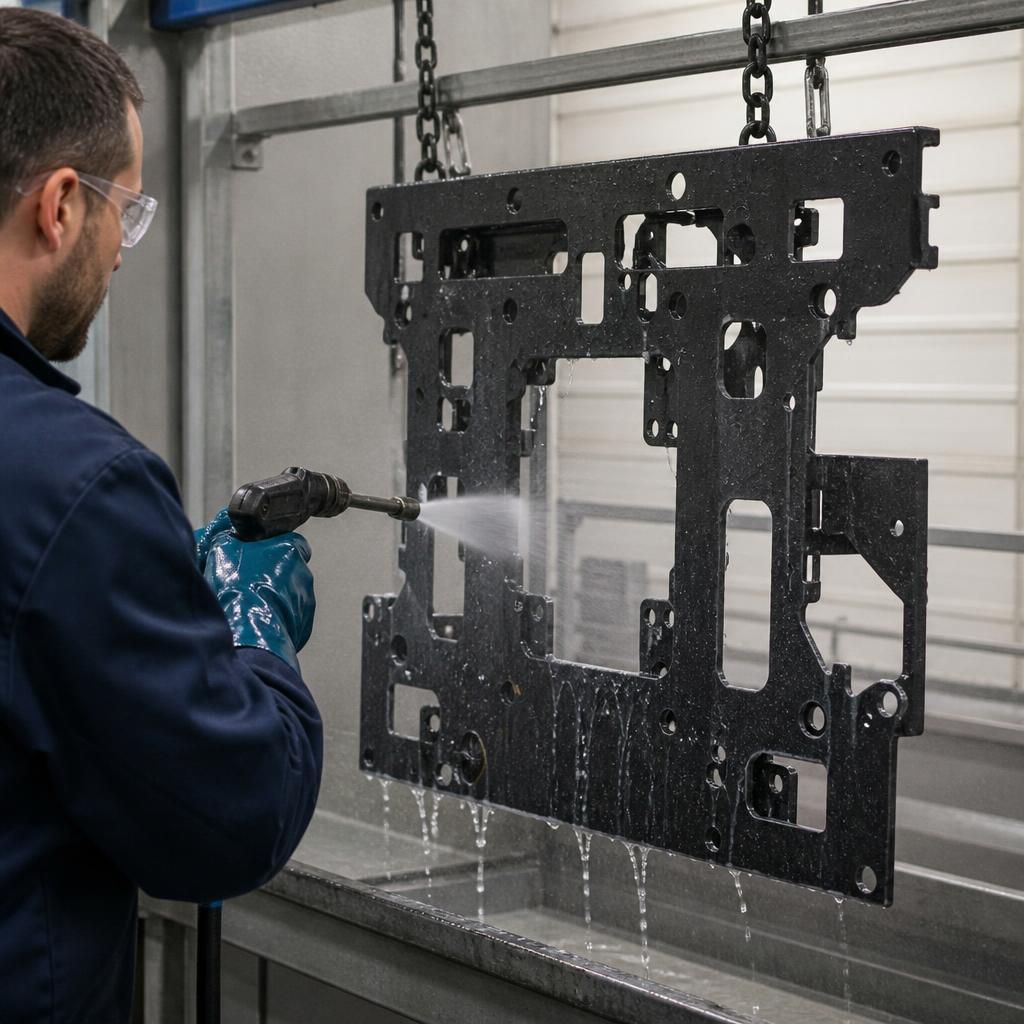
The coating material must be compatible with the component’s cleaning and maintenance regime, not just its general environment. Detergents, disinfectants, solvents and process residues can gradually change gloss, soften the film or cause staining if the formulation is not suited to the substances and contact conditions involved.
When specifying a powder coating, consider the cleaning chemicals used, their concentration, contact time, temperature and application method. A finish that performs well in dry indoor service may have a shorter useful life where components are regularly pressure-washed or exposed to aggressive cleaning agents. Matching the material to these maintenance conditions helps preserve both protective performance and appearance.
Discuss your component’s powder coating material requirements
Discuss your component’s powder coating material requirements with the team, including its operating conditions, substrate and performance priorities. This helps establish a suitable coating specification before production or batch processing begins.