

What role does conveyorised powder coating equipment play in scaling production while ensuring consistent quality?
Conveyorised powder coating equipment moves components through preparation, coating and curing stages at controlled speeds, allowing production to scale without relying entirely on manual handling. Consistent part positioning, powder application and oven conditions help maintain an even finish across batches while supporting repeatable quality control.
Conveyorised powder coating equipment enables production to scale by linking preparation, application and curing into a controlled, repeatable workflow. Instead of treating every component as a separate manual job, the system establishes a defined production route that can handle a continuing sequence of parts while applying the same operating parameters to each suitable load.
Its main contribution to scalability is the way it separates production capacity from individual operator handling. Manual coating can become difficult to expand when staff must move, coat and inspect every component independently. A conveyor system reduces unnecessary handling and allows operators to focus on loading, coating checks, powder recovery, quality inspection and adjustments. This creates a more structured division of work as order volumes or component quantities increase.
Conveyorised lines also help balance the different stages of the process. The conveyor speed, booth arrangement, oven capacity, cooling area and loading method must work together rather than allowing one stage to become a persistent bottleneck. If the curing oven cannot accommodate the required load, increasing application capacity will not improve overall output. Effective system design therefore considers the complete route, including:
- the size, weight and geometry of the components;
- the available hanging or racking capacity;
- the time required for cleaning and surface preparation;
- booth dimensions and powder application capacity;
- oven volume, temperature uniformity and heat-up characteristics;
- cooling and unloading space; and
- the inspection and packing requirements after curing.
Quality consistency depends on controlling variation as well as increasing throughput. Conveyorised equipment can support this by using defined settings for line operation, electrostatic application, oven temperature and curing exposure. When these settings are established for a particular component or coating specification, they can be recorded and reproduced rather than recreated from memory for every batch. This is particularly useful where a manufacturer requires the same colour, film performance and appearance across repeated production runs.
Part loading remains an important quality factor. Components must be supported so that contact points, recesses and shielded areas receive suitable powder coverage. Poor loading can create shadowing, uneven coating thickness, marks or inadequate electrical contact during electrostatic application. As production scales, standardised racks, hooks and loading instructions help reduce these avoidable differences. They also make it easier to identify when a component design or hanging arrangement is unsuitable for automated processing.
Automation does not remove the need for process control. Pretreatment, powder selection, application settings and curing must remain appropriate for the substrate and the required end use. For example, a coating specification for architectural or external exposure may require different controls from one intended for an internal industrial component. Operators and quality teams still need to verify surface condition, powder coverage, cure results and the condition of the finished part. Conveyorised equipment provides a repeatable framework, but it cannot compensate for contaminated metal, incorrect powder storage or an unsuitable curing schedule.
Another benefit is improved production traceability. A defined line process makes it easier to associate a component or load with its coating specification, powder batch, operating settings and inspection results. Records can help identify whether a defect relates to preparation, application, curing, handling or the incoming metal. This is more useful than relying solely on final visual inspection, because recurring problems can be investigated at the stage where they originate.
Changeovers require particular attention in a mixed-production environment. Different colours, substrates, component sizes and coating requirements may require booth cleaning, equipment adjustment, altered hanging arrangements or separate process settings. Frequent changes can reduce the practical capacity of a line if they are not planned carefully. Grouping compatible work, defining changeover procedures and using suitable powder recovery arrangements can help maintain output without allowing residue or colour contamination to affect the finish.
Conveyorised equipment is not automatically the best option for every workload. It is generally more suitable where components are repeatable, production is regular and the line can be kept productively loaded. Batch processing may remain more flexible for prototypes, irregular shapes, low-volume orders or frequent changes in colour and specification. The decision should therefore compare expected production patterns with the cost and complexity of the line, rather than considering conveyorisation in isolation.
For manufacturers and fabricators assessing a conveyorised system, the key question is whether the equipment can provide sufficient capacity while preserving control over the coating specification. A sound assessment covers component mix, loading methods, powder usage, colour changes, curing requirements, inspection points, maintenance access and future production needs. When these factors are designed as one process, conveyorised powder coating equipment can increase repeatable output while giving quality teams clearer control over the variables that determine the final finish.
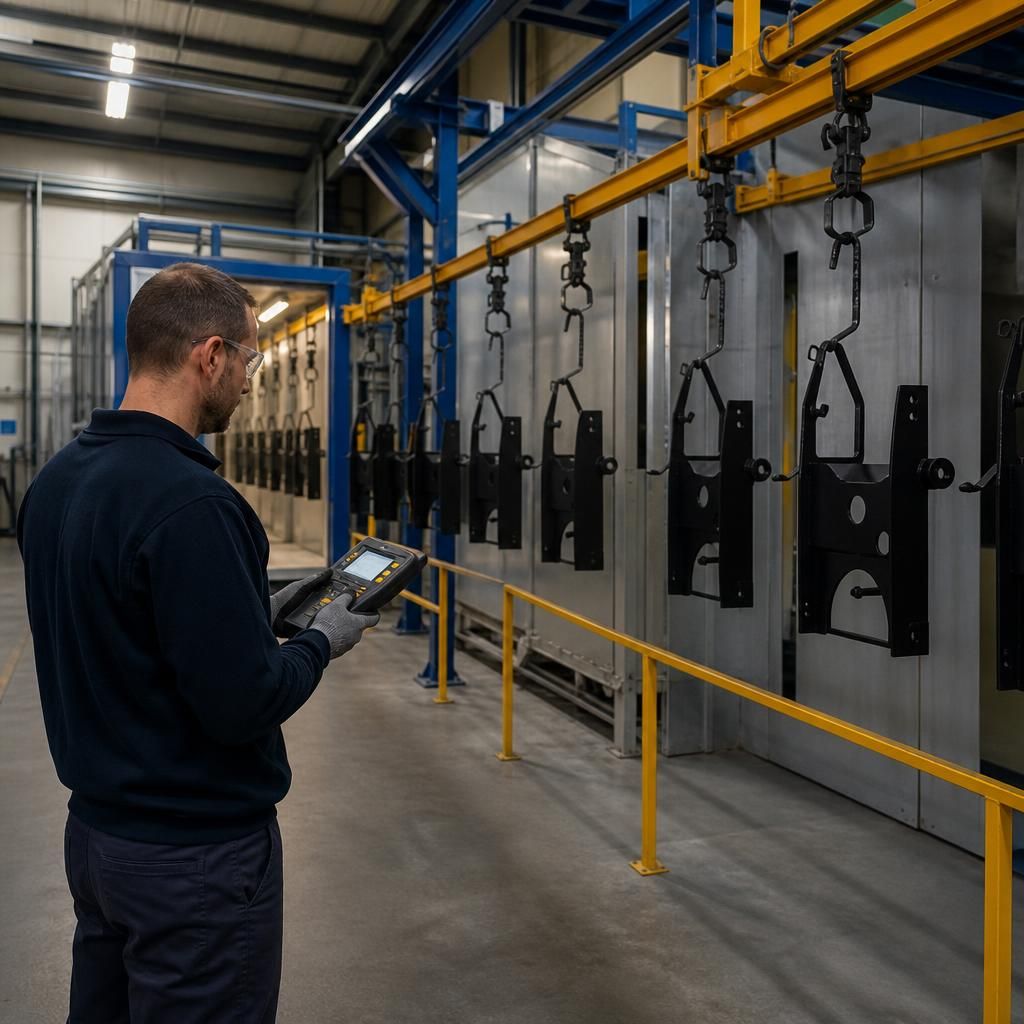
A conveyorised line supports consistent quality only when curing is assessed at the component, not just controlled by the oven’s air temperature. Powder coating requires the metal to reach the specified curing conditions for the required exposure period, and the result can vary between thin sections, heavy fabrications and densely loaded racks.
For this reason, process validation should consider representative component thicknesses, rack positions and conveyor speeds. Temperature profiling can show how quickly different parts reach the required metal temperature and whether any areas receive insufficient or excessive heat exposure. This helps establish suitable operating settings before a repeat production run is introduced.
Once validated, the curing profile becomes a practical reference for production checks. If the component mix, loading density or line speed changes, the profile may need to be reviewed rather than assuming that the original settings remain suitable. This approach helps conveyorised equipment increase production volume without treating oven control as a fixed setting that applies equally to every load.