

What are the key factors to consider when selecting a powder coat primer for steel in industrial applications?
Selecting a powder coat primer for steel depends on the required corrosion protection, exposure conditions, compatibility with the topcoat, application method and curing schedule. The primer should suit the steel’s preparation and the component’s operating environment while providing reliable adhesion and a sound base for the final powder coat.
A suitable powder coat primer for steel is selected as part of a complete coating system, rather than as an isolated product. The decision should consider the primer’s protective mechanism, the steel component’s design, the specified film thickness, the required mechanical performance, the intended appearance and the evidence available to verify the finished system.
Primer chemistry and protective function
Different primers protect steel in different ways. Epoxy-based primers generally provide a dense barrier against moisture and contaminants, while zinc-containing primers can provide additional sacrificial protection where the coating system is damaged. Other formulations may be selected where flexibility, overcoating characteristics or resistance to particular industrial conditions is more important than maximum barrier protection. The primer must be chosen for the role it is expected to perform; a product intended primarily as a barrier should not automatically be treated as equivalent to a zinc-rich system.
It is also important to establish whether the specification requires a primer at all. Some steel components are adequately protected by a single powder coat, whereas demanding applications may require a primer and topcoat system. Adding a primer increases total coating thickness and may affect dimensions, tolerances, masking requirements and the treatment of mating surfaces.
Steel design and component geometry
The shape of the part influences how consistently a primer can be deposited. Deep recesses, narrow channels, sharp transitions, folded sections and internal corners can make it difficult to achieve an even film. Welds, overlapping joints and areas where water or debris could collect may also require particular attention in the specification.
Edges are especially significant because coating can pull back from sharp profiles during application and curing, leaving a thinner protective layer. A primer should therefore be assessed against the actual component design, not only against a flat test panel. Where possible, the steelwork should be designed with coating in mind, using smooth transitions, accessible surfaces and suitable drainage.
Film thickness and dimensional control
The required dry film thickness should be defined for the primer and for the complete coating system. Excessive thickness can cause problems such as loss of edge definition, difficulty fitting assembled parts, interference with threads and changes to electrical contact points. Insufficient thickness may leave weak areas in the protective system.
Thickness requirements should allow for normal variation across the component and for the geometry of areas that are harder to coat. Measuring the cured coating at representative locations helps confirm that the selected primer and application specification are suitable for the component’s tolerances.
Mechanical demands on the finished coating
Steel components used in manufacturing, construction and automotive applications may be exposed to impact, abrasion, vibration, bending or repeated handling. The primer should contribute to a coating system that can tolerate these demands without cracking, delaminating or exposing the steel.
Hardness alone is not a complete measure of performance. A very hard coating may be less tolerant of flexing or impact than a system with a better balance of hardness and flexibility. The relevant requirements should therefore include tests or acceptance criteria for adhesion, impact resistance, flexibility and abrasion where these properties matter to the component’s service.
Resistance to chemicals and process contaminants
Consider substances that may contact the coated steel during manufacture, installation, cleaning or use. These could include oils, hydraulic fluids, detergents, salts, fuels or process chemicals. A primer that performs well in a dry indoor environment may not provide the same protection where chemical contact or repeated washing is involved.
The specification should identify the likely contaminants and the duration and frequency of exposure. Short-term splash resistance is different from continuous immersion, and occasional cleaning is different from regular chemical washing. The primer and topcoat should be assessed together against the most demanding credible condition.
Appearance and system build
Although the primer is normally hidden beneath the final powder coat, its colour, smoothness and surface profile can influence the appearance of the topcoat. A primer with an unsuitable shade may affect the visual result beneath a lighter or translucent finish. Surface texture, pinholing, cratering or outgassing from the substrate can also become visible through the final layer.
Where appearance is important, the proposed system should be evaluated on representative steel sections with the same fabrication details as the production parts. This is more reliable than judging the primer in isolation, because the final appearance depends on the combined behaviour of the primer, topcoat and steel substrate.
Outgassing and fabricated steelwork
Cast, galvanised or heavily fabricated steel can release trapped gases or contaminants when heated. This may produce pinholes, blisters or small surface defects in the powder coating. The risk depends on the material, its surface condition, fabrication history and coating system.
For components with a known outgassing risk, the specification may need a suitable degassing approach, a compatible primer or a process trial before production. The purpose is not simply to choose a more protective primer, but to select a system that can produce a continuous, acceptable film on the actual steelwork.
Testing and evidence
Laboratory data can help compare primers, but test results need to reflect the intended use. Useful evidence may include adhesion testing, corrosion testing, humidity resistance, impact testing, flexibility assessment and chemical-resistance data. A single accelerated corrosion result should not be used as the only basis for selection, because it may not represent the component’s geometry, handling or service conditions.
For a new or critical specification, representative trial pieces are valuable. They can reveal issues with coverage, surface appearance, masking, assembly tolerances and coating defects before full production begins. The agreed acceptance criteria should cover both protective performance and visible finish quality.
Practical specification checks
- Define whether the primer is required as a standalone protective layer or as part of a primer-and-topcoat system.
- Confirm the required dry film thickness for each layer and the permitted total build.
- Identify surfaces that must remain uncoated, such as threads, earth points, bearing seats or electrical contact areas.
- Check that the coating system suits the component’s handling, assembly and end-use requirements.
- Agree inspection methods for thickness, adhesion, appearance and visible defects.
- Request technical documentation covering application limits, storage, curing and compatibility with the specified topcoat.
For industrial steelwork, the most reliable choice is therefore the primer that meets the complete specification without creating problems in manufacture or assembly. Reviewing the steel design, coating build, mechanical demands, chemical exposure, appearance requirements and test evidence together gives a more dependable result than selecting a primer solely by its name or its headline corrosion rating.
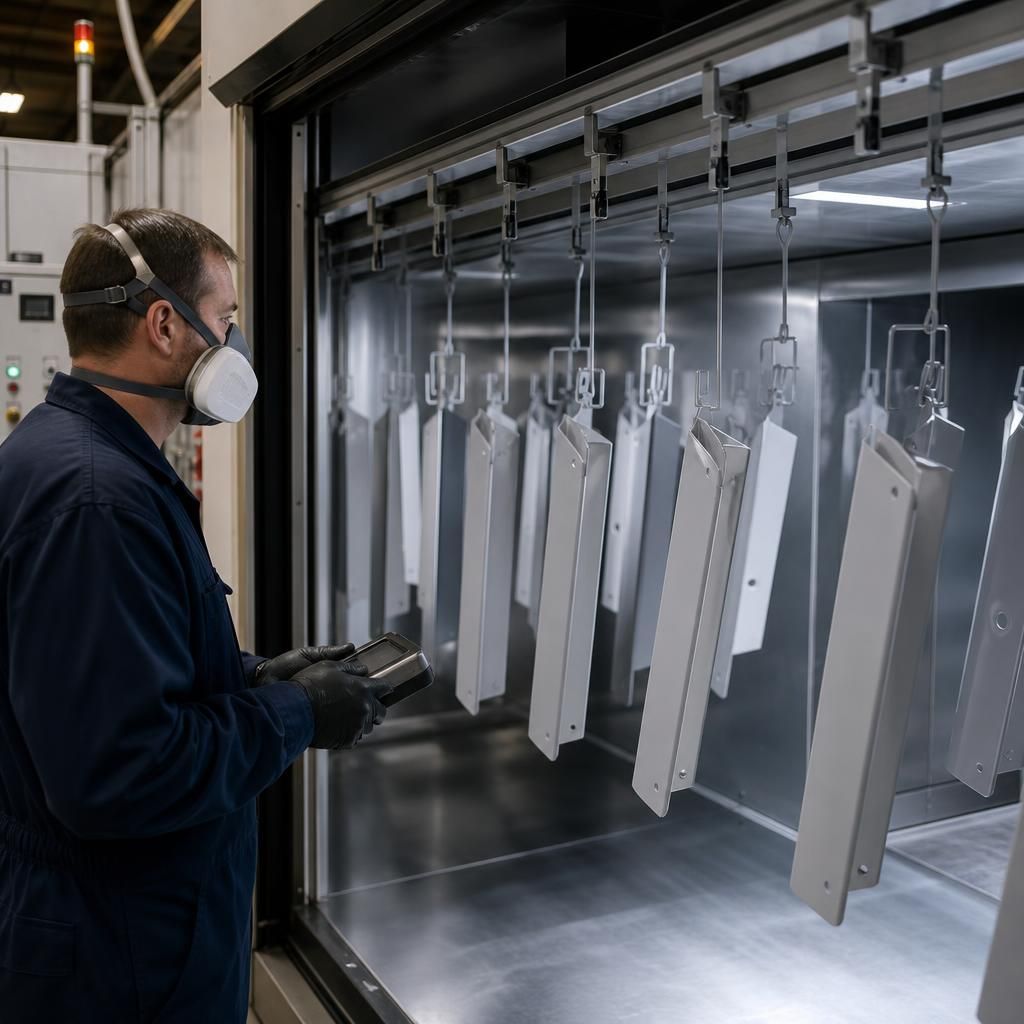
The primer’s curing requirements must match the powder coating line and the complete coating system. Selection should account for the oven temperature, the time available at the required metal temperature and the steel component’s mass, because heavy sections may heat differently from thin sheet. A primer that is not fully cured may have reduced performance, while excessive heat can affect the coating system or the substrate.
Where a primer is overcoated with a powder topcoat, confirm whether it should be fully cured, partially cured or gelled before the second layer is applied. The specified recoat conditions can affect intercoat adhesion, surface texture and the final appearance. A production trial using the actual steel section and proposed oven cycle can verify that both layers cure as intended without disrupting the manufacturing process.
Discuss your steel primer requirements
Discuss your steel components, operating conditions and coating specification with the powder-coating.co.uk team to assess the most suitable primer system. Providing component drawings, material details and any required performance criteria can help inform the next stage of the specification.