

What factors should be considered when assessing the energy efficiency and environmental impact of industrial powder coating services?
Assessing the energy efficiency and environmental impact of industrial powder coating involves examining curing-oven energy use, pretreatment requirements, powder recovery, overspray and waste management, VOC emissions, coating thickness, and the expected service life of the finished component. The assessment should also consider transport and collection arrangements, since a durable finish that reduces repainting and material replacement may have a lower whole-life impact than a less durable alternative.
Assessing the energy efficiency and environmental impact of industrial powder coating requires a whole-process review, not simply a comparison of coating materials. A robust assessment considers the electricity and fuel used by the coating facility, how efficiently equipment and labour are utilised, the origin and composition of the powder, the rate of rework, packaging, operational controls and the quality of environmental data used to support any comparison.
Define the assessment boundary first
Results can differ substantially depending on what is included. A site-level review may cover electricity, gas, compressed air, extraction and waste handling within the coating operation. A product-level review may also include powder manufacture, packaging, delivery, application, rework and the eventual treatment of the coated component. These boundaries should be agreed before comparing powder coating with another finish.
It is also important to distinguish between measured data and general environmental claims. A supplier or coating contractor should be able to explain whether figures relate to a particular batch, a typical production period or an estimated process model. Data should be recorded consistently so that different component sizes, loading patterns and coating specifications do not produce misleading comparisons.
Examine the complete energy profile
The curing stage is only one part of a coating facility’s energy demand. Other contributors can include booth extraction, ventilation, air movement, compressed-air generation, pumps, conveyors, lighting and the electrical load of control systems. The assessment should identify which items operate continuously, which operate only during production and which continue running while equipment is idle.
Useful evidence may include sub-metering, equipment specifications, maintenance records and production logs. Energy use can then be related to a meaningful output, such as the mass or surface area of components processed. This is more informative than assessing total site consumption alone, particularly where a facility performs several manufacturing or finishing activities.
Equipment condition also affects efficiency. Blocked filters, leaking air lines, poorly calibrated sensors and inefficient motors can increase resource use without improving the finish. Preventive maintenance, automatic shut-down controls and accurate temperature monitoring can reduce avoidable consumption. These measures should be considered alongside the coating specification rather than treated as separate environmental initiatives.
Consider production planning and material utilisation
How a job is scheduled can influence its environmental burden. Efficient loading and suitable job grouping may reduce the number of partially utilised production cycles. However, components must still be arranged so that all surfaces receive the required finish and the curing conditions remain appropriate. Overloading equipment or positioning parts incorrectly can lead to defects, rework and additional use of powder, energy and labour.
Material utilisation should be assessed across the whole operation. This includes powder supplied, powder applied to the component, powder collected for approved reuse where appropriate, and material rejected because of contamination or defects. Recovery does not automatically mean that all collected material is suitable for reuse: colour changes, mixed chemistries and contamination may limit its application. A credible assessment therefore looks at actual handling controls and waste records rather than assuming that all unused powder is recovered.
Review the powder chemistry and supply chain
The environmental profile of a coating depends partly on the powder formulation and the inputs used to manufacture it. Relevant questions include the resin and pigment system, the presence of substances subject to regulatory controls, the availability of technical and safety data, and whether the formulation is appropriate for the required operating environment.
Packaging should also be included. Consider the quantity and type of packaging used for powder, how it is protected from contamination, whether packaging can enter an established recycling stream and how rejected or obsolete material is managed. The most suitable option is not necessarily the one with the least packaging at purchase if poor protection causes contamination, disposal or repeat processing.
Supply-chain information can be difficult to compare because manufacturers may use different reporting boundaries. Environmental product declarations, lifecycle information or independently verified data can provide stronger evidence than unsupported statements. Where such information is unavailable, the limitation should be recorded rather than filling the gap with assumptions.
Measure defects, rework and rejected parts
Defects have a direct environmental cost because they consume additional powder, electricity, preparation materials, handling time and sometimes stripping or disposal resources. Common causes include contamination, unsuitable application settings, poor part positioning, incorrect colour selection and inadequate process control.
An assessment should therefore record first-pass yield, rework routes, rejected components and the reason for each failure. A low defect rate is valuable not only for productivity but also because it avoids repeating the most resource-intensive parts of the process. Where a component must be stripped and recoated, the environmental assessment should include those additional activities rather than counting only the successful application.
Include workplace and local environmental controls
Environmental performance is broader than carbon emissions. A coating operation should be assessed for dust control, powder handling, noise, waste segregation and the prevention of accidental releases. Extraction and filtration systems need to be suitable for the process and maintained so that captured material is managed safely.
Records relating to waste contractors, waste transfer documentation and the classification of unusable powder can help demonstrate how residues are controlled. These controls do not eliminate the need to reduce waste at source, but they show whether unavoidable residues are handled in a traceable and compliant way.
Assess the finished component’s whole-life implications
The coating should be judged against the actual duty of the component. A finish that is unsuitable for the operating environment may require earlier repair, replacement or additional processing, which can outweigh a lower impact at the application stage. Conversely, specifying more coating performance than the component needs may involve unnecessary material or processing.
This requires a technically appropriate specification covering exposure conditions, appearance, adhesion, chemical contact, abrasion and any relevant temperature or mechanical requirements. The aim is to select a finish that is fit for purpose without over-specifying it. End-of-life considerations should also be addressed: determine whether the coated component can be reused, repaired, separated from other materials or treated through the relevant recycling route.
Use comparable evidence when selecting a service
When comparing industrial powder coating services, ask for information that can be evaluated on the same basis:
- the energy sources used by the facility and how consumption is monitored;
- the main electricity-consuming equipment and the controls used to prevent unnecessary operation;
- how powder is stored, segregated, recovered or disposed of;
- the method used to record defects, rework and rejected components;
- the formulation, safety information and environmental data available for the proposed powder;
- the packaging materials used and their disposal or recycling arrangements;
- the boundary, assumptions and evidence supporting any carbon or environmental comparison; and
- the controls used for dust, waste and accidental releases.
No single indicator gives a complete answer. Energy consumption, material efficiency, waste records, process reliability and lifecycle performance should be considered together. For a B2B buyer, the most useful assessment is one that links environmental data to the actual component, coating specification, production volume and quality requirements rather than relying on a generic claim that powder coating is environmentally preferable in every situation.
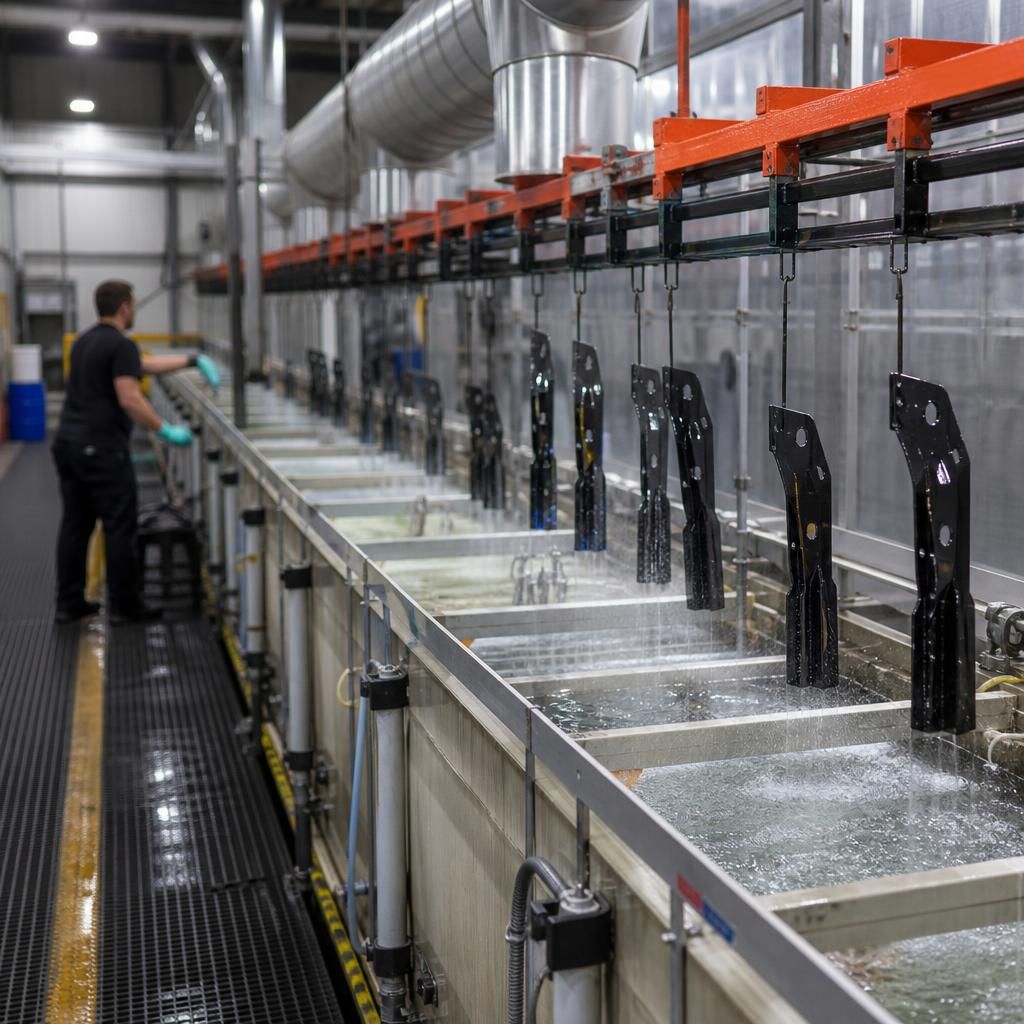
Pretreatment can make a significant contribution to the environmental impact of industrial powder coating because it may involve cleaning, rinsing, surface conversion, water heating and chemical management before powder is applied. Its energy and resource use should therefore be assessed alongside the curing stage.
Relevant evidence includes water consumption, chemical dosage, bath maintenance, rinse management and the treatment or disposal route for wastewater and residues. Longer-lasting process baths, controlled dosing and efficient rinsing may reduce material use, but only where they continue to provide the surface cleanliness and adhesion required by the coating specification. A lower-impact pretreatment method is not suitable if it increases defects, corrosion risk or repeat processing.
Discuss Lower-Impact Industrial Powder Coating Options
For a project-specific assessment, provide your component details, coating specification and environmental priorities so the required process and evidence can be considered together. Contact Powder-coatings.co.uk to discuss the most appropriate industrial powder coating approach.