

How does adjusting air pressure impact the performance of your powder coating gun for aluminium surfaces?
Adjusting air pressure changes how powder is conveyed, atomised and deposited by the gun, directly affecting transfer efficiency, coverage and finish quality on aluminium surfaces. Excessive pressure can cause bounce-back, overspray and an uneven film, while insufficient pressure may produce weak powder flow and patchy coverage.
Air pressure controls the rate and consistency at which powder reaches an aluminium component, so it must be balanced with the gun’s feed system, nozzle and electrostatic settings. The correct adjustment should provide a stable powder cloud that follows the intended spray pattern without disturbing the coating already deposited on the part.
Most powder coating guns use separate air functions. Conveying air carries powder from the hopper or pump towards the gun, while atomising or pattern air helps shape and disperse the powder cloud. Increasing one setting without considering the other can alter the powder-to-air ratio and change the shape, density and reach of the spray pattern. Aluminium components with broad faces may need a more open, evenly distributed pattern, whereas narrow profiles and recessed sections generally require a controlled pattern that does not force excessive powder into corners.
- Too much conveying air: powder can travel aggressively through the hose and leave the nozzle at a speed that makes controlled deposition difficult. It may also increase powder consumption and make the coating cloud less stable.
- Too much atomising air: the powder may be dispersed too widely, reducing control at the edges of the component and making it harder to keep the spray directed at the target surface.
- Too little air: powder delivery can become irregular, with surging, intermittent output or a spray pattern that does not reach the component consistently.
- Unbalanced air settings: the gun may appear to be feeding correctly while the powder cloud remains either too concentrated or too diffuse for the selected nozzle and component shape.
Aluminium makes pressure control particularly important because it is electrically conductive and is commonly coated using electrostatic attraction. The part must have a clean, effective earth path so charged powder can be drawn towards it. Air pressure cannot correct poor grounding, contamination or an unsuitable spray distance. If powder is not being attracted consistently, increasing pressure usually adds turbulence rather than solving the underlying problem.
Pressure also affects how efficiently powder reaches recesses, internal corners and edges. A forceful spray can push powder past a recess or disturb particles near an edge, while a gentler, more controlled pattern gives the operator greater scope to approach the area from a suitable angle. Faraday cage effects can still restrict penetration into deep corners; changing air pressure may help moderate the pattern, but it will not eliminate the electrical limitations of enclosed geometry.
Powder characteristics must be considered before making an adjustment. Particle size distribution, formulation, moisture pickup and storage condition all affect how readily the material flows through the pump and hose. A powder that has absorbed moisture or begun to agglomerate may behave erratically at any pressure. Check the powder condition, hopper fluidisation and hose connections before compensating by increasing the air supply.
A practical adjustment sequence is:
- Confirm that the aluminium component is clean, correctly prepared and properly earthed, and check that the gun, hose, pump and nozzle are free from contamination or accumulated powder.
- Start with the equipment manufacturer’s recommended baseline for the particular gun, powder and nozzle. Treat this as a reference point rather than changing several controls at once.
- Observe the powder cloud against a suitable test panel or scrap component. Look for steady delivery, an even pattern and powder that reaches the surface without excessive turbulence.
- Make small changes to the relevant air control only. Allow the spray to stabilise, then assess the pattern again before making another adjustment.
- Check the applied film after curing. A pressure change should be judged by the uniformity of the finished coating, not solely by how dense the cloud appears during spraying.
When coating large aluminium parts, the correct pressure should support a consistent pass as the operator moves across the surface. If the pattern is too narrow, increasing pressure may simply create a more forceful stream rather than a useful wider pattern; the appropriate nozzle or pattern adjustment may be more effective. On thin sections, excessive air movement can make it harder to control edge coverage, so reducing the disturbance and maintaining a suitable gun distance is usually preferable to chasing additional powder output.
Pressure should be reassessed whenever the setup changes. Different hose lengths, powder pumps, nozzle designs, coating materials and component geometries alter the resistance and delivery characteristics of the system. A setting that works for a flat aluminium panel may not suit a fabricated assembly with folds, apertures and recessed areas. Record effective settings for repeat batches, while still checking the first coated components for pattern and film consistency.
Uneven results should be diagnosed systematically. Pulsing may indicate inconsistent fluidisation, a restricted hose or an air leak. A broad, weak pattern may point to excessive pattern air, an unsuitable nozzle or insufficient powder concentration. Powder collecting around the nozzle can disrupt the pattern and should be removed using the approved cleaning method. If the spray remains unstable after the air balance, powder condition and equipment cleanliness have been checked, inspect the regulator and air supply for fluctuations.
The aim is not to use the highest pressure that moves powder through the gun. It is to use the lowest stable air setting that provides controlled delivery for the aluminium component, the selected powder and the required spray pattern. This approach helps maintain predictable application conditions and makes it easier to identify whether a problem comes from air balance, electrostatic performance, equipment condition or component preparation.
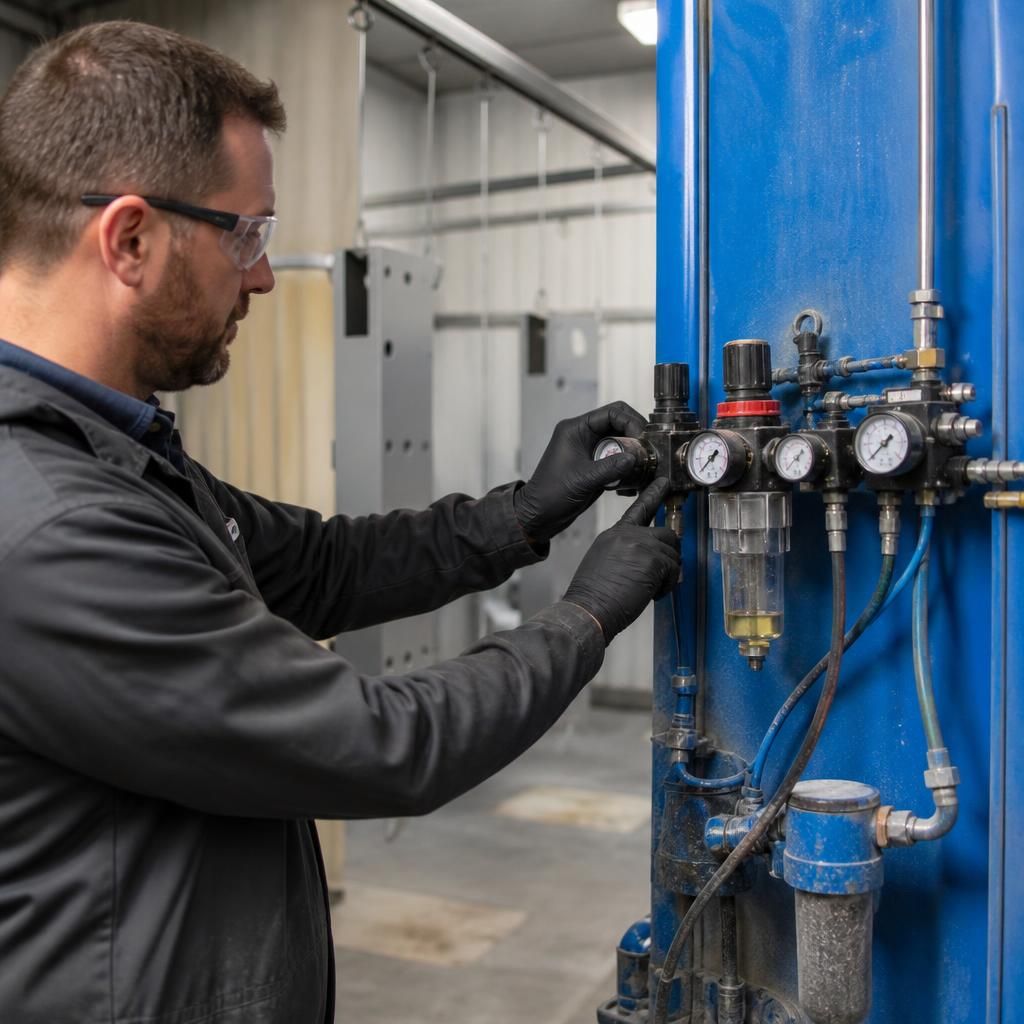
Air pressure can only be adjusted reliably when the compressed-air supply is clean, dry and stable. Moisture, oil or condensate entering the powder coating gun can interfere with powder transport, contaminate the finish and make the spray appear inconsistent, even when the regulator shows the intended setting.
Check the air preparation equipment before changing gun pressure. Drain moisture separators, inspect filters and look for damaged hoses or leaking connections. The pressure should also be observed while the gun is operating, as a restriction or undersized supply line may cause it to fall under load. If the reading changes significantly when spraying starts, correct the air-supply fault before altering the powder or pattern settings. This prevents pressure adjustments from masking contamination or supply limitations that could otherwise affect the aluminium coating.
Discuss Air Pressure Settings for Aluminium Powder Coating
If you need help establishing a suitable powder coating approach for aluminium components, discuss your part geometry, powder and finish requirements with the Powder-coatings.co.uk team. Collection and delivery options are available for businesses across the Midlands and surrounding areas.