

What factors should be considered when evaluating the cost-effectiveness of small powder coating machines in relation to productivity and quality outcomes?
Evaluate a small powder coating machine by its total cost per acceptable finished part, including purchase and installation costs, powder usage, energy, labour, maintenance, throughput and the cost of rework or rejects. It is cost-effective when its capacity matches the workload while delivering the required coating consistency, coverage and finish quality without creating bottlenecks or excessive waste.
The cost-effectiveness of a small powder coating machine depends on whether it produces saleable, specification-compliant parts at a sustainable rate, rather than on its purchase price alone. A sound evaluation compares usable output with the full resources required to achieve it, while checking that the machine can maintain the required finish across the intended range of components.
Assess usable capacity rather than quoted capacity. Manufacturers may describe capacity in terms of booth dimensions, gun output or theoretical cycle time. These figures do not necessarily represent the number of acceptable parts produced in normal operation. Allow for loading, masking, colour changes, gun cleaning, oven heating, unloading and inspection. The relevant measure is the repeatable output of conforming parts under the proposed production mix.
Capacity should also be assessed against the shape, size and presentation of the work. A compact machine may be productive for small batches or individual components but inefficient if parts must be arranged with excessive spacing, rotated several times or processed in separate orientations. Conversely, a machine that suits the component geometry can reduce handling and make better use of each cycle without increasing coating defects.
Examine the relationship between throughput and finish quality. Increasing conveyor or handling speed, shortening spray time or reducing curing time may appear to improve productivity, but these changes can result in inadequate coverage, poor edge protection, uneven film thickness or incomplete cure. The best option is the operating range that delivers the required specification consistently, not the highest theoretical speed.
Quality evaluation should include the characteristics that matter for the finished part, such as:
- consistent film thickness across faces, edges and recessed areas;
- uniform colour, gloss and texture;
- adequate adhesion after curing;
- freedom from inclusions, pinholes, contamination and visible runs;
- complete cure appropriate to the powder and substrate; and
- repeatability between batches and after setup changes.
These outcomes should be checked using a defined inspection method and the customer’s relevant specification. A machine that produces a visually acceptable finish but cannot maintain measurable coating properties may create hidden costs through testing failures, returns or shortened service life.
Consider how the machine handles variation. A productive system should cope with the actual range of component materials, geometries, colours and batch sizes. Evaluate adjustment of spray voltage, current, powder flow and gun position, together with the ability to reach recesses and Faraday areas. Excessive manual intervention can make quality dependent on operator technique, particularly when different parts are processed in succession.
Changeover performance is important where production involves several colours or powder types. The evaluation should cover the time and material needed to clean the booth, gun, hoses and recovery equipment, as well as the risk of colour contamination. A lower-priced machine may be less cost-effective if frequent changeovers interrupt production or generate off-specification parts.
Review powder transfer efficiency and recovery arrangements. The quantity of powder that reaches the component is affected by gun settings, part presentation, grounding and operator control. Overspray recovery can reduce material waste where the system is designed for it, but recovered powder may not be suitable for every application and requires controlled handling. The value of recovery should therefore be judged alongside segregation, filtration, cleaning and quality-control requirements.
Grounding deserves particular attention because poor grounding can reduce transfer efficiency and contribute to uneven coverage or powder accumulation. Include checks for workpiece contact, hooks, racks and regular cleaning in the operating assessment. These details can have a greater effect on day-to-day results than the headline specification of the spray equipment.
Include curing performance in the productivity calculation. The oven or curing stage can become the constraint even when the spray equipment has spare capacity. Assess usable oven volume, temperature uniformity, heat-up behaviour, loading configuration and the time required for the coating to reach its specified cure. The correct assessment is based on the metal temperature and powder cure schedule, not simply the oven air temperature or the nominal cycle duration.
Energy use should be considered in relation to the workload and loading pattern. Running a small oven with lightly loaded batches may be appropriate for short runs, but it can be inefficient if the process requires repeated heating cycles. A system that allows sensible grouping of compatible parts may improve resource use, provided that loading does not compromise airflow, temperature control or finish quality.
Measure labour and operator dependency. Small equipment can be economical when it reduces handling and gives one operator effective control of the process. However, labour requirements may increase if parts need repeated repositioning, manual powder recovery, frequent cleaning or extensive inspection. Record the practical tasks associated with each batch rather than counting only the time spent spraying.
Controls and process records also affect cost-effectiveness. Clear, repeatable settings make it easier to reproduce a proven finish and identify the cause of defects. Useful records may include powder reference, substrate, preparation method, spray settings, oven conditions, batch identification and inspection results. Traceability is particularly valuable for B2B work where coating performance must be demonstrated or a finish must be reproduced later.
Compare the cost of defects with the cost of prevention. Rework may involve stripping, re-preparing and recoating a component, while a rejected part may also incur additional handling, transport or production delays. When comparing machines, examine how their design affects the likelihood of defects and how easily problems can be detected before a complete batch is processed. Test pieces, first-off approval and scheduled checks can limit the impact of an incorrect setting.
A practical evaluation should use representative components and the intended powder system rather than relying solely on a demonstration with an easy-to-coat test panel. Record cycle steps, powder consumption, operator time, changeover effort, oven performance and inspection results. Repeat the assessment across the main component types and batch sizes, because a machine can perform well in one application while being unsuitable for another.
Finally, consider whether the machine can support the required process discipline as production develops. Useful capabilities may include adjustable application settings, stable workpiece grounding, accessible cleaning points, suitable filtration, straightforward inspection access and controls that allow repeatable recipes. The most cost-effective small system is therefore the one that achieves the required quality with predictable, usable output and manageable process variation—not necessarily the smallest or least expensive machine.
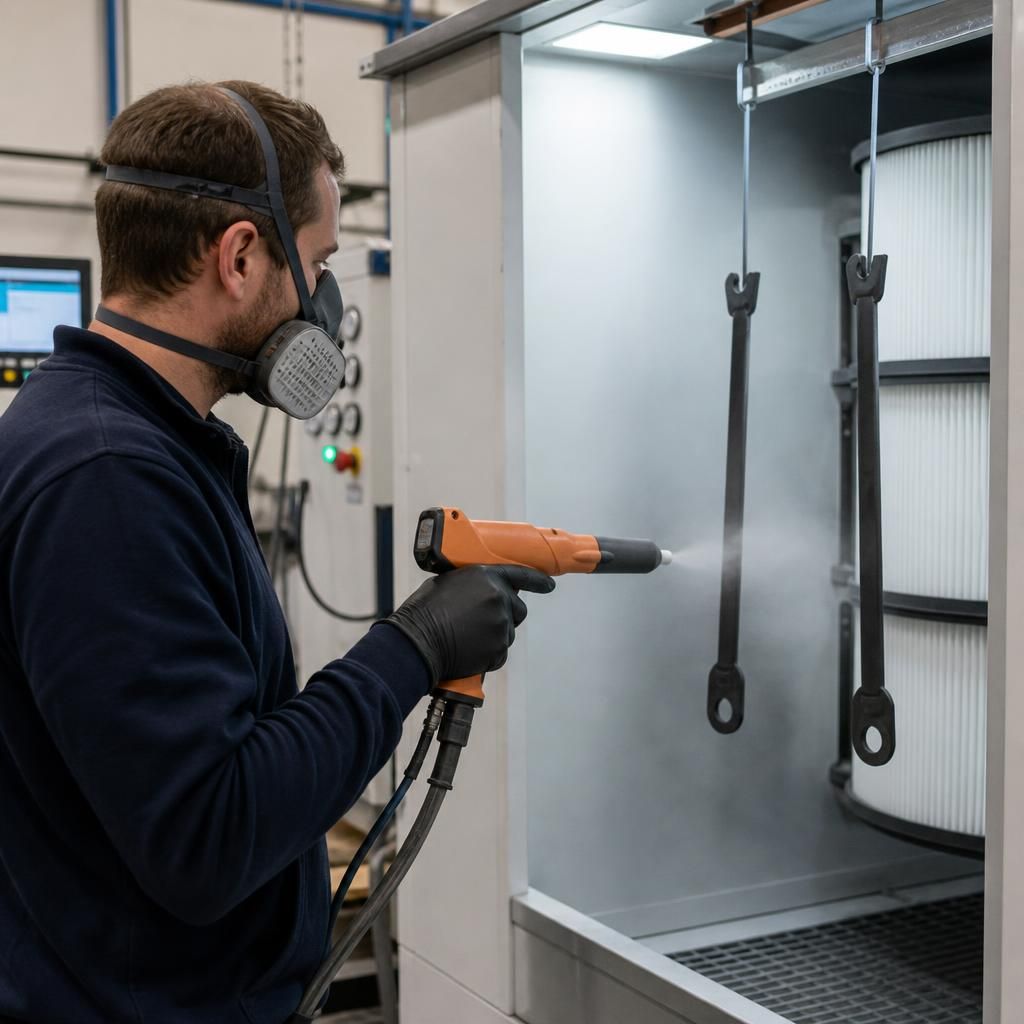
A small powder coating machine should be evaluated against the realistic alternative of using an external coating service, not only against its purchase price. Compare the cost of owning and operating the equipment with the current cost of sending parts out, including transport, packaging, minimum batch charges, handling and any production disruption caused by waiting for coated components.
Separate costs that remain broadly fixed from those that increase with production volume. Fixed costs may include the equipment, installation, workspace alterations, extraction and operator training. Variable costs include powder, energy, labour, cleaning materials, maintenance and the treatment of rejected or reworked parts. This distinction shows whether the machine remains economical at the expected workload or depends on a level of utilisation that the business is unlikely to achieve.
The comparison should also account for quality and operational control. In-house coating may make it easier to coordinate coating with fabrication or assembly, but it places responsibility for process control, inspection, records and equipment upkeep with the purchaser. External processing may involve less capital commitment, while an in-house system may be more suitable where regular production, repeatable specifications and control over scheduling justify the additional responsibilities. The preferred option is the one that meets the required finish specification at a credible total cost per conforming part.