

How does improper degreasing impact the adhesion and longevity of powder-coated finishes on metal surfaces?
Improper degreasing leaves oils, grease and other residues on the metal, preventing the powder coating from forming a sound bond with the surface. This can lead to defects such as poor coverage, blistering or flaking, reducing the finish’s durability and allowing corrosion to develop beneath the coating.
Improper degreasing undermines powder-coated performance by leaving the metal chemically unsuitable for coating, even when the surface appears visually clean. The result is not limited to an initial adhesion problem: contamination can alter the way powder melts, flows and cures, creating a finish with inconsistent mechanical resistance and a shorter service life.
Adhesion depends on intimate contact between the prepared metal and the cured coating. Oils, machining fluids, polishing compounds and handling residues can form a thin separation layer that is difficult to see. If degreasing removes only part of this film, the powder may bond adequately in some areas but weakly in others. This uneven bond is particularly problematic around edges, recesses, welds, drilled holes and areas that have been touched after cleaning.
The type of residue left behind is also important. An alkaline cleaner that has not been rinsed properly may leave a detergent or salt deposit on the surface. Solvent cleaning can spread contamination rather than remove it if the cloth or bath is saturated. Inadequate drying may leave water in joints and cavities, while aggressive cleaning can introduce staining or surface alteration on sensitive metals. Each of these conditions changes the surface chemistry before the powder is applied.
- Uneven wetting: contamination can cause the molten powder to pull away from isolated areas, producing craters, pinholes or a patchy appearance.
- Reduced mechanical resistance: a weak interface is more likely to suffer damage during handling, assembly, impact or abrasion.
- Premature edge failure: poorly prepared edges and crevices can become starting points for coating separation.
- Under-film deterioration: moisture and corrosive agents can travel through weak areas and attack the metal beneath the coating.
- Inconsistent finish quality: different levels of contamination across a batch can produce variation in gloss, texture, colour and film uniformity.
Improper degreasing can also interfere with the wider preparation sequence. If a conversion treatment, primer or other pre-treatment is applied over residual contamination, it may not form a consistent layer. That reduces the value of subsequent stages rather than correcting the original problem. Similarly, applying powder over a surface with cleaner residue can trap the residue beneath the film, where it may contribute to localised adhesion loss during service.
Longevity is affected because powder coating is a complete protective system, not simply a decorative layer. Its service performance depends on a sound interface with the substrate. Where that interface is inconsistent, ordinary exposure to humidity, temperature changes, chemicals, vibration or repeated cleaning can enlarge small weaknesses. A component may therefore pass a basic visual inspection yet deteriorate prematurely in use.
Reliable degreasing requires more than selecting a strong cleaning product. The process should match the metal, the type of contamination and the component’s geometry. Important controls include:
- using a compatible cleaning chemistry at its specified concentration and temperature;
- allowing sufficient contact time for the contaminant to dissolve or emulsify;
- agitating, spraying or otherwise reaching recessed and enclosed areas;
- replacing contaminated cleaning solution and using clean wiping materials where applicable;
- rinsing thoroughly so that cleaner, dissolved soil and salts are not left on the substrate;
- drying fully, including holes, seams and joints, before further preparation;
- preventing contact with bare hands after cleaning; and
- checking that the surface remains clean immediately before coating.
Inspection should combine visual and practical checks. The metal should be free from visible oil, streaks, water marks and cleaner residue, with no beading pattern that indicates localised surface contamination. A clean, lint-free wipe can help reveal remaining soil, although a wipe test should be appropriate to the material and process. Areas that fail inspection should be cleaned again rather than coated and assessed later.
For production work, recurring defects should be traced back through the degreasing process rather than treated only at the coating stage. Reviewing cleaner condition, rinse quality, application method, drying and handling can identify why adhesion varies between parts. Properly controlled degreasing gives the powder a consistent substrate on which to flow and cure, supporting a more uniform finish and longer-term protection of the metal.
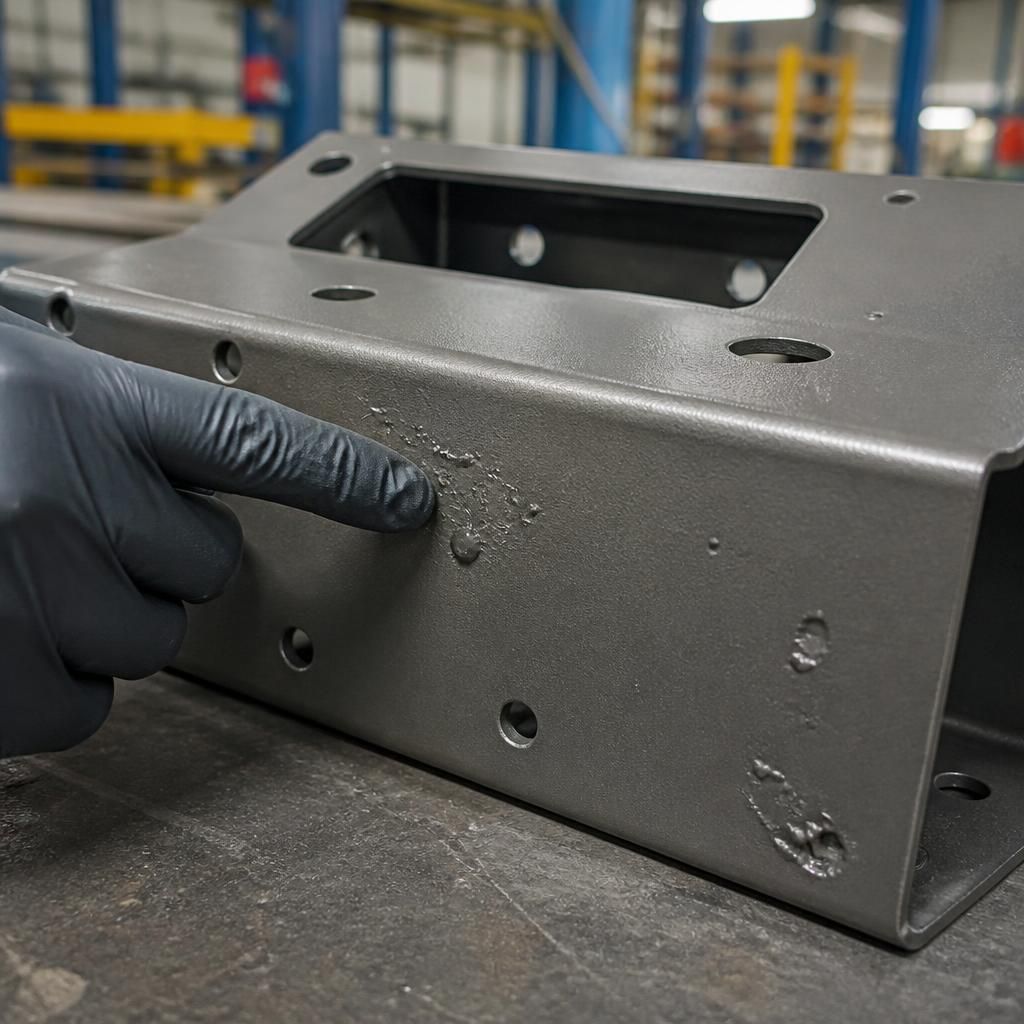
The curing stage does not correct inadequate degreasing; it can make the contamination problem visible. Heat may soften, mobilise or volatilise residual oils, polishing compounds and moisture trapped in joints. As the powder melts, these substances can disrupt film formation and produce localised pinholes, blisters, craters or loss of contact at the metal interface.
This is why a part can appear acceptable before coating yet develop defects during or shortly after curing. The risk is greater where contamination is held in seams, folded sections, threaded holes or enclosed cavities. If defects are found after curing, the affected coating normally has to be removed and the substrate prepared again rather than simply recoated. Controlling degreasing and drying before the part enters the oven is therefore more effective than relying on the curing cycle to reveal preparation failures.