

How do powder coating application techniques and equipment used ensure superior quality and consistency for steel tubes?
Powder coating delivers superior quality and consistency on steel tubes through controlled surface preparation, electrostatic powder application and precisely managed curing. Specialist spray equipment, suitable racking and an evenly controlled curing oven help achieve uniform coverage, reliable adhesion and a repeatable finish across individual tubes and production batches.
Superior quality and consistency on powder coated steel tubes depend on controlling the complete application system, not simply applying powder with a spray gun. Tube geometry, suspension, powder delivery, environmental conditions, curing verification and inspection must work together so that every part receives the specified finish without thin areas, excessive build, contamination or handling damage.
Tube-specific application control
Steel tubes present several challenges that do not occur to the same extent on flat components. Their curved surfaces can alter the distance and angle between the spray equipment and the workpiece, while tube ends, brackets and adjoining components can create areas of reduced powder deposition. Operators therefore adjust the gun position, movement and part presentation to maintain a consistent coating profile around the full circumference.
Where tubes include narrow gaps, welded details or recessed sections, the application sequence is planned to reach these areas before surrounding surfaces receive excessive powder. This helps limit uneven build and reduces the risk of visible variation between the exposed face and less accessible sections. If a project requires coating inside a tube, that must be treated as a separate technical requirement because internal coverage needs suitable access and process controls; external coating equipment alone does not automatically provide a complete internal finish.
Equipment that supports repeatable results
- Powder spray equipment: Modern guns and powder-feeding systems allow the operator to control powder flow and application conditions for the component being processed. Stable delivery helps prevent surging, patchy coverage and unnecessary build-up.
- Booth and extraction systems: A clean, well-managed booth limits airborne contamination and helps prevent particles of a contrasting colour or coating type becoming embedded in the finish. Controlled extraction also supports safe, predictable powder handling.
- Purpose-designed racking: Racks and hooks hold tubes securely while exposing the required surfaces. Correct spacing prevents components touching one another and allows consistent access during application and subsequent handling.
- Powder management equipment: Where powder recovery is used, collection and reclaim arrangements must be controlled carefully. Colour changes, incompatible powders and contamination risks require suitable cleaning and segregation procedures.
- Temperature-monitoring equipment: Monitoring the part temperature, rather than relying only on the air temperature shown by an oven controller, provides more meaningful evidence that the coating has received the required thermal treatment.
Managing the coating build
A consistent finish requires the correct amount of powder to be deposited. Too little can leave weak coverage, visible variation or reduced protection at exposed points. Too much may produce runs, heavy edges, texture changes or problems around joints and corners. Operators assess the coating against the agreed specification and use suitable measurement equipment to check the finished film where required.
Edges, tube ends, welds and areas close to fixtures deserve particular attention because powder can accumulate or be displaced there. The part design and rack layout are reviewed before processing so that contact points are kept to suitable locations and any marks caused by suspension can be minimised or placed where they are least significant.
Reliable curing and process verification
The coating’s final properties depend on the steel reaching the required temperature for the appropriate period. A large or densely loaded batch may behave differently from a smaller batch, even when the oven display appears unchanged. For this reason, process verification considers tube size, wall thickness, loading arrangement and the position of the parts within the oven.
Recorded temperature checks, oven monitoring and periodic validation help identify under-cured or over-cured work before it moves to the next stage. Under-cured powder may lack the intended hardness and resistance, while excessive heat can affect colour or finish. The correct cure schedule is selected according to the powder system and the component, rather than applied as a universal setting to every order.
Inspection and batch consistency
Quality checks normally combine visual inspection with practical and measurable checks appropriate to the specification. Inspectors look for pinholes, inclusions, scratches, missed areas, uneven texture, colour variation and damage around contact points. Film thickness checks can identify differences that are not obvious to the eye, while adhesion and other performance tests may be used where the project specification calls for them.
Inspection is most effective when carried out at defined points: after coating, after curing and before packing. Defects found early can be investigated while the relevant batch, rack arrangement and process settings are still identifiable. Batch records can also link the tubes to the specified powder, process route and inspection findings, supporting repeat production and making deviations easier to trace.
Handling after coating
A technically correct finish can still be compromised by poor handling. Tubes should be allowed to reach a suitable condition before packing, separated to avoid rubbing and protected from contact with dirty or abrasive surfaces. Appropriate packaging and lifting methods reduce scuffing, impact marks and pressure points during movement and delivery.
For manufacturers and fabricators ordering repeat batches, consistent drawings, coating specifications, colour requirements, rack orientations and acceptance criteria make the process easier to reproduce. Powder-coating specialists serving businesses across the Midlands can use these details, together with collection and delivery arrangements, to plan the work around the component design and the required finish.
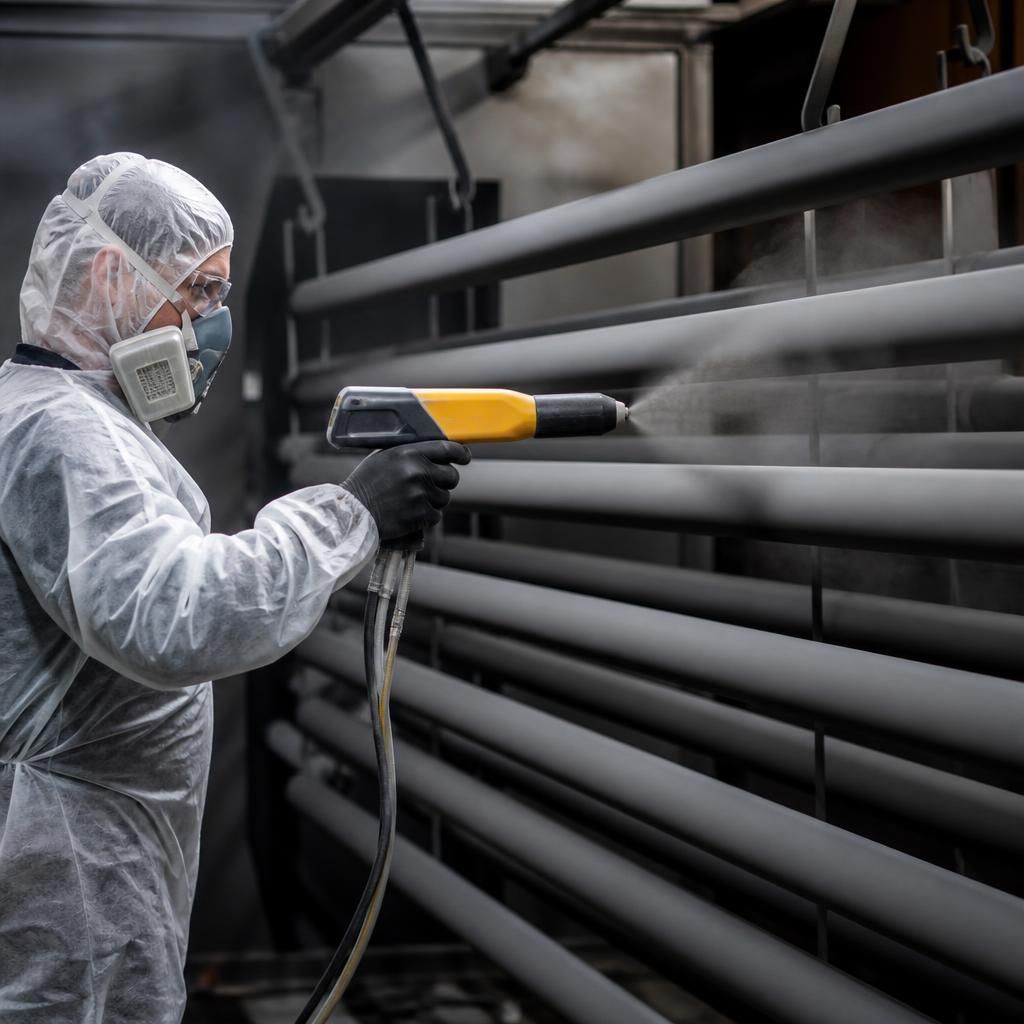
Electrostatic control is a key factor in achieving an even powder coating on steel tubes. The tube is electrically grounded while the spray gun charges the powder particles, causing them to be attracted to the metal surface. This improves transfer to the exposed circumference and helps the powder remain in place before curing.
Grounding must be reliable through the rack, hooks and contact points; paint, powder or oxidation at these points can reduce the electrical connection and contribute to uneven deposition. Operators also select suitable gun settings and maintain an appropriate distance and movement speed. Excessive charge can cause back-ionisation, while insufficient charge may reduce powder attraction and coverage, particularly around curved surfaces and recessed details.
For repeat batches, recording the relevant electrostatic settings and checking the workpiece ground helps make the application method reproducible. These controls complement the physical spray technique and allow steel tubes with different diameters, wall thicknesses or fabricated features to be processed with a more consistent finish.