

What measures are in place at your powder coating facilities to handle complex geometry in metal components without compromising the quality of the finish?
Complex metal components are managed through careful pre-coating assessment, suitable fixturing and controlled positioning to give powder access to recesses, edges and enclosed features without creating excessive build-up. Masking, appropriate curing control and inspection of coverage, adhesion and finish consistency help protect critical areas and maintain a durable, even result.
Complex geometry is handled by controlling powder deposition, electrical grounding, coating boundaries, dimensional tolerances and curing requirements for each component design. The aim is to achieve a continuous protective finish while avoiding problems such as thin coverage in recessed features, heavy deposits on corners, blocked threads, trapped moisture or coating on surfaces that must remain uncoated.
Part drawings and customer requirements are used to identify functional areas before processing begins. These may include bearing seats, mating faces, contact points, threaded holes, hinge surfaces and close-fitting interfaces. Where coating thickness could affect assembly, the required finish boundary and any areas requiring protection are agreed before production rather than corrected after coating.
- Drainage and venting: Hollow sections, folded profiles and fabricated assemblies need suitable drain and vent paths. These reduce the risk of pre-treatment chemicals, rinse water or moisture becoming trapped and later causing blistering, corrosion or contamination.
- Access to internal features: Internal corners, narrow channels and box sections are considered in relation to the application equipment and powder flow. Where a feature cannot be coated reliably because it is enclosed or inaccessible, the design or coating specification may need to address that limitation before processing.
- Electrostatic control: Powder coating relies on an electrical charge to attract powder to the earthed metal. Deep recesses and sharp internal corners can create a Faraday cage effect, where the electric field restricts powder entry. Application settings, gun movement and powder delivery are adjusted to reduce this effect without applying excessive powder to easier-to-reach areas.
- Reliable grounding: Clean, suitable contact points help maintain a consistent earth path through the component and its support arrangement. Poor grounding can reduce transfer efficiency and contribute to uneven deposition, particularly on assemblies containing painted, oxidised or non-conductive areas.
- Controlled coating boundaries: Plugs, caps or other approved masking methods can protect threads, bores, contact faces and inspection points. Masking is selected with the part’s shape and coating process in mind so that it does not leave contamination, unwanted marks or an indistinct edge.
- Powder and finish selection: The coating system needs to suit the component’s service conditions, substrate and required appearance. For parts with demanding wear, chemical or impact requirements, a protective or specialist coating may be more suitable than a standard decorative finish. Nylon coatings can also be considered where their particular performance characteristics match the application.
- Thickness management: Corners, edges and recessed transitions are checked for excessive build as well as insufficient coverage. Excessive film can interfere with assembly, reduce the clearance of moving parts or alter the appearance of adjoining surfaces, while insufficient film may reduce protection. Measurement methods are selected according to the substrate, geometry and coating system.
Large or thermally varied components also require attention to how heat moves through the metal. Thick sections, thin brackets and enclosed areas may reach the required metal temperature at different rates. The curing process is therefore considered against the component’s material thickness and mass, with attention to the coating manufacturer’s requirements rather than relying only on the surrounding air temperature.
Handling after coating is another important control. Complex parts are supported at suitable points and protected from impact, abrasion and contamination during transfer, cooling, packing and dispatch. Any contact marks or areas affected by the process are assessed against the agreed specification, particularly where the component has visible faces or precision interfaces.
For repeat batches, the agreed method is kept consistent across the run. Part identification, coating requirements and any special exclusions can be recorded so that subsequent batches follow the same specification. This is particularly useful for fabricated assemblies where small changes in welds, vents, folded sections or component orientation can alter powder access and the final film build.
Where a geometry presents an unusual coating risk, a practical review before production can identify whether the issue is best addressed through application technique, temporary masking, a revised coating boundary, additional venting or a different coating system. This approach helps ensure that the finish is judged not only by its appearance, but also by its suitability for assembly, service exposure and the component’s functional requirements.
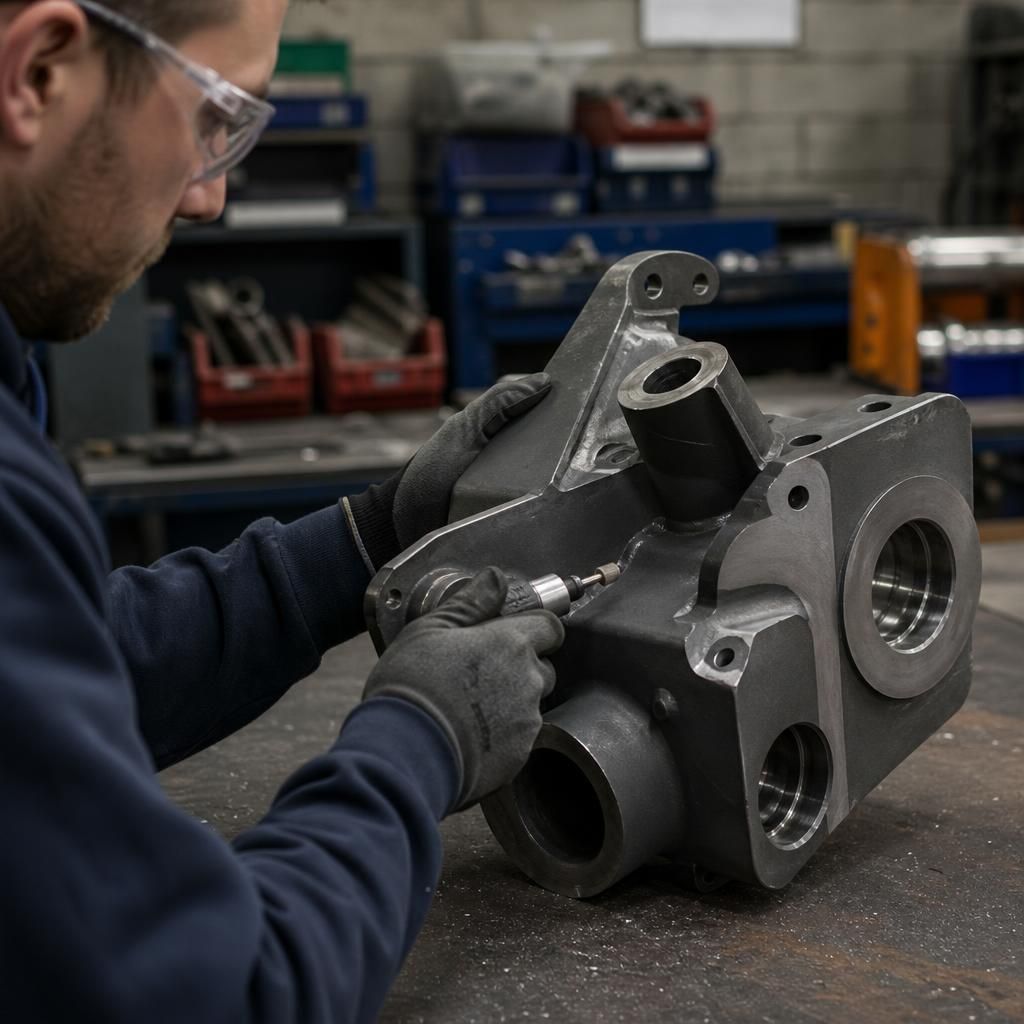
Physical surface preparation is particularly important where complex geometry includes cut edges, drilled holes, welds or fabricated joints. Burrs, weld spatter and abrupt rough transitions can interrupt powder deposition, create visible defects or leave weak points in the finished film. These features are therefore identified and, where appropriate, removed or smoothed before coating so the powder can form a continuous surface rather than reproducing defects in the metal.
This check is separate from the coating application itself: a component may be correctly earthed and cured yet still show imperfections caused by the underlying fabrication. Reviewing these details before processing helps distinguish a geometry-related coating challenge from a substrate defect and supports a more consistent finish on complex assemblies.
Discuss Your Complex Geometry and Coating Requirements
Discuss your component drawings, critical interfaces, masking requirements and service conditions with the powder-coating team so the geometry can be assessed before processing. Provide the relevant specifications to request a considered quotation for your complex metal components.