

What specific considerations should be taken into account when selecting stainless steel shot sizes for diverse metal components in powder coating preparation?
Select stainless steel shot size according to the component’s material, thickness, geometry, surface condition and required profile: finer shot suits smaller or more detailed parts, while larger shot is better for robust components and heavier contamination. Also consider access to recesses, the risk of distortion or excessive impact, and whether the resulting surface profile is suitable for powder coating adhesion.
The correct stainless steel shot size is selected by balancing the required surface preparation with the component’s specification, the blasting equipment and the powder coating system. Size selection should therefore be based on documented trials or process requirements rather than on a general preference for fine or coarse media.
Start with the component and coating specification
Review the part drawing, material specification and coating requirements before choosing a shot grade or size. Important details include permitted dimensional change, masking requirements, edges that must remain sharp, threaded features, sealing faces and areas that must retain a particular appearance. A component may be structurally robust but still contain precision features that cannot tolerate the same treatment as its main surfaces.
The powder coating specification may also set requirements for cleanliness, surface roughness or adhesion testing. If the coating system has a defined surface profile range, the selected shot size should be assessed against that requirement. A visually uniform blast is not necessarily evidence that the surface is suitable for the specified coating system.
Interpret shot-size designations accurately
Stainless steel shot is supplied in designated size ranges, but naming conventions can vary between suppliers and media types. Confirm whether the designation refers to a nominal diameter, a mesh range or another classification. This avoids comparing apparently similar sizes that produce different results.
Check the consistency of the batch as well as its nominal size. As shot wears, larger particles gradually become smaller and may produce a different cleaning and profiling effect. A working mix containing a wide spread of sizes can also alter the balance between coverage, impact energy and access to features. Media replenishment should follow a defined control method rather than being based solely on appearance.
Consider the equipment as part of the selection
Shot size cannot be separated from the blasting process. Wheel or nozzle equipment, operating pressure, wheel speed, blast angle, stand-off distance, exposure time and part presentation all influence the result. A size that performs effectively in one machine may be unsuitable in another because the available energy and media flow are different.
Confirm that the equipment can feed, accelerate and reclaim the selected shot consistently. Oversized media may affect flow through nozzles, valves or recovery systems, while very small media may behave differently in separation and reclamation equipment. The process should also be checked for stable coverage when components are rotated, racked or passed through a production line.
Assess edge and feature sensitivity
Features such as holes, grooves, weld toes, flanges and folded sections can receive a different impact pattern from broad, exposed faces. Selection should account for the possibility of shadowing, rebound and uneven media accumulation. On assemblies, the most restrictive feature often determines the practical shot size, even when the main surfaces could accept a more aggressive treatment.
For components with close tolerances, use inspection points that represent the areas most likely to change. These may include mating faces, bore dimensions, threads and locations where coating thickness is tightly controlled. Protect or mask features where blasting is not intended, and confirm that masking materials can withstand the selected process.
Check substrate compatibility and contamination control
Stainless steel shot is often considered where control of ferrous contamination is important, but the suitability of the media still depends on the substrate, previous finishes and the required cleanliness level. Parts made from different alloys should not automatically be processed together. Residues from previous jobs, worn media or an inadequately cleaned machine can compromise the surface even when the nominal shot size is correct.
Where appearance, corrosion resistance or a non-ferrous surface specification is critical, establish cleaning and segregation procedures for the machine, blast cabinet, racks and recovery system. A trial should include an inspection for embedded residue, discolouration and any change in the surface condition after blasting.
Use trials to establish the working range
A controlled trial should compare the proposed shot size with the actual component, equipment settings and intended powder coating. Record the media condition, machine settings, coverage pattern, processing time and inspection results. Examine representative parts rather than relying on a small, easily accessible test area.
Inspect the prepared surface using the method required by the project or coating specification. Depending on the application, this can include visual cleanliness checks, surface-profile measurement, dimensional checks, adhesion testing and examination of critical features. Trial parts should then pass through the planned cleaning, handling and powder application stages, because a shot size that appears satisfactory immediately after blasting may not provide consistent results after the complete preparation process.
Allow for production control
The chosen size should remain practical throughout the production run. Define limits for media breakdown, fines, contamination, dust, surface profile and machine performance. Keep the shot charge sufficiently consistent for repeatable preparation, and review the size when the component design, substrate, powder system or equipment changes.
For mixed batches, group parts with similar preparation requirements where possible. If one shot size cannot meet the needs of all components without compromising a critical feature, separate process stages or separate media conditions may be more appropriate than accepting a compromise. This approach links shot selection to measurable coating preparation requirements and helps maintain repeatability across diverse metal components.
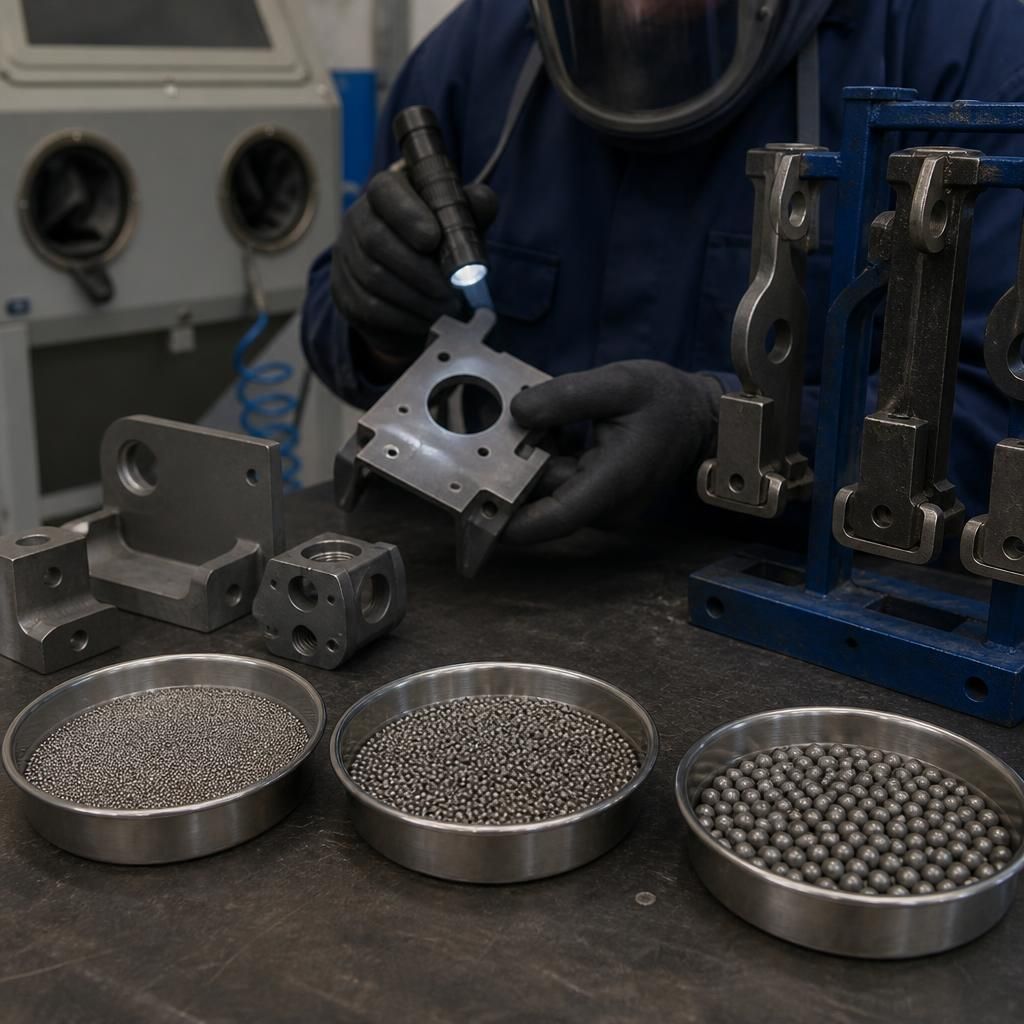
Stainless steel shot size should be assessed alongside shot shape, hardness and condition, because these properties affect how each particle transfers energy to the metal. Two media grades with a similar nominal size can produce different cleaning and surface-profile results if one is sharper, harder or more worn than the other.
When comparing sizes, keep the shot specification consistent and record whether the media is new, conditioned or heavily worn. This makes it easier to identify whether a change in finish is caused by particle diameter or by a change in the media itself. For precision components, a controlled comparison of like-for-like media can prevent an apparent size adjustment from masking the real process variable.
Discuss Your Stainless Steel Shot Size Requirements
Discuss your component specifications and stainless steel shot size requirements with our Midlands powder coating specialists. Providing details of the substrate, geometry, surface condition and intended coating system will help establish a suitable preparation approach.