

What criteria should be used to evaluate the effectiveness of sandblasting and powder coating services?
Evaluate sandblasting and powder coating services by checking surface preparation, coating specification, application control, finish uniformity, adhesion, corrosion protection, inspection procedures and documented quality standards. Also assess whether the provider can handle the component sizes, materials, batch requirements and performance conditions relevant to your application, with clear pricing and collection or delivery arrangements.
Effective sandblasting and powder coating should be judged by how reliably the finished component performs in its intended service, not by appearance alone. A sound evaluation considers technical suitability, dimensional accuracy, process consistency, handling, traceability, communication and the provider’s ability to identify and control risks before production begins.
Assess the technical review before work starts. A competent provider should ask for relevant information about the component, including its metal type, shape, welds, threaded areas, apertures, moving interfaces and intended use. They should also discuss operating conditions such as outdoor exposure, abrasion, chemicals, heat, moisture and contact with other materials. This review helps determine whether the proposed blasting and powder coating system is suitable, or whether certain areas require masking, a different coating arrangement or additional controls.
Check dimensional and functional requirements. Powder coating adds a measurable film thickness, while blasting can affect edges, surface texture and the condition of small features. Evaluation should therefore include tolerances for holes, threads, mating faces, sliding surfaces and locating points. Ask how the provider protects areas that must remain uncoated and how coated components are checked to prevent interference during assembly. For fabricated parts, attention should also be given to weld spatter, sharp edges, folded sections and enclosed areas that may be difficult to treat consistently.
Look for evidence of repeatability. A service may produce an acceptable individual component yet perform inconsistently across a production run. Useful evidence includes approved sample parts, agreed visual standards, process records and a clear method for comparing results between batches. The provider should be able to explain how blasting conditions, powder application and curing are controlled so that colour, texture and film build remain within the agreed requirements.
Evaluate coverage of difficult geometries. Corners, recesses, internal faces, perforations and Faraday cage areas can be more difficult to coat than broad, accessible surfaces. Ask how the provider approaches these features and how they assess areas that are not readily visible. The relevant criterion is not simply whether powder has been applied, but whether the coating provides appropriate and consistent protection across the parts that matter in service.
Consider curing and material compatibility. The powder system must be compatible with the substrate and the component’s use, and it must be cured according to the powder manufacturer’s technical requirements. Incorrect or uneven curing can affect hardness, flexibility, appearance and long-term performance. A useful evaluation asks how the provider confirms that parts have reached the required curing conditions, particularly where component thickness and geometry vary.
Examine quality records and traceability. Records should make it possible to link a completed batch to the agreed specification, materials used, processing stages and inspection findings. Traceability is particularly important for safety-relevant or repeat-manufactured components. It also makes investigation more efficient if a defect is found after delivery. Ask what information is retained and whether non-conforming parts are identified rather than mixed with acceptable work.
Review the approach to defects and rework. Every industrial finishing process needs a defined response to problems such as pinholes, contamination, missed areas, runs, inconsistent texture or damage during handling. An effective provider should explain how defects are assessed, whether rework is technically appropriate, and how repaired parts are segregated and rechecked. Repeated rework may indicate a process-control issue, so records of recurring defects can be as informative as records of accepted parts.
Inspect handling and packaging arrangements. A correctly finished part can be damaged by unsuitable racks, contact points, stacking or transport protection. Evaluation should include how components are suspended during processing, how contact marks are managed and how finished items are protected from impact, rubbing and contamination. Packaging should reflect the geometry and vulnerability of the parts rather than treating every item in the same way.
Assess communication and technical documentation. Drawings, coating specifications, photographs and written acceptance criteria reduce the risk of different interpretations between the customer and the finisher. The provider should raise uncertainties before processing rather than making unrecorded assumptions. Clear documentation is especially valuable when the same components will be coated repeatedly or when several finishes are used within one assembly.
Use proportionate performance testing. Visual inspection is necessary but may not be sufficient for demanding applications. Depending on the specification, relevant checks can include film-thickness measurement, adhesion assessment, cure verification, surface-defect inspection and corrosion or durability testing. The selected tests should relate to the component’s actual service conditions; unnecessary testing adds cost without necessarily improving confidence, while insufficient testing may fail to reveal a significant weakness.
Compare whole-service value rather than the lowest quotation. A meaningful comparison includes preparation and finishing scope, masking, inspection, packaging, documentation, rework arrangements and any requirements for customer-supplied information. A lower initial price may not represent better value if it leads to assembly problems, inconsistent batches or repeated handling. The strongest option is the one that provides evidence that the agreed technical and operational requirements can be met consistently.
Before appointing a provider, request a written review of the component, the proposed process, acceptance criteria, exclusions and required records. Where the application is critical or the finish is unfamiliar, approving a representative sample or first-off part provides a practical basis for judging the service before wider production proceeds.
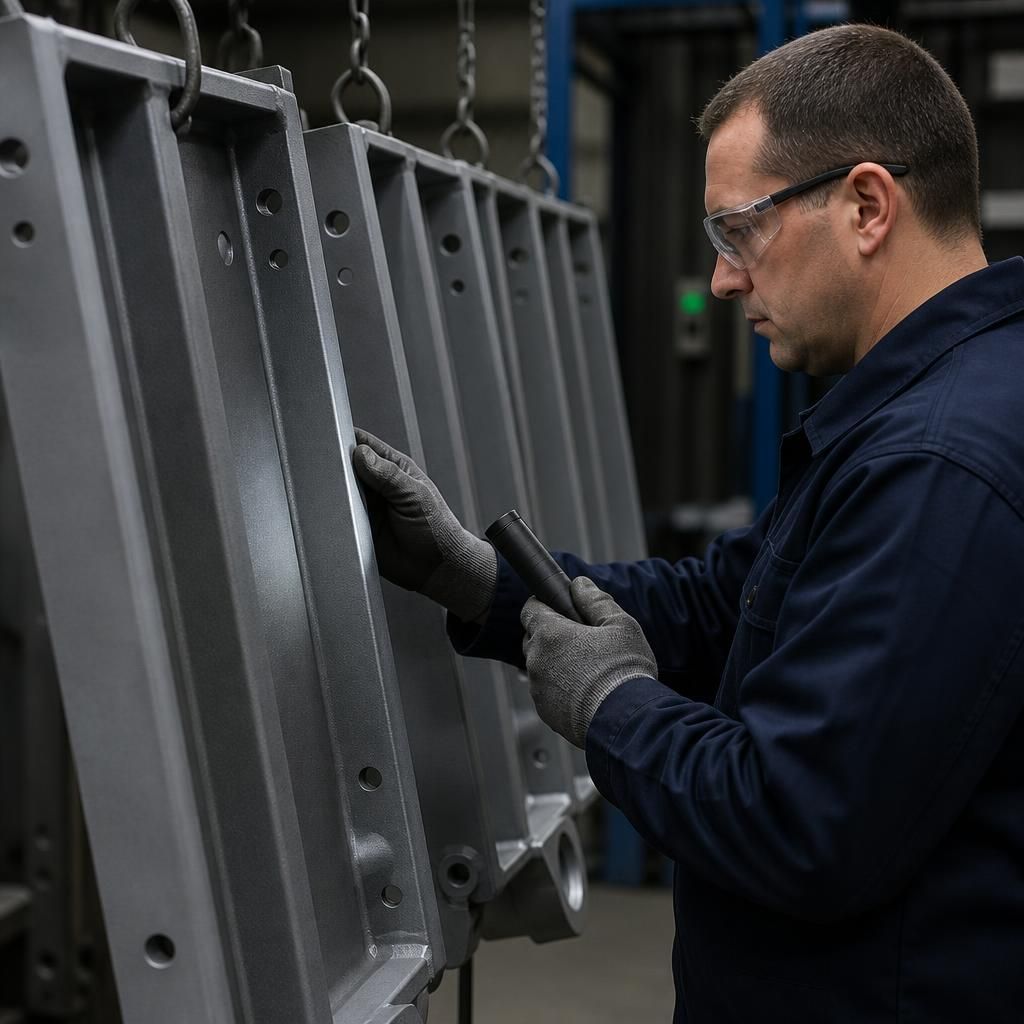
A critical measure of effectiveness is the condition of the blasted surface immediately before powder application. Ask whether the provider checks for residual rust, mill scale, abrasive dust, oil, salts and flash rust, rather than treating blasting as complete once the metal looks clean. Surface profile should also be suitable for the specified coating system: an insufficient profile may reduce mechanical keying, while an excessive or uneven profile can affect coverage and appearance. Reliable evaluation therefore depends on recorded preparation checks and clear acceptance limits, particularly for components exposed to moisture, chemicals or abrasion.
Discuss Your Sandblasting and Powder Coating Requirements
Discuss your component requirements with Powder-coatings.co.uk to clarify the appropriate sandblasting and powder coating specification for your application. Provide relevant drawings, materials and service conditions so the proposed process can be assessed against your functional needs.