

What are the key considerations for ensuring colour consistency and quality across large-scale batch applications when selecting powder colour paints?
Ensuring colour consistency and quality in large-scale powder coating batches depends on using a defined colour reference, controlling surface preparation and application parameters, and maintaining consistent curing conditions. Batch samples, calibrated equipment and documented quality checks should be used to verify colour, coverage, gloss and adhesion before full production and throughout the run.
Consistent colour and quality across large-scale powder coating batches depend on controlling the variables that influence appearance before production begins, during the run and when repeat orders are specified. The selected powder should have a clearly defined colour, gloss level, texture and finish type, while the coating system, metal substrate, production sequence and quality tolerances must be agreed in advance.
Define the required appearance precisely. A colour name alone is rarely sufficient for industrial work. The specification should identify the colour reference, gloss category, texture, surface effect and any acceptable variation. Two powders that appear similar in a catalogue may differ noticeably once applied, particularly where one is smooth and the other is textured, or where gloss levels are different. A physical approved panel is useful because it records the intended finished appearance under known viewing conditions rather than relying only on a screen or printed chart.
Consider how the powder formulation affects repeatability. Powder colour paints can contain different pigment systems, resins and additives, and these may respond differently to production conditions. Some colours are more visually sensitive to small changes in film build or heating than others. Metallic, pearlescent and fine-textured finishes can be particularly demanding because the distribution and orientation of particles affect the perceived shade. For repeat production, it is sensible to confirm that the proposed powder is suitable for the required batch size and that subsequent material can be obtained to the same specification.
Control powder supply and batch identity. Powder from different manufacturing batches should not automatically be treated as interchangeable, even when it carries the same colour description. Batch numbers, supplier documentation and retained reference samples help identify the material used on each production run. Where a project involves multiple deliveries or future repeat work, agree how colour matching will be managed between powder batches. Mixing materials from different batches in one hopper or reclaim system can introduce avoidable variation unless compatibility and visual effect have been assessed.
Plan the production sequence. The order in which parts are processed can influence consistency. Similar colours and finish types are generally easier to manage in a planned sequence than frequent changes between contrasting powders. Strongly pigmented colours, bright finishes and textured products may require particular attention when changing material, as traces of an earlier powder can affect the following work. The production plan should allow for suitable cleaning and segregation of powder-handling areas where the appearance specification is demanding.
Account for the metal and component design. The same powder can look different on dissimilar substrates or on parts with substantially different shapes. Steel, galvanised surfaces and aluminium may reflect light differently beneath the coating, while edges, recesses and broad flat faces can show differences in coverage or visual texture. Welds, cast surfaces, sharp corners and areas with varying thermal mass may also produce local changes in appearance. If components from different materials are intended to appear identical when assembled, representative samples should be reviewed together rather than separately.
Set practical tolerances. Colour consistency should be defined in terms that are meaningful for the finished product. The specification may need to distinguish between a difference visible only under certain lighting and a variation that would be unacceptable when adjacent panels are fitted together. It should also state whether the priority is close shade matching, uniform gloss, consistent texture or all three. Clear acceptance criteria reduce disagreement between the coater, manufacturer and end customer, particularly for large assemblies where parts are viewed side by side.
Use consistent inspection conditions. Visual comparisons should be made using the same type of lighting, viewing angle and background wherever possible. Gloss and texture can change the way a colour is perceived, so a sample should be assessed in the context in which the finished component will be used. For critical work, visual inspection can be supported by recorded colour and gloss measurements, but readings should always be interpreted alongside the approved physical sample and the agreed tolerance.
Protect powder and finished parts from avoidable variation. Powder should be stored in conditions appropriate to the supplier’s instructions and protected from contamination, moisture and excessive heat. Finished components should be handled and packed in a way that prevents scuffing, marking or surface contamination before inspection. A coating that met the colour requirement at the point of production may appear defective if it is damaged during movement or storage.
Maintain traceability throughout the batch. Production records should link each group of components to its powder identity, substrate, finish specification and inspection outcome. This is particularly important when a batch is split across collection or delivery stages, or when parts are processed in more than one production run. Traceability makes it easier to investigate a difference between components and provides a reliable basis for repeating an accepted finish.
For a large-scale application, the most reliable selection is therefore not simply the closest colour on a chart. It is a powder and specification that can be reproduced across the intended substrate, component range and production sequence, with agreed tolerances, identifiable material batches and a retained reference for comparison. These considerations help manufacturers, fabricators and other industrial users assess whether a powder colour paint is suitable for both the immediate order and future batches requiring the same appearance.
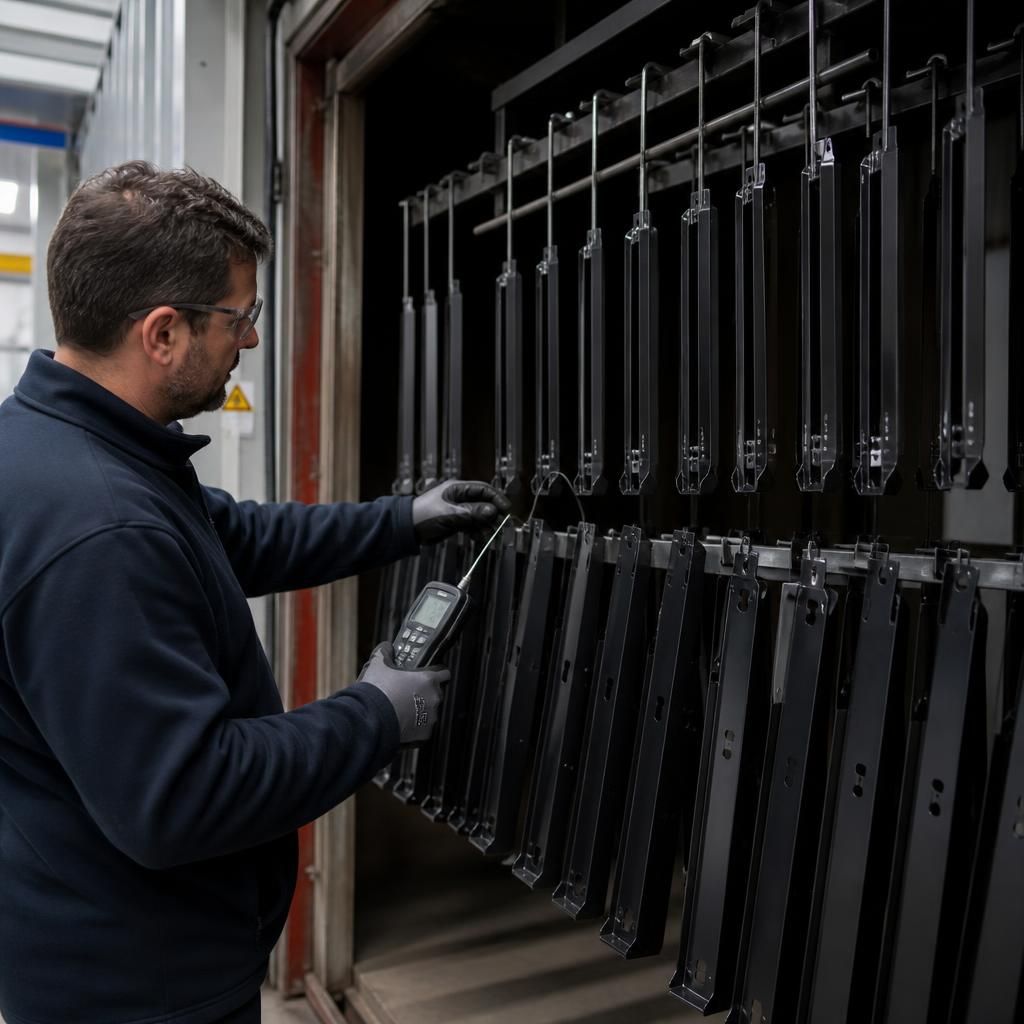
A powder colour paint should be selected with a curing schedule that suits the full range of component sizes in the batch. Oven air temperature alone does not confirm that the coating has reached its required cure; heavier sections and assemblies with greater thermal mass may take longer to reach the target metal temperature than smaller parts.
For reliable repeat production, the curing process should be checked against the powder supplier’s technical requirements using representative components. This helps establish whether the oven profile is suitable for the batch and reduces the risk of under-cured or over-cured areas affecting colour, gloss, hardness or adhesion. Where a batch contains parts with significantly different dimensions, cure verification should cover each relevant component type rather than relying on one test piece.