

What environmental and operational conditions should be considered when evaluating the suitability of black powder coated metal sheets for specific applications?
Suitability depends on the sheet’s exposure to moisture, UV light, temperature changes, chemicals, abrasion and impact, alongside the required finish, substrate and coating specification. Assess the full operating environment and maintenance routine to confirm that the black powder coating can provide the required appearance and protection throughout its intended use.
The suitability of black powder coated metal sheets depends on whether the complete coating system can withstand the site conditions, handling methods and functional demands of the finished component. Evaluation should cover the sheet’s design, substrate, pre-treatment, coating specification, installation method and cleaning regime rather than considering colour alone.
Start by classifying the exposure. A sheet used inside a controlled, dry building has different requirements from one installed on an external façade, plant enclosure or exposed structural component. Consider whether the sheet will be sheltered, directly exposed or positioned where contaminants can collect. Coastal locations, industrial atmospheres, areas near vehicle traffic and sites with persistent condensation can place greater demands on the pre-treatment and powder system. The required level of protection should be agreed with the coating specialist before production, particularly where replacement or access would be difficult.
Assess the design of the sheet and its details. Large flat areas are only part of the evaluation. Folded edges, apertures, drilled holes, seams, returns and joints can affect coating coverage and create locations where moisture or dirt remains trapped. Sharp edges may receive less effective coverage than rounded or suitably prepared edges. Crevices and poorly drained sections can also undermine the durability of the overall component even when the visible face appears sound. Drawings should therefore identify folds, welds, cut-outs, fixings and drainage paths before the coating specification is finalised.
Check how fabrication will affect the finish. Cutting, drilling, welding and forming may take place before or after coating, and each sequence has different consequences. Coating after fabrication can provide a continuous finished surface, but the component must be suitable for pretreatment and oven processing. Post-coating drilling or trimming exposes the underlying metal and may require an appropriate repair method. Welding can also damage adjacent coated areas and introduce heat-affected zones. The intended manufacturing sequence should be reviewed so that exposed edges and repaired areas are not overlooked.
Consider the substrate and its preparation as one system. Steel, galvanised steel and aluminium do not behave identically during cleaning, pretreatment, forming or curing. The selected powder must be compatible with the substrate and the intended service environment. Surface contamination, mill scale, oil, welding residue or unsuitable previous finishes can reduce adhesion regardless of the quality of the powder itself. Where different metals are assembled together, the design should also account for contact between dissimilar materials and the possibility of localised corrosion at joints.
Evaluate black’s appearance and heat-related behaviour specifically. Black surfaces can make dust, handling marks, fine scratches and uneven gloss more visible than lighter finishes. They may also absorb more solar radiation, which can increase the temperature of the sheet and any enclosed space or equipment behind it. This matters for panels near temperature-sensitive components, seals, insulation or materials with different expansion characteristics. The assessment should distinguish between the temperature the coating can tolerate and the temperature reached by the complete installed assembly.
Match the coating to the way the sheet will be handled and used. Consider lifting, stacking, transport, installation, contact with tools, sliding parts, fasteners and repeated cleaning. A sheet that is suitable once installed may be damaged during fabrication or assembly if protective packing and handling controls are inadequate. Where panels are subject to flexing, vibration or repeated contact, the coating system should be selected and tested for that specific duty rather than judged only by its initial appearance.
Review chemicals and cleaning products at their actual concentrations and temperatures. Do not rely solely on a general statement that a powder coating is chemical-resistant. Identify oils, detergents, disinfectants, solvents, process fluids and fumes that may contact the sheet, including substances used during maintenance. Occasional splashes present a different risk from continuous immersion or repeated wash-down. The supplier should confirm compatibility for the intended substances and cleaning method. Abrasive pads, aggressive solvents and poorly controlled pressure washing can damage the finish even where the surrounding atmosphere is otherwise suitable.
Separate decorative requirements from protective requirements. A project may need consistent colour, gloss and texture as well as corrosion protection. Inspectable areas should be agreed in advance, including acceptable variation between batches, visible edges and repaired sections. Black finishes can show local differences in sheen more readily under directional lighting. If several components must appear uniform, use a coordinated specification and avoid mixing unrelated coating batches without confirming compatibility.
Account for safety and functional requirements that the coating does not automatically provide. Powder coating is a finish, not a substitute for structural design, sealing, earthing, fire engineering or chemical containment. If a sheet forms part of an electrical enclosure, contact points may need to remain free from coating to achieve reliable electrical continuity. If it is used in a hygienic or regulated setting, the complete material and cleaning specification must be verified for that application. Likewise, the coating should not be treated as proof that the panel is fire-resistant or suitable for direct contact with a particular substance.
A practical assessment should finish with a written specification covering the substrate, preparation, powder type, colour and finish, required coverage, masking points, repair procedure, inspection criteria and installation environment. Sample panels or representative components can help establish how the chosen black finish looks after fabrication and whether its cleaning and handling requirements are acceptable. For unusual exposure, complex geometry or demanding industrial use, provide the coating specialist with drawings and details of the operating conditions before committing to production.
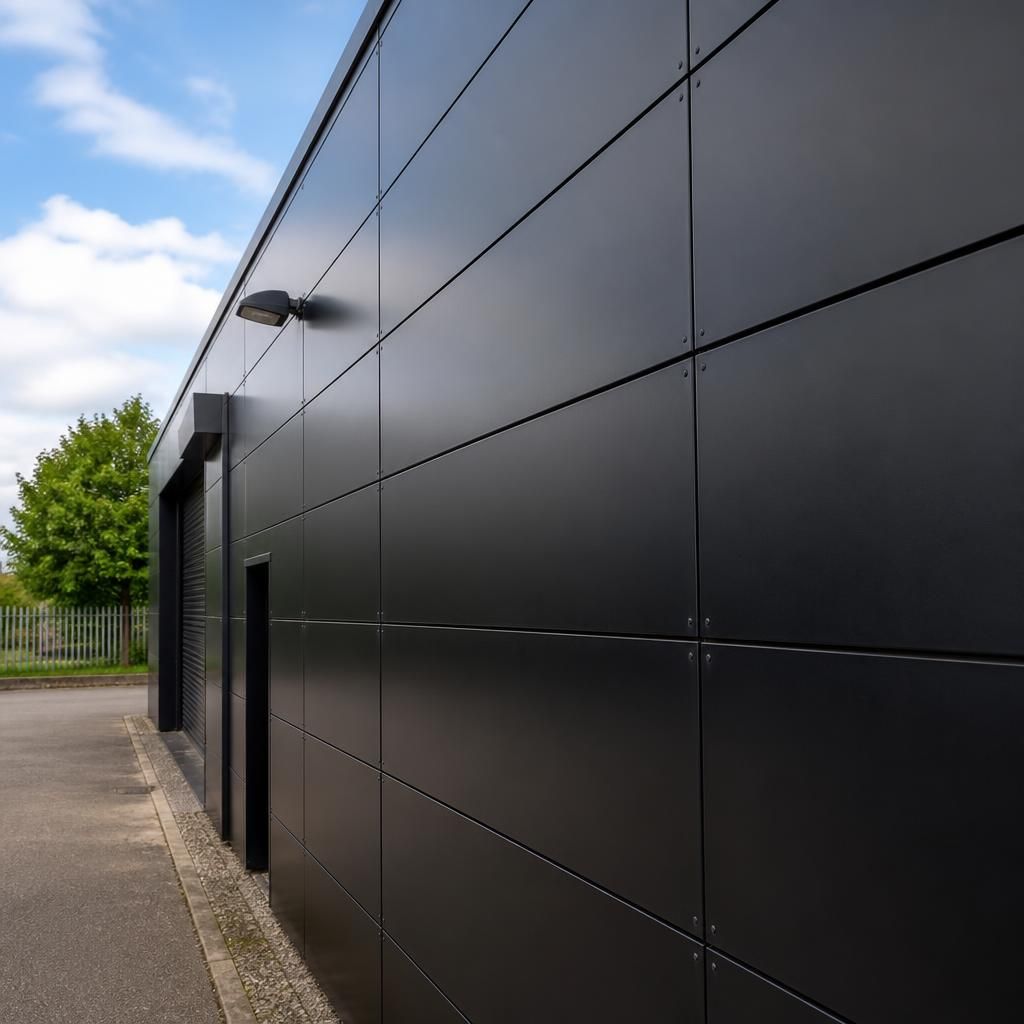
For externally installed black powder coated metal sheets, UV exposure should be assessed separately from corrosion protection. Sunlight can gradually alter colour, gloss and surface appearance, with the effect influenced by the sheet’s orientation, surrounding shade and local exposure. A coating that performs adequately in a sheltered position may not retain the same appearance on a prominent, south-facing façade or exposed enclosure.
Specify the required level of weathering resistance and define what degree of colour or gloss change is acceptable over the intended service period. Where visual consistency is important, assess the finish on representative samples and confirm that the selected powder is intended for the relevant exterior conditions. This helps distinguish a suitable outdoor specification from one selected mainly for its initial appearance.