

What factors should be considered to ensure the quality and longevity of black powder coated sheet metal in industrial environments?
Quality and longevity depend on suitable sheet metal, thorough cleaning and preparation, the correct powder specification, even application and complete curing at the manufacturer’s recommended temperature and time. Environmental exposure, edge coverage, handling, installation and routine cleaning should also be considered, as moisture, chemicals, abrasion and poor maintenance can shorten the coating’s service life.
The quality and longevity of black powder coated sheet metal depend on controlling the specification, component design, coating consistency and inspection criteria throughout the job. Black is a colour choice rather than a performance specification, so the required finish should be defined by the component’s function, appearance, dimensional tolerances and intended service conditions.
Begin with a written coating specification that records the points likely to affect performance. This should include the required colour reference, gloss level, texture, permitted visual variation, coating system, target film build, masking requirements and acceptable surface defects. A clear specification helps distinguish genuine faults from normal characteristics of a textured or matt finish, and gives the coater and end user the same acceptance standard.
- Finish appearance: define whether the part requires a smooth, fine-textured or heavily textured black finish. Gloss and texture influence how visible minor marks, handling damage and surface irregularities will be.
- Dimensional requirements: identify holes, threads, mating faces, hinges, sliding surfaces and other areas where coating build could affect assembly. These zones may require masking or a defined tolerance.
- Functional requirements: state whether the coating is primarily decorative, protective, electrically insulating or intended to withstand repeated contact and movement.
- Batch consistency: specify how colour and gloss are to be compared between production batches, particularly where panels or parts will be installed together.
Component design has a direct effect on the finished result. Sharp internal corners, narrow returns, deep recesses and tightly adjoining surfaces can make it harder to obtain an even coating distribution. Designs should allow access for the coating equipment and provide suitable points for racking that will not interfere with important visible faces. Drainage and venting provisions may also be necessary where hollow sections, folded parts or enclosed features are present, as trapped process residues can compromise the finish or create issues during subsequent use.
Welds, joints and formed areas deserve particular attention. Spatter, rough weld profiles and abrupt transitions can remain visible through the finished coating or create local weaknesses. Where appearance is important, the fabrication drawing should state the required level of weld finishing rather than leaving it open to interpretation. Burrs, sharp projections and distortion should also be addressed before coating, since powder coating will follow the underlying profile rather than conceal substantial fabrication defects.
Quality control should be based on inspection at several stages rather than a visual check of the completed parts alone. Useful checks include:
- Confirming that the job matches the approved drawing, coating specification and masking plan.
- Inspecting the prepared component for fabrication defects, contamination or areas that could affect adhesion.
- Checking the applied finish for consistent coverage, runs, inclusions, pinholes, craters, excessive orange peel and visible colour variation.
- Verifying coating thickness using an appropriate non-destructive gauge, with readings taken at representative positions rather than relying on a single measurement.
- Assessing adhesion and cure when required by the specification or risk profile, using suitable test methods and controlled sampling.
- Recording non-conformities, rework decisions and batch details so that recurring problems can be traced to their source.
Film thickness needs to be controlled rather than simply increased. Too little coating can reduce coverage and protection, while excessive build may affect edges, recesses, threads, fit and appearance. The correct range depends on the powder system, substrate, part geometry and performance requirement. A coating provider should therefore work to an agreed specification and measure representative areas, especially where the component has both broad flat surfaces and complex formed sections.
Consistency between batches is another important consideration for black finishes. Differences in powder formulation, gloss, texture, application conditions or production batch can be noticeable when adjacent parts are viewed together. For projects involving repeat orders, retain an approved reference sample or documented standard and identify which faces are visually critical. Parts should be assessed under consistent lighting, because reflections can make otherwise similar black finishes appear different.
Packaging and storage are part of quality control after coating. Components should be separated so that faces cannot rub together, protected from moisture and contamination, and supported in a way that does not introduce pressure marks. Packaging materials should be compatible with the finish and removed in accordance with the coating supplier’s guidance. Long-term storage should avoid conditions that allow condensation to form on or between coated parts.
Installation details can also determine service life. Contact points, fasteners, cut-outs and drilled areas should be considered in the original specification, particularly where coating damage could expose the underlying metal. Avoiding unnecessary site modification is preferable; where modification is unavoidable, the exposed area should be treated using a repair method appropriate to the coating system and the component’s duty. Repairs should be recorded where traceability is important.
For repeat industrial work, an agreed inspection plan, retained sample, defined acceptance criteria and batch traceability provide a more dependable basis for quality than appearance alone. Powder-coating specialists serving manufacturers, fabricators, construction firms and automotive businesses can also advise on design details, masking, inspection requirements and collection or delivery arrangements across the Midlands and surrounding areas. The most durable result is achieved when these requirements are established before fabrication and checked throughout the coating process.
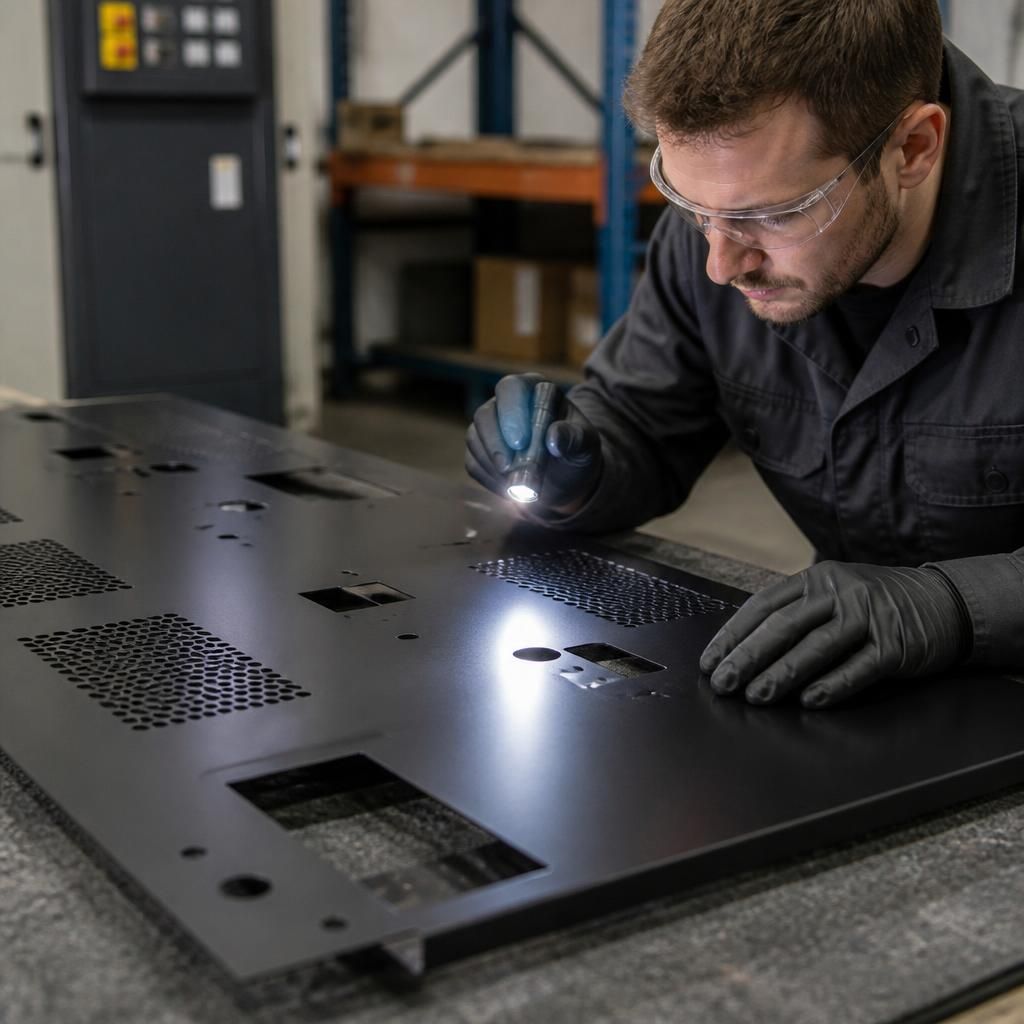
Substrate compatibility is a fundamental factor in the longevity of black powder coated sheet metal. The powder system and pretreatment must suit the underlying metal, whether it is untreated steel, galvanised steel or aluminium. Differences in surface chemistry, existing treatments and thermal behaviour can affect adhesion, appearance and resistance to corrosion.
Sheet metal should be free from mill scale, rust, oil, residues and moisture before coating. Galvanised or previously treated surfaces may require a pretreatment designed for that specific substrate, while porous or contaminated areas can lead to pinholing, blistering or localised loss of adhesion during curing. Any existing coating should be assessed for compatibility rather than simply coated over.
For industrial components, the substrate condition should therefore be recorded before production, with unsuitable material, corrosion or surface damage corrected before powder application. This is particularly important where the finished part will face humidity, outdoor exposure or contact with corrosive substances, because weaknesses at the metal-to-coating interface can shorten service life even when the visible black finish initially appears sound.