

What are the latest advancements in electrostatic coating technology that can benefit large-scale industrial applications?
The latest advancements in electrostatic coating technology include robotic application, closed-loop control of gun settings, improved powder recovery and reclaim systems, and powders formulated for lower-temperature or faster curing. For large-scale industrial applications, these developments can improve transfer efficiency, coating consistency, finish control and process repeatability across high-volume batches and complex metal components.
The latest advancements in electrostatic coating technology are centred on more precise charge control, digital process monitoring, intelligent inspection, improved powder chemistry and better integration with wider production systems. In large-scale industrial applications, these developments help coating lines manage complex components, demanding specifications and high production volumes while producing more measurable and repeatable results.
More controlled electrostatic charging
Modern coating equipment is becoming more capable of controlling how powder particles are charged and deposited. Adjustments to electrode design, charging modes and spray geometry can help operators tailor the electrostatic field to the shape of a component. This is particularly relevant when coating recessed areas, edges, corners, tubes, mesh or assemblies with varying surface depths.
Improved charge control can also reduce the risk of excessive powder attraction in areas that already have a heavy deposit. This helps create a more even film rather than allowing powder to accumulate preferentially on exposed edges. For large components, where the distance between the gun and the workpiece may vary, more adaptable charging systems can support consistent application across different sections of the part.
Inline inspection and measurement
Another important development is the increased use of inspection technology within the coating line. Non-contact film-thickness gauges can assess the deposited coating without damaging the surface, while machine-vision systems can identify visible issues such as missed areas, contamination, pinholes, uneven coverage or colour variation.
When inspection is carried out during production rather than only after curing, faults can be identified earlier. This gives the production team an opportunity to investigate application settings, grounding, surface preparation or powder condition before a complete batch is processed. Measurement data can also form part of the quality record for components used in safety-critical, structural or highly regulated applications.
Data-connected coating lines
Electrostatic coating equipment can increasingly be connected to manufacturing execution systems and other production software. This allows information such as coating parameters, oven conditions, batch identity, operator adjustments and inspection results to be recorded against a job.
For large-scale operations, this connectivity improves traceability and makes it easier to compare results between batches. It can also help identify patterns that are difficult to detect through visual checks alone, such as gradual changes in film build, recurring defects on a particular component design or variations associated with a specific powder batch. The value is not simply the collection of data; it is the ability to use that data to support process control and documented quality decisions.
Improved coating of difficult geometries
Large industrial components are often not straightforward flat panels. They may include deep recesses, narrow channels, perforations, welded joints and areas with different electrical characteristics. Recent application developments focus on managing the Faraday cage effect, where the electrostatic field makes it difficult for powder to enter an internal corner or recessed section.
More flexible application equipment, refined nozzle designs and better control of air and powder delivery can help address these areas. The correct approach still depends on the component geometry, powder characteristics, grounding and operator technique. Technology does not remove the need for suitable racking and preparation, but it can give the coating process more control over difficult surfaces.
Functional and specialist powder formulations
Powder manufacturers are developing formulations for more specific operating conditions rather than treating powder coating as a single-purpose decorative finish. Depending on the application, powders may be engineered to provide enhanced resistance to chemicals, corrosion, impact, abrasion, weathering or elevated temperatures. Specialist formulations can also support particular appearance requirements, including texture, gloss level and colour stability.
For industrial users, the important advancement is the closer matching of powder chemistry to the component’s service environment. A coating selected for indoor machinery may not be suitable for exposed infrastructure, chemically aggressive surroundings or parts subject to repeated abrasion. Specification should therefore consider the substrate, pretreatment, expected exposure, required appearance and the performance of the finished system rather than relying only on a colour reference.
Better control of grounding and safety
Reliable grounding remains fundamental to electrostatic coating, and newer systems provide more sophisticated monitoring of electrical conditions. Grounding checks can help identify fixtures, hooks or contact points that are not making a sufficiently reliable connection with the workpiece. This is important because poor grounding can affect powder transfer, film distribution and operational safety.
Modern installations also incorporate more comprehensive interlocks and fault monitoring around high-voltage equipment, booth access and extraction systems. These features support safer operation while allowing the coating line to be assessed as an integrated system rather than as a collection of separate machines.
Integration with industrial production planning
Large-scale coating benefits when application technology is considered alongside part presentation, racking, pretreatment, curing, inspection and material handling. Digital job records can support repeat work, while standardised recipes can reduce unnecessary variation when the same component is coated in different production runs.
However, advanced equipment cannot compensate for unsuitable preparation or an incorrectly specified coating. Oil, rust, scale, moisture and residues can interfere with adhesion, while poor racking can obstruct access or compromise electrical contact. The most effective results come from combining modern electrostatic control with suitable substrate preparation, correct coating selection and inspection criteria that reflect the component’s end use.
For manufacturers, fabricators, construction businesses and automotive operators, these advancements make electrostatic coating a more measurable production process. The main benefits are improved control over difficult parts, earlier detection of defects, stronger traceability and a closer relationship between coating performance and the conditions in which the finished component will operate.
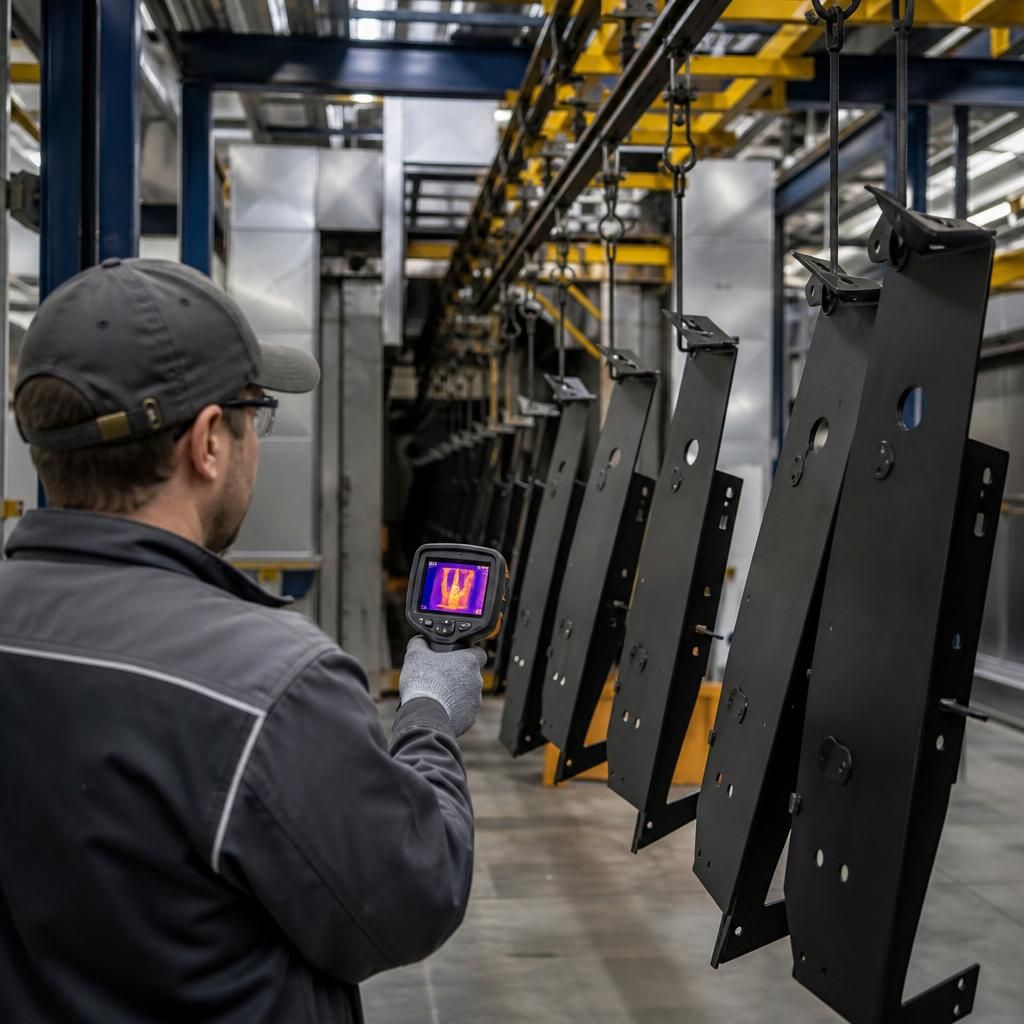
Advances in powder curing are helping large-scale coating lines apply heat more precisely to the component rather than relying on a single oven setting. Lower-temperature and faster-curing powder formulations can be combined with improved oven zoning, airflow control and thermal profiling to match the curing cycle to the part being processed.
This is particularly useful where batches contain components with different wall thicknesses, masses or heat-up rates. Monitoring the metal temperature helps confirm that the coating has received the required cure, rather than judging the process only by the oven air temperature or dwell time. The result is a more controlled production method, with curing parameters that can be recorded and repeated for future batches.