

What role do batch ovens play in ensuring the efficiency and uniformity of large-scale powder coating applications?
Batch ovens cure powder-coated components under controlled temperature, airflow and dwell-time conditions, helping each batch develop a consistent finish. For large-scale applications, repeatable loading and curing cycles support efficient production while reducing variation between parts and batches.
Batch ovens provide the controlled thermal environment needed to convert deposited powder into a durable coating, while making the curing process repeatable across substantial quantities of components. Their contribution to efficiency and uniformity goes beyond simply heating the oven: the load, part geometry, metal thickness, air movement and curing schedule must work together so that every component receives sufficient heat to complete the coating’s cross-linking process.
Uniform curing depends primarily on the temperature reached by the metal substrate, rather than the oven air temperature alone. Components with different thicknesses or thermal masses heat at different rates, so the batch must be assessed when selecting the curing cycle. Thin brackets may reach the required temperature quickly, whereas heavy fabricated parts can require a longer period for heat to penetrate. If the cycle is too short, the coating may remain insufficiently cured; excessive heat or dwell can affect appearance, colour and coating performance.
Air circulation within the oven helps reduce temperature variation around the load. Effective airflow distributes heat around faces, edges and recesses, but parts still need to be positioned so they do not shield one another. Overcrowding can restrict circulation and create cooler areas, particularly where components are closely nested or suspended too near each other. Consistent loading arrangements therefore form an important part of process control for repeat production.
Batch ovens also support efficient production by allowing similar components to be grouped into planned loads. This reduces unnecessary changes between curing conditions and helps the operator organise preparation, coating and unloading in a logical sequence. Different products should not automatically be combined merely because they fit physically: coating type, colour, substrate, component size and required cure schedule all need to be compatible. A well-planned batch uses the available oven space without compromising heat circulation or inspection access.
For large-scale work, reliable operation is supported by documented procedures and checks at several stages:
- Load planning: parts are arranged with suitable separation and presented consistently from one batch to the next.
- Cycle selection: the curing schedule is matched to the powder specification and the thermal characteristics of the components.
- Temperature verification: oven controls and, where appropriate, temperature monitoring on representative parts are used to confirm that the required conditions are being achieved.
- Visual inspection: finished components are checked for consistent colour, gloss, coverage, texture and signs of under-curing or overheating.
- Process records: batch information and observations provide a reference for investigating variation and repeating an approved process.
The batch format is particularly useful where components vary in size or shape but can be processed under a common specification. It also allows non-standard or heavier parts to be treated without forcing every item through the same continuous production route. However, the oven cannot correct problems created earlier in the process. Poor cleaning, unsuitable masking, inconsistent powder application or incorrect grounding can still produce defects even when the thermal cycle is properly managed.
In practice, the oven should be considered as one part of an integrated powder coating process. Consistent preparation and application, suitable racking, correct loading and verified curing conditions are what allow batch ovens to deliver repeatable results across large production runs. For manufacturers and fabricators, this combination helps maintain finish consistency while making high-volume work easier to plan, inspect and reproduce.
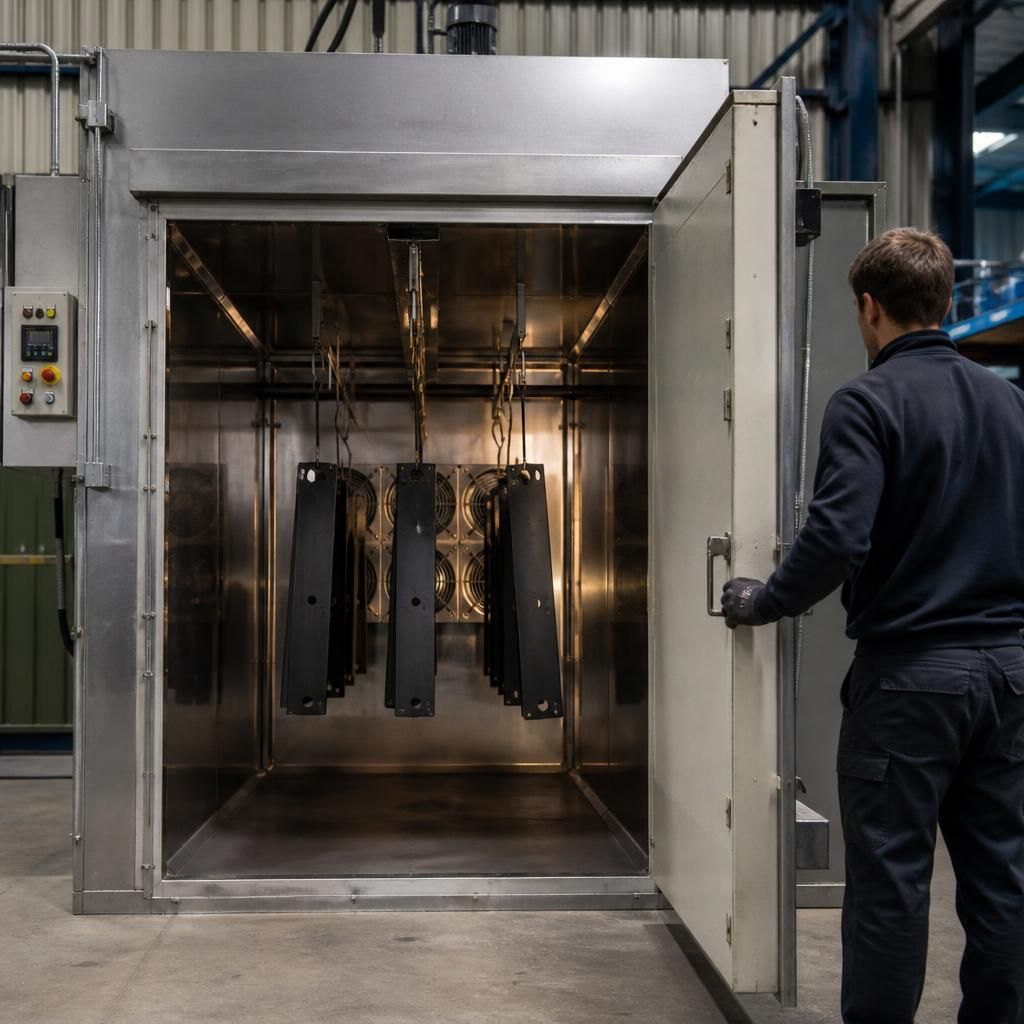
A batch oven supports efficient curing by retaining heat within an enclosed, controlled chamber rather than exposing components to changing ambient conditions. Insulation, stable temperature control and correctly functioning heating equipment help the oven maintain the required thermal conditions throughout the curing cycle. Keeping the door closed except during loading and unloading also helps limit heat loss and unnecessary temperature recovery.
This matters in large-scale work because inefficient heat management can extend cycles or introduce variation between loads. Oven performance should therefore be assessed alongside its nominal capacity: controls must respond consistently, sensors should be checked, and the chamber should be maintained so that heat is distributed as intended. These measures help the oven provide a repeatable curing environment without making the coating process dependent on uncontrolled temperature fluctuations.
Discuss Your Large-Scale Powder Coating Requirements
Discuss your large-scale powder coating requirements with the team, including component sizes, batch volumes, coating specifications and collection or delivery needs. This information can help establish a practical curing and production approach for your project.