

What are the key environmental benefits of choosing electrostatic powder coating over traditional liquid coatings?
Electrostatic powder coating can reduce environmental impact compared with traditional liquid coatings because it uses dry powder rather than solvent-based paint, resulting in very low or negligible VOC emissions and less hazardous solvent waste. Overspray may also be collected and reused where the coating system allows, while the durable cured finish can reduce the need for frequent recoating.
Electrostatic powder coating can offer environmental advantages over traditional liquid coating by reducing solvent-related impacts, improving material utilisation and producing a hard-wearing finish with fewer process residues. The overall benefit depends on the powder formulation, application equipment, curing temperature, pretreatment method and how the coating line manages cleaning and waste.
Lower risk from liquid handling
Powder is supplied as a dry coating material, so the process does not involve storing and handling the same volume of liquid paint, thinners or solvent-based cleaning agents. This can reduce the risk of spills entering drainage systems or contaminating floors and surrounding ground. It also simplifies the containment requirements associated with liquid coating materials, although powder still needs to be stored and handled carefully to prevent dust release and cross-contamination.
Less hazardous process residue
Liquid coating operations can generate used solvent, paint sludge, contaminated wipes and containers with residual liquid product. Powder coating does not create these particular solvent-based residues. Unused or contaminated powder must still be managed responsibly, particularly where different colours, formulations or coating classes have been mixed. A suitable waste procedure is therefore still necessary; powder coating is not a zero-waste process.
Efficient application and controlled consumption
Electrostatic charging helps powder particles adhere to an appropriately prepared metal component before curing. This supports controlled application and can reduce unnecessary use of coating material when the equipment is correctly set up. Factors such as gun settings, component geometry, coating thickness, earthing, operator technique and booth design all affect the result. Complex shapes, recessed areas and parts with Faraday-cage effects may require additional passes or adjusted settings, which can reduce the environmental advantage if not properly controlled.
Potentially lower energy demand through powder selection
The curing oven is one of the main environmental considerations in powder coating. Conventional powders generally require the component to reach a specified metal temperature for a defined period, and the oven must use energy to heat both the parts and the surrounding air. However, powder technologies designed for lower-temperature curing may reduce energy demand where the component, coating specification and production process are compatible. The correct comparison should consider the full curing schedule rather than assuming that every powder system uses less energy than every liquid system.
Energy use can also be controlled through accurate oven profiling, preventing over-curing, maintaining effective insulation and avoiding unnecessary empty-oven operation. Batch size and component mass matter as well: heating heavy steel fabrications requires more energy than heating smaller parts. These practical factors should be assessed alongside the coating type when comparing environmental performance.
Fewer impacts from cleaning and changeovers
Powder coating equipment is cleaned using methods appropriate to the powder system, often without the extensive solvent washing associated with liquid paint equipment. This can reduce the volume of solvent-contaminated cleaning material. Even so, colour changes and product changeovers can generate booth sweepings, filter waste or powder that cannot be recovered for the intended application. Planning production runs and maintaining dedicated or well-managed equipment can help limit these residues.
Lifecycle considerations
A coating’s environmental performance should be assessed over the life of the finished component, not only during application. A correctly specified powder finish can protect metal against wear and environmental exposure, helping components remain serviceable for their intended use. This may reduce the need to strip and refinish parts, but performance depends on pretreatment, coating thickness, cure quality, exposure conditions and maintenance. A finish that fails prematurely can create additional environmental impacts through replacement, repair and reprocessing.
It is also important to distinguish between the metal component and its coating at end of life. Cured thermoset powder cannot normally be melted and remoulded in the same way as the underlying metal. The steel or aluminium part may still be recoverable through established metal-recycling routes, but the coating itself should not be presented as readily recyclable simply because the substrate is recyclable.
What to assess when comparing systems
- The powder formulation and any environmental information supplied for it.
- The curing temperature, oven cycle and energy source.
- Application efficiency, booth design and the management of collected powder.
- Cleaning methods and the type of waste produced during colour changes.
- Pretreatment chemicals, rinsing stages and any resulting wastewater.
- The expected service conditions and the likelihood of premature recoating.
Pretreatment deserves particular attention because it can involve degreasers, conversion coatings and rinse water. A powder coating process should therefore be evaluated as a complete system, including preparation and curing, rather than judged solely by the absence of liquid paint. For industrial components, the most credible environmental comparison considers material use, energy consumption, waste handling and service life together.
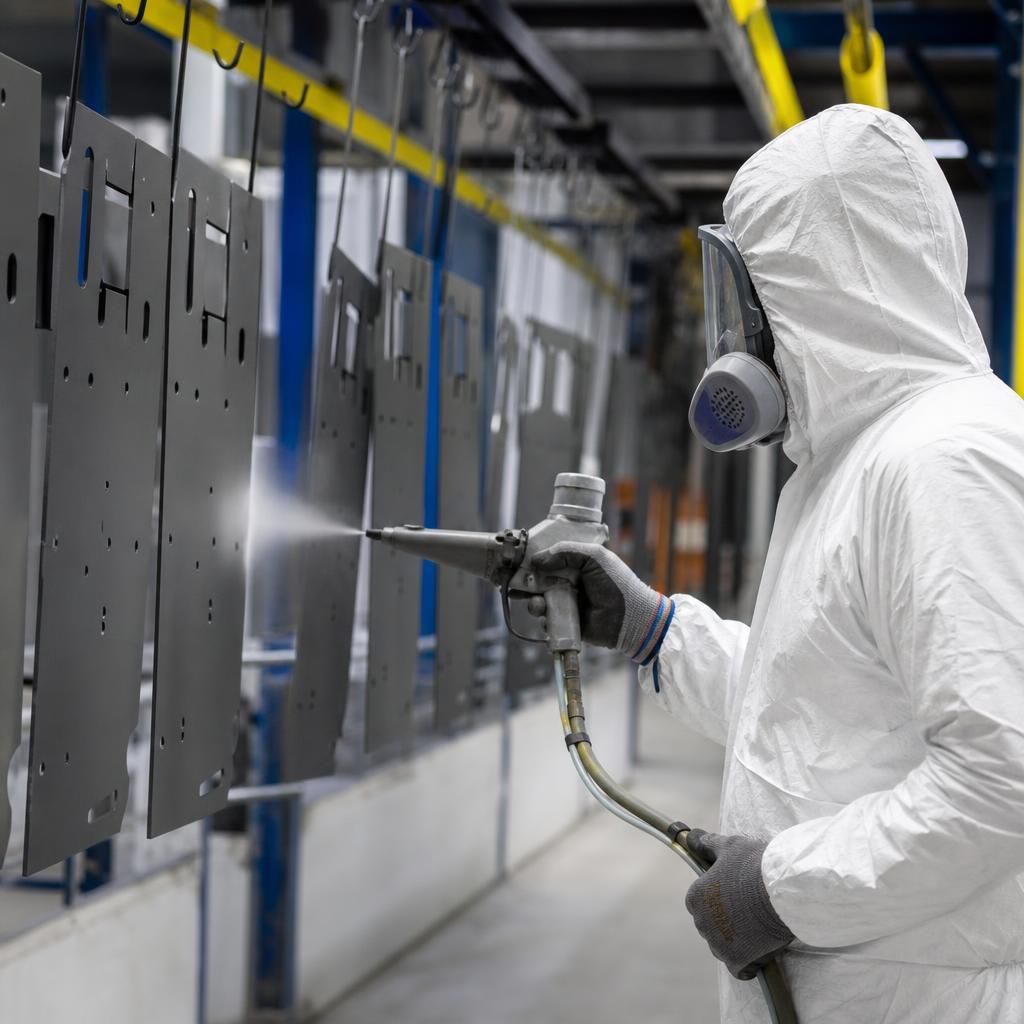
Because powder is applied in dry form, it does not need to be diluted with water before spraying. This can avoid the water use associated with preparing and adjusting some liquid coating materials. However, the complete process may still require aqueous degreasing, rinsing or conversion treatments before application, so any environmental comparison should include those preparation stages rather than treating powder coating as a water-free process.
Discuss your electrostatic powder coating requirements
Discuss your component specifications and environmental priorities with the powder-coating.co.uk team to assess the most suitable coating system for your application. Providing details of the substrate, service conditions, finish requirements and production volumes will help inform the assessment.