

What safety measures should be considered during the metal shot blasting process?
Metal shot blasting requires a suitable risk assessment, enclosed and guarded equipment, effective ventilation or dust extraction, and pre-use checks on the blast machine, hoses and connections. Operators should use appropriate PPE, secure components correctly, control access to the blasting area and follow procedures for handling spent abrasive and contaminated dust.
Safe metal shot blasting depends on controlling the full work process, not just the blast cabinet or room. In addition to the core equipment and respiratory controls, employers should address operator competence, noise, compressed air, manual handling, electrical safety, emergency procedures and the condition of the workpiece before blasting begins.
Operator training and authorisation are essential. Personnel should understand the operating instructions, the abrasive being used, the limitations of the equipment and the hazards associated with the particular component. Training should cover safe start-up and shut-down, clearing blockages, reporting faults and responding to abnormal conditions. Only trained operators should use the blast equipment or enter a controlled blasting area, and supervision should be appropriate to the level of risk.
The blasting process can generate harmful noise, particularly when large components or hard abrasives are involved. A noise assessment should identify whether hearing protection is required and whether noisy operations need to be segregated from other work. Hearing protection should be selected to suit the measured exposure and worn correctly. Warning signs and restricted access can help prevent other workers from entering a high-noise area without suitable protection.
Compressed-air safety requires particular attention. Hoses should be routed so they cannot create trip hazards or be crushed by vehicles, components or doors. Couplings should be compatible and secured, and air lines should not be disconnected while pressurised. Compressed air must never be directed at a person, clothing or skin, as it can drive abrasive particles into the body or cause serious internal injury. Air should also not be used casually to blow dust from work surfaces or clothing.
Before a component is placed in the blast area, check that it is suitable for the process. Remove loose items that could detach during blasting, confirm that cavities or enclosed sections will not trap abrasive, and identify thin sections, welds, sharp edges or fragile fittings that may require masking or a different blasting approach. Components should be supported in a stable position, with lifting equipment used where their size or weight makes manual handling unsafe.
Manual-handling controls should cover loading, turning and unloading. Use suitable trolleys, hoists, slings or fixtures for heavy or awkward parts, and keep hands clear of pinch points when positioning components. A lifting plan may be appropriate for unusually large fabrications. Operators should not attempt to catch, steady or reposition a moving part while the blast stream is active.
Electrical and fire precautions should be considered alongside the mechanical hazards. Electrical supplies, control panels and isolation points should be suitable for the environment and protected from abrasive ingress. Damaged cables, plugs or controls must be taken out of use until repaired by a competent person. Keep ignition sources and unsuitable combustible materials away from areas where dust or residues may accumulate, and make sure extinguishers and emergency isolation controls are accessible.
Effective communication is important where one person loads components while another operates the equipment. Agree clear signals or use reliable communication systems, particularly where noise, enclosures or physical separation make verbal instructions difficult. No one should restart a machine after maintenance or a stoppage until all personnel are accounted for and guards, doors and interlocks are back in their intended condition.
Maintenance should be planned rather than carried out only after a failure. Follow the manufacturer’s instructions for replacing worn liners, nozzles, seals and hoses, and isolate and depressurise the system before intervention. Interlocks, emergency stops and warning indicators should be tested at suitable intervals. Inspection records can help demonstrate that defects have been identified, repairs completed and safety controls reviewed.
Emergency arrangements should be specific to the work area. Workers need to know how to isolate the equipment, raise an alarm, obtain first aid and report exposure to abrasive, dust or excessive noise. Eye injuries, cuts, entrapment, air-line failure and loss of containment should be considered when preparing procedures. Any incident or near miss should be investigated, as it may reveal a failure in training, equipment selection or the working method.
After blasting, operators should remove contaminated workwear in a controlled manner and avoid taking abrasive residue into clean areas. Reusable protective clothing and other equipment should be inspected and maintained according to its purpose. Good housekeeping should be achieved using methods that do not re-suspend hazardous dust, with collected residues managed in line with their material and contamination profile.
For commercial work, these precautions should be supported by documented assessments, equipment records, training records and suitable control-of-substances information. Where the process creates continuing exposure to noise, vibration or airborne contaminants, occupational health advice and health surveillance may be appropriate. A competent metal finishing provider will apply these principles to the component, abrasive and blasting method rather than relying on a single generic safety procedure.
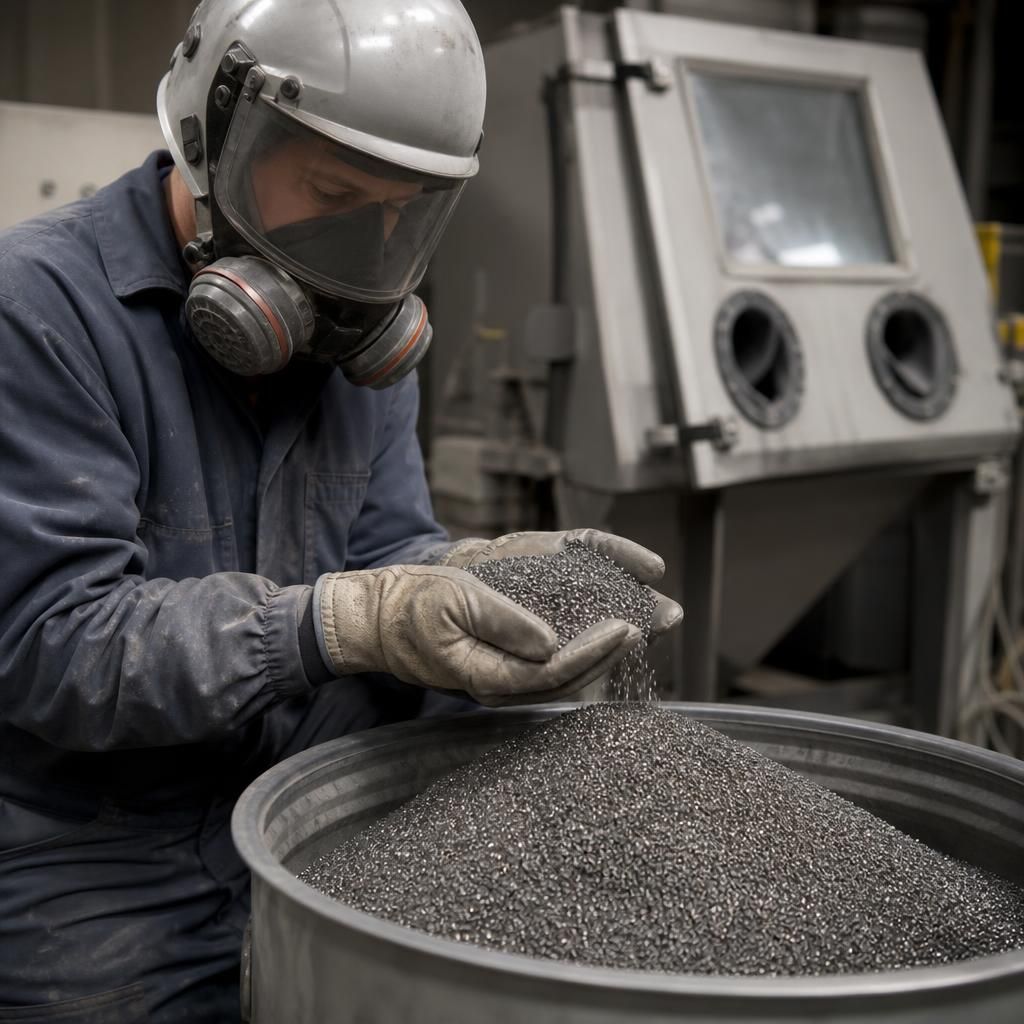
Abrasive selection is an important safety control in metal shot blasting. Before work begins, check the media’s safety data and confirm that its composition, particle size and condition are suitable for the equipment and component. Avoid abrasives that could create an unacceptable respiratory hazard, and do not assume that a material is safe because it is routinely used for blasting.
Spent abrasive can also contain residues from paint, plating, oils or the substrate being cleaned. Keep used media separate from unused stock, prevent unnecessary disturbance during collection, and arrange disposal according to the contaminants present. If the material or previous coating is uncertain, obtain suitable technical or hazardous-waste advice before blasting.