

What factors determine the appropriate sandblasting technique for different metal types and coatings?
The appropriate sandblasting technique depends on the metal’s hardness, thickness, condition and sensitivity to heat or distortion, as well as the coating being removed or prepared. Media type, particle size, air pressure, nozzle distance and blasting angle must then be matched to achieve the required surface profile without damaging the substrate.
The appropriate sandblasting technique is selected by matching the substrate and existing coating to the required surface condition, while controlling the risk of dimensional change, embedded abrasive, corrosion or cosmetic damage. The decision therefore involves more than choosing a blasting medium: the component’s geometry, access, contamination, coating chemistry, required surface profile and planned coating system all influence the process.
Identify the metal and its construction
Different metals respond differently to abrasive impact. Mild steel and cast iron can generally tolerate more aggressive preparation than aluminium, zinc-coated steel or thin-gauge sections. Softer or thinner materials may require a less aggressive abrasive and more controlled application to avoid excessive roughening, edge erosion or distortion. Stainless steel also requires careful control of abrasive contamination, because residues from unsuitable equipment or previously blasted materials can affect the surface and contribute to corrosion problems.
Fabricated components need assessment as complete assemblies rather than just as flat material. Welds, folded edges, drilled holes, recesses, threads and joints can retain abrasive or coating residue. Complex geometry may require a technique that gives consistent access without overworking exposed edges. Internal areas and narrow sections should be considered before processing, particularly where abrasive recovery or subsequent coating coverage could be difficult.
Assess the coating or contamination being removed
The existing layer determines how readily it will break down and whether the objective is complete removal, keying for a new coating or cleaning back to a sound substrate. Loose powder coating, firmly bonded paint, corrosion products, mill scale, grease and process residues do not respond in the same way. A strongly bonded, thick or brittle coating may need a staged approach, whereas a delicate underlying metal may be damaged if the same treatment is continued after the coating has been removed.
Where several coatings are present, their order and condition matter. A surface can appear clean while retaining residue in pits, weld profiles or crevices. The process should therefore be judged by the required end condition, not simply by how quickly the visible coating disappears. If the old coating may contain hazardous substances, its composition and disposal requirements should be established before blasting begins.
Define the required surface profile
The new coating system normally determines how much surface texture is appropriate. The surface must provide a suitable key without creating peaks that remain insufficiently covered or valleys that retain contamination. Excessive blasting can also remove useful substrate material and make dimensions or sharp edges difficult to control.
Profile requirements should be agreed with reference to the coating manufacturer’s technical guidance or the project specification. Inspection can include visual comparison, surface-profile checks and cleanliness assessment. These checks are particularly important for components with close tolerances, visible faces or a specified corrosion-protection system.
Consider shape, size and access
Large fabricated items, small precision parts and intricate brackets may need different blasting arrangements even when they are made from the same metal. Flat exposed faces are comparatively straightforward, while tubular sections, box sections, perforations and recessed features can produce shadowed areas. The operator may need to vary the sequence, rotate the component or use suitable access equipment so that preparation is consistent across the whole surface.
Edges and corners deserve particular attention. Abrasive action can concentrate at exposed edges, while tight internal angles may remain underprepared. Masking or temporary protection may be necessary for machined faces, bearing seats, threads, identification marks and other areas that must retain their original dimensions or finish.
Choose the technique around the final coating
A powder-coated component usually needs a clean, suitably keyed surface that will allow the new powder to fuse and adhere consistently. The preparation method must not leave loose abrasive, dust, oil or moisture that could interfere with coating application. For protective systems used on structural or industrial parts, the required cleanliness and profile may be more demanding than for a purely cosmetic finish.
If the component is to receive a sensitive or specialist coating, the preparation specification should cover the permitted abrasive, cleanliness standard, profile range and time between blasting and coating. The interval after preparation matters because a freshly prepared ferrous surface can begin to oxidise if exposed to moisture. Handling, storage and transfer to the next coating stage should therefore form part of the technique selection rather than being treated as separate concerns.
Account for contamination and abrasive compatibility
Previous work carried out on blasting equipment can affect the suitability of a process. Abrasive residues, oil from compressed air systems and dust from earlier jobs can transfer to a component. This is especially relevant for stainless steel, aluminium and other surfaces where contamination may be visible only after coating or during service.
The selected abrasive should be compatible with the substrate and end use. Consider whether it may become embedded, alter the colour or appearance of the metal, affect corrosion performance or complicate waste handling. Clean equipment, appropriate separation of materials and effective removal of blast residue help reduce these risks.
Use controlled trials for uncertain or mixed materials
A test area or representative sample is useful where the metal, coating history or required finish is uncertain. It allows the operator to check coating removal, surface texture, edge condition, cleanliness and appearance before the full component is processed. A trial is particularly valuable for mixed-metal assemblies, thin sections, repaired surfaces and parts with both visible and functional areas.
The result should be reviewed against measurable acceptance criteria rather than judged only by appearance. If the trial reveals excessive roughness, remaining coating or damage to a sensitive area, the technique can be adjusted before the complete batch is treated. This approach is more reliable than assuming that one setting is suitable for every metal or coating.
Include process, safety and environmental constraints
Technique selection must also reflect the working environment and the way abrasive, dust, removed coating and wastewater, where applicable, will be contained and handled. Dry and wet processes have different implications for visibility, residue, drying and corrosion control. The chosen method should support suitable ventilation, personal protective equipment, containment and waste management.
For businesses sending parts for preparation before powder coating, the most useful information to provide is the metal type, component drawings or critical dimensions, previous coating, areas requiring protection, required finish and intended coating system. A specialist can then assess whether the proposed preparation will achieve the necessary condition without compromising the part’s function or appearance.
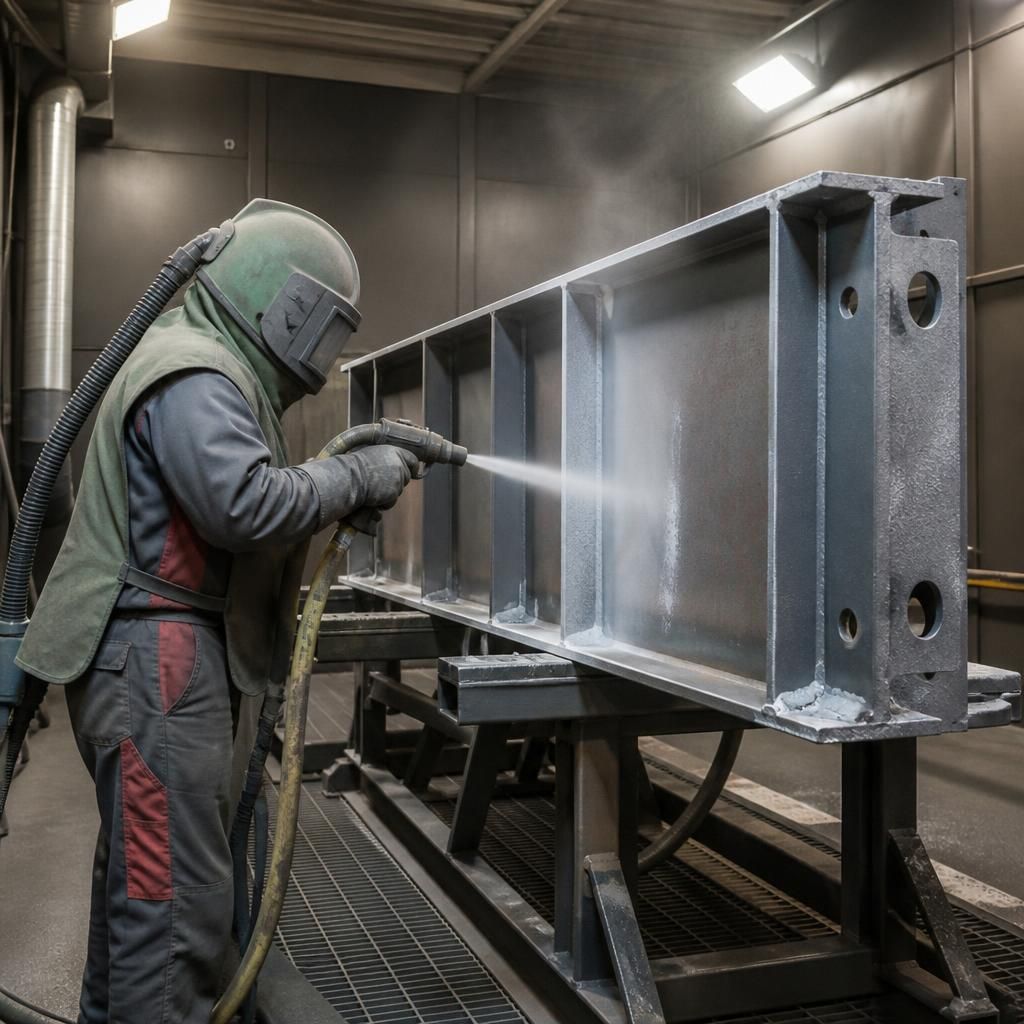
Blasting intensity is determined by the combined effect of air pressure, abrasive flow, nozzle size, stand-off distance and nozzle movement, rather than by pressure alone. The same pressure can produce very different results when the abrasive, nozzle or working distance changes, so these variables must be set as a system for the particular metal and coating.
Controlled nozzle movement is especially important when working on thin sections, edges or areas where the coating has already been removed. Keeping the nozzle moving and using even, overlapping passes helps prevent concentrated impact in one location. A more durable substrate or firmly bonded coating may tolerate slower travel or repeated passes, while a softer metal or exposed finished surface may require lighter, faster application.
During preparation, the surface should be checked as the coating changes from intact to removed. Settings that are suitable for breaking through the old layer may be unnecessarily aggressive once the substrate is exposed. Adjusting the technique at this transition can help achieve the required cleanliness and profile while limiting unnecessary material removal.