

How does the choice of blasting media impact the longevity and effectiveness of a powder coating application?
The blasting media controls the cleanliness, texture and profile of the metal surface, directly influencing powder-coating adhesion and long-term performance. A suitable medium and correctly controlled blasting process create a consistent key for the coating without unnecessarily deforming or contaminating the component.
The blasting media affects powder-coating longevity by determining how thoroughly the metal is prepared, how much surface texture is created, and whether the substrate is damaged or contaminated during preparation. The correct choice produces a clean, suitably keyed surface that allows the powder coating to bond consistently; an unsuitable choice can leave rust, embed abrasive, create an irregular profile or distort the component, reducing service performance.
Surface cleanliness is the first factor. Rust, mill scale, old coating, weld residues and corrosion products can prevent the powder coating from contacting sound metal. If these materials remain in pits or on less accessible areas, moisture and contaminants may continue to affect the substrate beneath the coating. Aggressive media can remove firmly bonded corrosion more effectively, while gentler media may be more appropriate where the objective is to clean without materially changing the surface. The blasting method must therefore match the condition of the component rather than being selected solely by abrasive hardness.
The media also influences the surface profile. Angular particles cut into the substrate and normally create a more pronounced texture, whereas rounded particles tend to clean or peen the surface with less cutting action. A profile that is too shallow may provide insufficient mechanical keying. One that is too deep can leave peaks with inadequate coating coverage and valleys that retain dust or corrosion residues. Both conditions can make the finished system more vulnerable to local breakdown, particularly on exposed edges, joints and recessed areas.
Different media produce different preparation results:
- Aluminium oxide is a hard, angular abrasive suited to removing corrosion, existing coatings and other firmly attached material. It can create a strong profile, but excessive pressure or prolonged blasting may roughen thin sections or remove more base material than intended.
- Steel grit provides an aggressive cutting action and is often considered for robust steel components. Its performance depends on the grade and condition of the abrasive, as worn particles behave differently from fresh, sharp grit. Residual ferrous contamination can also be a consideration where the substrate or coating specification requires a particularly controlled finish.
- Glass beads are generally used where a less cutting, more uniform treatment is required. They can clean and brighten suitable surfaces, but may not remove heavy rust or thick, firmly bonded coatings as efficiently as an angular abrasive.
- Finer or softer media may be suitable for thinner, softer or more easily marked substrates. They reduce the risk of distortion, but may require a different approach where deep corrosion or a substantial existing coating must be removed.
These distinctions affect coating performance in practical ways. A medium that is too mild may leave contamination behind, causing early adhesion failure or corrosion beneath the powder film. A medium that is too aggressive may create excessive roughness, sharp peaks, dimensional change or warping. Damage is especially relevant on thin sheet, machined faces, threads, edges and components with tight tolerances. Protecting such areas, reducing the blasting intensity or using a more suitable abrasive can preserve the function of the part while still providing an effective preparation.
Control of the blasting process is as important as the media itself. Air pressure, nozzle distance, blasting angle, traverse speed and dwell time all alter the result. Holding the nozzle too close or moving too slowly concentrates energy in one area, producing an uneven profile or local deformation. Inconsistent technique can leave different sections with different preparation levels, which may lead to variable coating adhesion and appearance across the same batch.
Media condition must also be monitored. Reusable abrasive becomes rounded or fractured as it is recirculated, and its cleaning action changes over time. Dust, removed coating, oil, moisture and other debris can accumulate in the blasting system or on the component. Contaminated abrasive may deposit unwanted material rather than preparing a clean surface. Suitable separation, storage and inspection practices help maintain consistent results, while compressed air and equipment must be appropriate for producing a dry, clean surface.
After blasting, the component should be inspected before powder is applied. Inspection should consider visible residues, remaining rust, uniformity of the prepared surface, sharp edges, recessed areas and any signs of distortion. The surface should not be handled unnecessarily, because fingerprints, oil and moisture can compromise the newly prepared metal. Where the coating specification requires a particular surface profile or cleanliness level, those requirements should be checked using the relevant inspection method rather than relying only on appearance.
The choice must also account for the complete coating system and the component’s service conditions. Outdoor structures, automotive parts, fabricated machinery and components exposed to chemicals or abrasion may require a different preparation approach from lightly loaded indoor items. The metal type, thickness, geometry, previous finish and required appearance should be considered alongside the powder coating specification. A preparation method that is appropriate for carbon steel may be unsuitable for aluminium or another non-ferrous substrate.
Effective preparation does not replace correct powder application. The coating still needs suitable application thickness, thorough curing and protection of edges, joins and difficult geometries. However, these later stages cannot reliably compensate for corrosion or contamination left by poor blasting. In this sense, media selection influences longevity at the earliest stage of the coating process: it determines whether the powder is being applied to sound, suitably prepared metal.
For industrial components, the most reliable selection is therefore based on a balance between cleaning power, achievable profile, substrate sensitivity and the required finish. A coating specialist can assess the metal and its existing condition, select an appropriate abrasive and control the preparation so that the blasted surface supports consistent powder-coating performance rather than introducing avoidable defects.
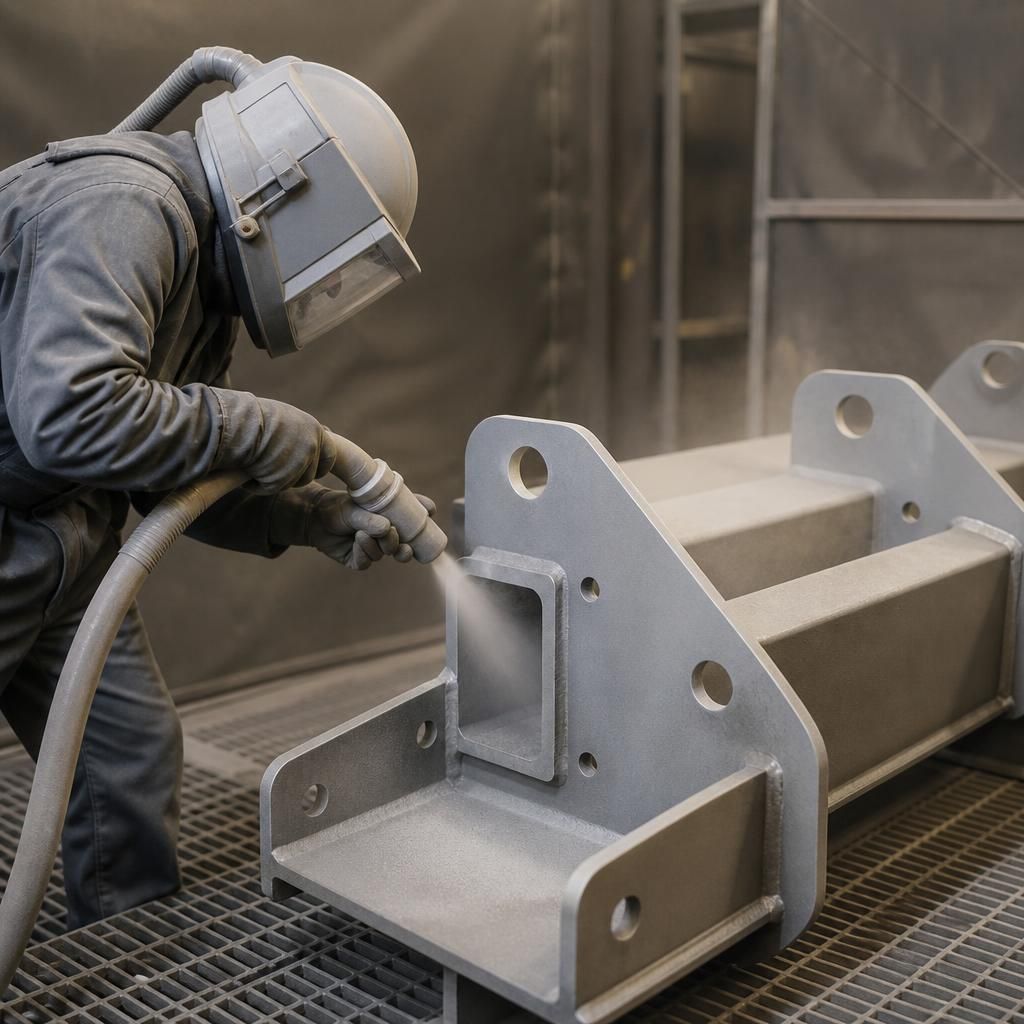
Blasting media can affect powder-coating performance through its interaction with the component’s geometry, particularly where surfaces meet. Weld toes, folded corners, holes and internal sections can receive a different impact from flat faces, so a single abrasive setting may not produce an equivalent preparation result everywhere.
This matters because powder coating must form a continuous film across changes in shape without creating excessively thin areas or trapped abrasive. Preparation may therefore involve changing the blasting angle, shielding sensitive features or using a complementary treatment for difficult sections. Assessing the component as a complete three-dimensional part, rather than judging only its most accessible faces, helps ensure that the selected media supports consistent protection throughout the finished application.