

What measures are taken during the application of a RAL 2000 powder coat to ensure it meets industry standards for durability and uniformity?
A RAL 2000 powder coat is applied under controlled conditions, with the coating coverage and film thickness monitored to promote a consistent finish across each aluminium component. The coated parts are then cured to the powder manufacturer’s specified requirements and inspected for uniform colour, coverage, adhesion and surface defects, with appropriate quality checks used to verify durability.
Industry-standard results depend on controlling the complete application system rather than relying on the powder alone. For a RAL 2000 powder coat on aluminium, this includes a defined coating specification, correctly prepared application equipment, controlled powder handling, consistent spraying technique, suitable part positioning and documented checks against the customer’s requirements.
The work normally begins with a job specification that identifies the RAL colour, required finish, acceptable appearance, intended service environment and any performance tests required. This prevents decisions being made by visual judgement alone. Where colour consistency is important across separate components or production batches, reference samples or an agreed colour standard can be used for comparison. Parts are also identified so that any inspection result can be linked to the relevant production batch and process records.
Application equipment is set up for the geometry and material of the aluminium components. Gun position, movement, powder flow and electrostatic settings all affect how evenly particles are deposited. Operators maintain a consistent distance and travel pattern, while paying particular attention to corners, recesses, edges, apertures and changes in section. These areas can receive too little or too much powder if they are approached in the same way as broad, flat surfaces. Correct earthing of the workpiece is also important because an unstable electrical connection can reduce transfer efficiency and create uneven deposition.
Powder handling is controlled to protect both appearance and performance. The powder must be stored and used in accordance with its technical requirements, kept free from moisture and contamination, and handled in a way that avoids mixing RAL 2000 with other colours or coating types. Where powder recovery is used, its suitability and management must be controlled so that the composition and appearance of the applied material remain consistent. Sieves, hoses, guns and feed equipment may need appropriate cleaning between different products or colours.
Part loading and racking are also significant. Components are arranged to allow the spray to reach all specified surfaces without excessive shadowing from neighbouring parts. Contact points are selected so they do not interfere with the required coated area, and masking is used where threads, mating faces, holes or electrical contact surfaces must remain free of coating. Consistent loading helps ensure that similar components experience the same application conditions and are handled without damaging the deposited powder.
Operators monitor the process for signs of contamination, poor transfer or surface disturbance before the coating proceeds further. Dust, fibres, oil, silicone, moisture and handling marks can produce craters, pinholes, inclusions or areas of poor appearance. If an irregularity is found, the affected part can be segregated for assessment rather than allowing a suspected defect to pass through the remainder of the process.
Uniformity is assessed using more than colour alone. Depending on the specification, checks may include:
- visual comparison under suitable lighting for shade, gloss, texture, coverage and visible defects;
- instrument-based colour or gloss readings where a measurable comparison is required;
- film-build readings taken at representative locations, including areas that are difficult to coat evenly;
- adhesion, impact, flexibility or other mechanical tests selected for the component’s use;
- corrosion or environmental resistance testing where the service conditions and project specification require it.
The relevant acceptance criteria should be agreed before production, since the appropriate test and permitted variation depend on the component, substrate, coating system and operating environment. A decorative architectural component may be judged primarily on shade, gloss and visual uniformity, whereas an industrial part may require greater emphasis on mechanical or corrosion performance.
Finally, process records provide evidence that the specified powder, equipment settings, component identification and inspection results correspond to the finished parts. This traceability supports consistent production and makes it easier to investigate any variation between batches. Together, these measures reduce avoidable defects and provide a structured basis for demonstrating that a RAL 2000 finish has been applied consistently and assessed for the durability requirements of its intended use.
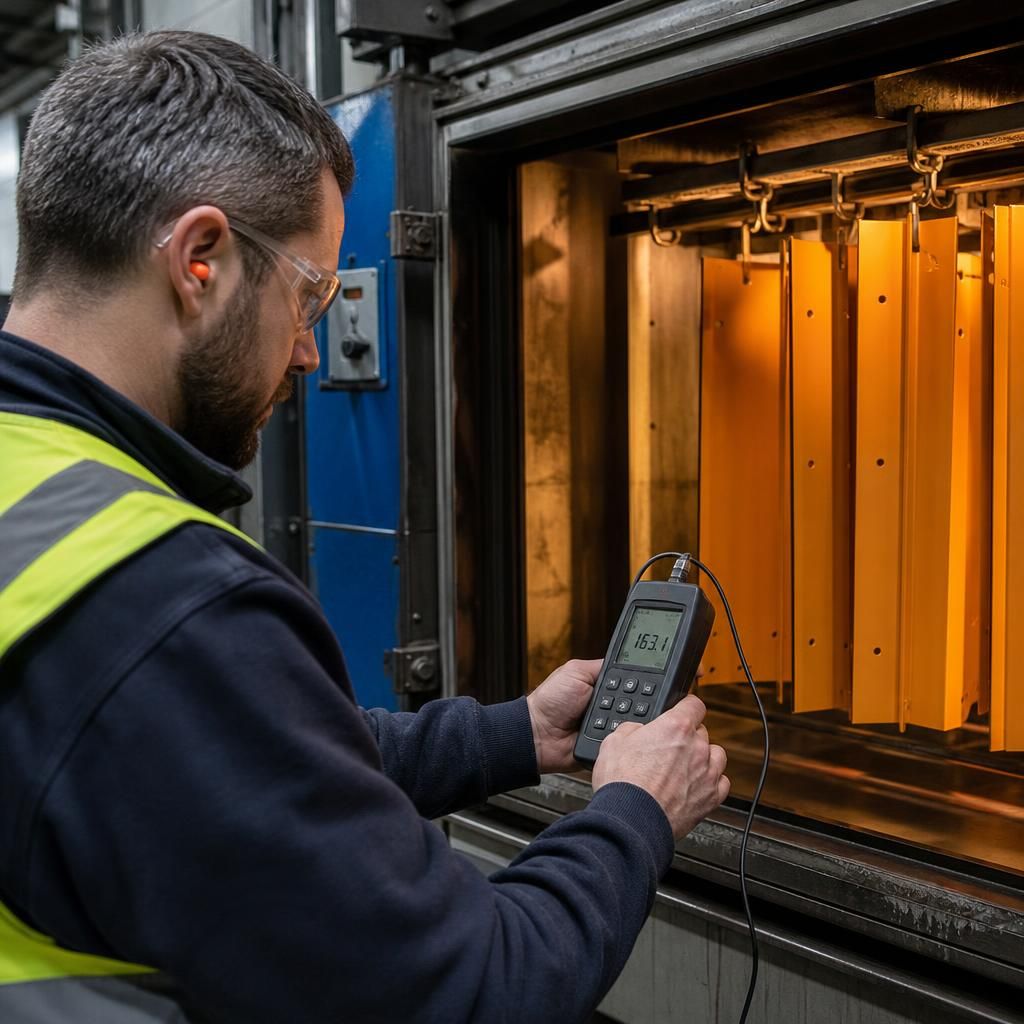
For a RAL 2000 powder coat, cure verification is based on the aluminium component reaching the powder manufacturer’s specified metal-temperature and time requirements, not simply on the oven display. Parts with different thicknesses or thermal mass can heat at different rates, so the curing schedule must reflect the actual components being processed.
Temperature monitoring at representative points helps confirm that the coating has received sufficient heat to develop its intended film properties. Under-curing can leave the finish short of its required performance, while excessive heat or prolonged exposure may affect colour and appearance. Recording the relevant cure checks provides evidence that the coating cycle was suitable for the batch and supports investigation if later inspection identifies variation.