

How does the complexity of aluminium component shapes impact the cost of powder coating?
Complex aluminium shapes can increase powder coating costs because they require more careful preparation, masking, positioning and handling to achieve even coverage. Parts with recesses, narrow sections, internal faces or difficult access may therefore take longer to process and require a more detailed quotation than simple, open shapes.
The complexity of an aluminium component’s shape can increase its powder coating cost when the geometry adds process time, specialist fixturing, extra inspection or a greater risk of rework. A simple, accessible part is usually more straightforward to process than a component with several planes, deep profiles, tight tolerances or features that make it difficult to coat consistently. However, shape alone does not determine the price; its effect is assessed alongside the component’s size, quantity, coating specification and production requirements.
One important consideration is the total surface area relative to the part’s overall dimensions. A highly profiled extrusion, finned section or component with multiple faces may require more powder and more attention than a similarly sized item with a flat profile. The additional area can also affect how parts are arranged on the coating line and how many can be processed together. This may influence the price per component, particularly where the geometry limits efficient batch loading.
Shape can also determine whether standard racking and hanging methods are suitable. Components need to be supported securely while allowing the required surfaces to be coated and then cured. An unusual centre of gravity, thin projections or an irregular outline may require a bespoke hook, jig or support. The cost of producing or setting up that fixture may be spread across the order, so it can have a greater effect on a small batch than on a larger repeat run.
Dimensional requirements are another factor. Powder coating adds a measurable film thickness, which can matter where components include close-fitting interfaces, threaded holes, bearing seats, sliding areas or mating faces. Such features may need to remain free of coating or be checked carefully after processing. If the design has several critical dimensions, the quotation may need to allow for more controlled processing, masking specifications supplied by the customer and additional inspection rather than treating the component as a general-purpose finish.
Some shapes create practical issues during the coating cycle without being visibly intricate. Closed sections, cavities and enclosed volumes may need suitable venting or drainage for safe and consistent processing. Welded fabrications can also include joints, overlaps and heat-affected areas that behave differently from the surrounding aluminium. Cast aluminium parts may require particular attention where their surface condition or porosity affects the finish. These characteristics do not automatically make coating unsuitable, but they can add assessment and process requirements to the quotation.
Complex geometry may affect the likelihood of imperfections being noticed or needing correction. A flat face makes unevenness relatively easy to identify, while a part with transitions, edges and multiple viewing angles may require closer visual inspection. Sharp edges, deep changes in profile and areas near contact points can also influence the consistency of the finished film. Where the component is decorative or highly visible, the required inspection standard should be agreed before pricing.
For an accurate quote, a powder coater will generally need more than a basic length, width and height. Useful information includes:
- an engineering drawing, CAD file or clear photographs showing the complete profile;
- overall dimensions, approximate weight and the number of components per batch;
- which faces, holes, threads, contact points or mating surfaces must remain uncoated;
- the required finish, colour, film specification and any appearance standard;
- whether the parts are repeat work or a one-off batch; and
- any restrictions on hanging points, allowable contact marks or finished dimensions.
When comparing quotations, check whether fixture manufacture, masking materials, inspection and any one-off set-up work are included. Two prices can differ even when the coating material is the same because one supplier may be allowing for the actual geometry while another is pricing the component as a standard shape. For repeat orders, the initial fixture or set-up cost may be allocated differently from the coating charge itself, so asking for a clear breakdown helps distinguish a genuine shape-related cost from a batch-size or specification difference.
In practice, the most cost-effective design is not necessarily the simplest-looking one. A component that can be securely supported, processed in a consistent orientation and inspected without special intervention is generally easier to price and produce. Discussing coating requirements during the design stage can identify suitable hanging points, drainage features and areas that should remain uncoated before manufacture, reducing avoidable complications without changing the component’s intended function.
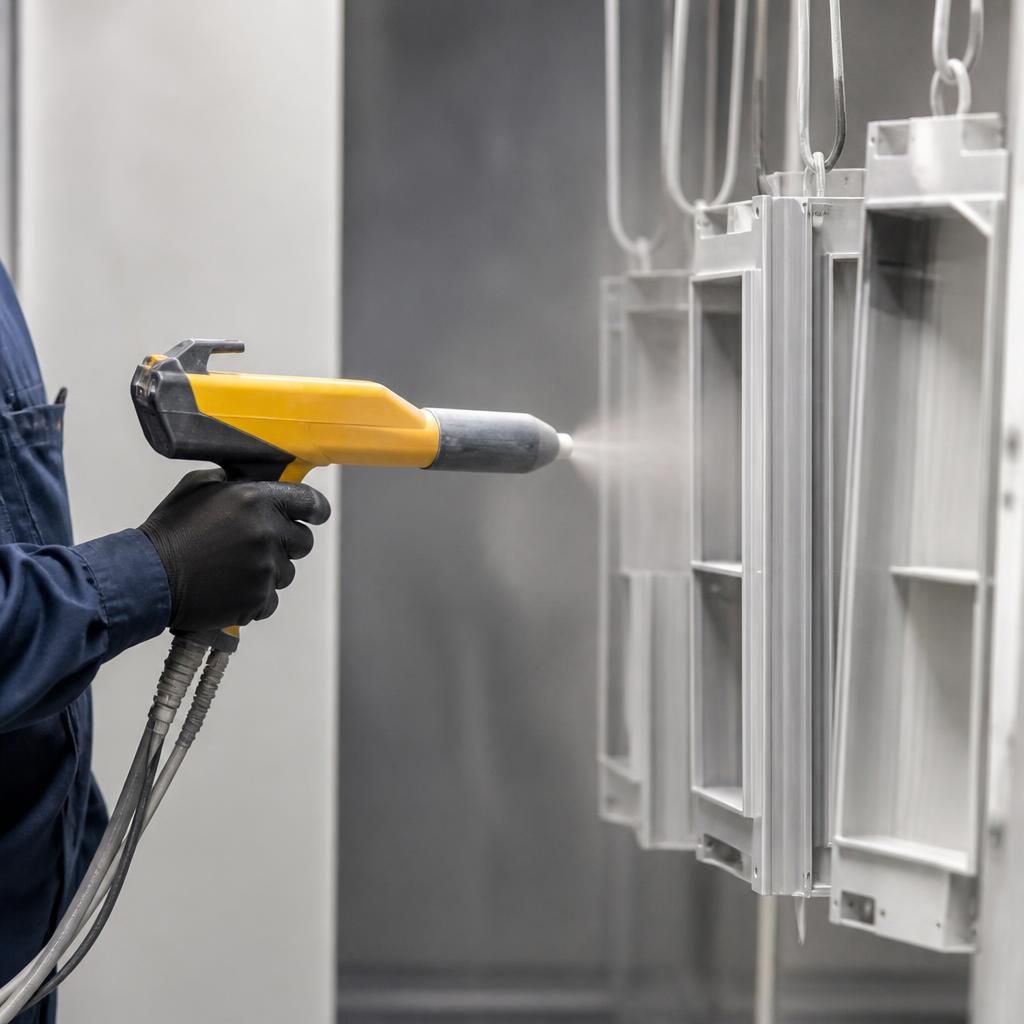
Recessed aluminium shapes can increase powder coating costs because of the Faraday cage effect. Powder particles tend to collect on exposed edges and outer surfaces rather than reaching deep corners, narrow channels or enclosed profiles. Achieving an even film may therefore require adjusted spray settings, different gun angles and more controlled application than an open, easily accessible surface.
This issue is separate from the component’s overall size: a relatively small part with deep recesses can demand more coating attention than a larger flat item. The quotation may reflect the additional application control and inspection needed to confirm that difficult areas have received consistent coverage, particularly where the finish is functional or highly visible.
Discuss Your Aluminium Component Coating Requirements
Share your aluminium component drawings or photographs, together with the required finish and any critical uncoated areas, to discuss how the shape may affect processing and pricing. Powder-coatings.co.uk can review the requirements and prepare a quotation for your project.