

What should businesses consider when evaluating the durability and environmental benefits of polyester powder coated aluminium?
When evaluating polyester powder coated aluminium, businesses should assess resistance to corrosion, UV exposure, abrasion and the intended service environment alongside pre-treatment, coating specification and finish quality. Environmental benefits can include solvent-free application, efficient use of powder and a longer service life that may reduce the need for recoating or replacement.
Businesses evaluating polyester powder coated aluminium should assess the complete lifecycle of the finished component, not just its initial appearance. Durability depends on how the aluminium is designed, handled, coated and used, while environmental performance depends on material choices, curing requirements, waste management, transport and what happens when the component reaches the end of its service life.
Consider the component’s design before coating. Geometry can affect both coating coverage and the way a part performs in service. Deep recesses, narrow gaps, sharp edges, drilled holes and concealed faces may require particular attention during preparation, racking and application. Welds, fixings and contact points can also become vulnerable areas if they are difficult to coat consistently. Reviewing the component drawings with the coating specialist before production can identify areas where a minor design adjustment may improve coverage, handling or future maintenance.
Durability should also be considered in relation to the mechanical demands placed on the part. A finish used on a protected architectural panel will face different stresses from one applied to fabricated equipment, vehicle components or frequently handled enclosures. Relevant questions include whether the coating must withstand impact, bending, handling during assembly, contact with tools, repeated cleaning or exposure to oils and other chemicals. Where performance is critical, businesses should ask which test methods are relevant to the finished application and whether sample panels or representative production parts should be assessed before a full batch is approved.
Adhesion and flexibility are important alongside surface hardness. A coating that appears hard may still be unsuitable if it cracks when an aluminium component is formed, fastened or subjected to movement. The selected polyester system should therefore be compatible with the manufacturing sequence. Coating before fabrication, for example, can create different risks from coating after fabrication. Drilling, cutting or bending coated aluminium may expose uncoated areas or damage nearby film, so the order of operations needs to be agreed at the design and production-planning stage.
Colour and gloss retention are practical durability considerations, but visual uniformity also matters across batches. Businesses should define acceptable tolerances for colour, gloss, texture and coverage, particularly where separate components will be assembled into one visible installation. A retained reference panel, agreed approval sample or documented finish description can help distinguish a genuine coating defect from a normal variation caused by viewing conditions, component geometry or batch production.
Environmental assessment should use a lifecycle view. The powder coating itself is only one part of the overall impact. Aluminium production, component manufacture, coating, packaging, delivery, installation, maintenance and end-of-life recovery all contribute to the environmental profile. A finish that remains serviceable for longer may avoid some replacement work, but that benefit should be considered alongside the energy and materials used to manufacture and coat the original component.
- Aluminium recovery: Check whether the component can be separated from fixings, seals, inserts or other materials so that the metal can enter an appropriate recycling route.
- Coating and substrate choices: Consider the effect of the chosen finish, colour, texture and component construction on future refurbishment or recycling.
- Curing energy: Ask how the coating process fits into the manufacturer’s environmental objectives and whether production planning can avoid unnecessary reprocessing or rejected parts.
- Packaging and transport: Review the packaging needed to prevent damage in transit and whether collection, delivery and return movements can be planned efficiently for the project.
- Waste controls: Confirm how unused material, contaminated powder, masking materials and damaged components are handled and recorded.
Environmental claims should be supported by evidence rather than based solely on the description “powder coated”. Useful information may include product technical data, safety documentation, environmental product information or project-specific records of material and waste handling. Where a building or procurement framework requires formal environmental documentation, this should be identified before the coating system is selected.
Maintenance and future repairability should be agreed at the outset. Even a durable finish may eventually require cleaning, local repair or complete recoating if the component is damaged or its use changes. Ask whether the specified polyester system can be visually matched for future work, how damaged areas should be treated, and whether the part can be removed without damaging adjacent materials. The answer may affect the choice of colour, texture, fixings and the accessibility of the installed component.
Supplier controls are another part of the evaluation. Businesses should look for a clearly documented process covering incoming aluminium, identification of the required finish, masking and racking, batch traceability, inspection and the treatment of non-conforming parts. These controls help link the final result to the agreed specification and make it easier to investigate variation between batches. They are particularly relevant where coated parts form part of a larger manufactured product and must fit with other components.
For a practical comparison, create an evaluation brief covering the component design, handling conditions, chemical contact, cleaning regime, appearance requirements, expected service period, repair arrangements and environmental reporting needs. A specialist coating provider can then advise whether polyester powder coated aluminium is suitable and identify any limitations before production begins. For manufacturers, fabricators, construction firms and automotive businesses across the Midlands, a regional powder coating service with collection and delivery options can also help coordinate coating requirements with the wider production process.
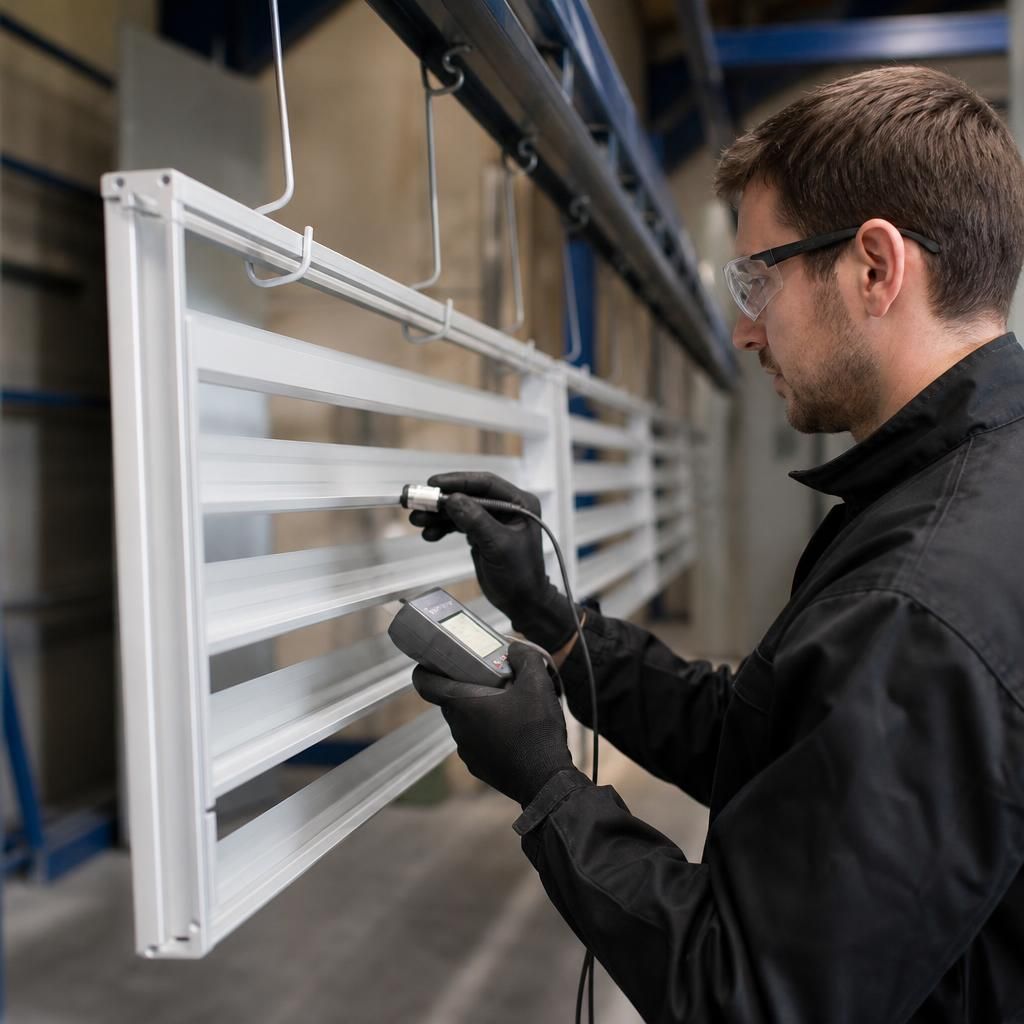
Coating thickness is a practical link between the durability and environmental performance of polyester powder coated aluminium. A film that is too thin may provide inadequate coverage at edges, corners or recessed areas, while excessive powder can affect curing, appearance and material use. Businesses should therefore agree the required thickness range for the chosen system and application, rather than judging performance by colour or gloss alone.
Ask how thickness is checked across representative areas of the component, including difficult-to-coat features, and how results are recorded. This evidence can help identify inconsistent application before parts enter service and reduce the risk of premature rework or replacement. It also supports more efficient use of powder by ensuring that material is applied to the agreed specification rather than simply building up a heavier finish.
Discuss Your Polyester Powder Coated Aluminium Requirements
Discuss your polyester powder coated aluminium requirements with our Midlands coating team, including component drawings, finish specifications and environmental documentation needs. We can help you assess the proposed coating approach before production begins.