

What critical aspects of the electrostatic spray process ensure even and durable aluminium powder coating results?
Even, durable aluminium powder coating depends on effective earthing, consistent electrostatic charging, correct gun settings, controlled spray distance and a steady coating pattern with suitable overlap. Maintaining uniform powder coverage across edges, recesses and difficult geometries helps achieve consistent film thickness, while controlled handling prevents contamination or disturbance before curing.
Even and durable aluminium powder coating results depend on more than the electrostatic charge at the spray gun. The complete spray stage must deliver a stable supply of suitable powder, maintain clean and predictable booth conditions, present each component consistently, and apply enough material for the specified film thickness without creating heavy areas, thin spots or defects.
Powder delivery must remain consistent. The powder should be properly fluidised so that it moves steadily from the feed system to the gun rather than pulsing or separating. Moisture, compacted powder and contamination can alter how the material flows and sprays. The condition of hoses, pumps, filters and fluidising equipment therefore affects the uniformity of the coating just as much as the gun itself. A fluctuating powder feed can produce visible variation between parts in the same batch.
Powder storage and preparation are also important. Material should be kept in conditions that prevent moisture uptake and contamination, and different powders or colours should not be mixed unintentionally. Where recovered powder is used, its proportion and condition need to be controlled so that the sprayed material remains consistent. Poorly managed reclaim can introduce foreign particles, colour variation or altered application behaviour.
Booth airflow must support, rather than disrupt, the spray. Air movement carries overspray towards the extraction system, but excessive or poorly balanced airflow can pull powder away from the component before it deposits. Insufficient extraction can allow airborne powder to settle on the workpiece or equipment. Clean booth surfaces, correctly maintained filters and suitable extraction balance help limit contamination and keep the application environment stable.
Component presentation has a direct effect on coating uniformity. Parts should be positioned so that the spray can reach the required surfaces without unnecessary obstruction from fixtures or neighbouring components. Consistent spacing and repeatable loading are particularly important in batch production, because changes in orientation can alter how much powder reaches each face. Fixtures should support the work securely while limiting masked areas and preventing contact with surfaces that must be coated.
The geometry of aluminium components can create local application effects that need to be managed deliberately. Sharp corners may attract more powder than broad flat faces, while deep internal angles can behave differently from exposed surfaces. Excessive powder deposition in a confined area can cause back-ionisation, in which trapped electrical charge disrupts the finish and creates roughness or small craters. Reducing the severity of the electrical effect and adjusting the application sequence for the component can help produce a more balanced deposit.
Application sequence matters when a component has several faces or complex features. Operators may need to approach surfaces in a planned order rather than treating every area identically. Exposed faces can be coated without allowing already covered sections to receive unnecessary additional powder, while concealed or internally angled areas may need attention before surrounding surfaces build up. The aim is to control the total deposit across the part, not simply to maximise visible powder coverage.
Film thickness should be treated as a measurable requirement rather than judged only by appearance. A coating that looks uniform may still be too thin for the specified application, whereas excessive thickness can affect appearance, edge definition, cure behaviour and material use. Thickness checks on representative areas, including locations likely to receive more or less powder, provide evidence that the application is within the relevant specification. Results should be reviewed alongside the powder manufacturer’s technical requirements and the component’s intended service conditions.
Inspection between spraying and curing can identify problems before they become fixed into the finish. Operators can look for bare areas, visible contamination, excessive build-up, uneven texture and signs of disturbed powder. Any correction should be made without damaging the underlying surface or introducing debris. Components also need to be transferred carefully so that vibration, contact or impact does not mark the uncured powder layer.
Durability begins with a sound and sufficiently uniform powder deposit, but the applied film must then be cured in accordance with the powder specification. The spray process should therefore be assessed as part of the wider coating sequence: powder condition, component preparation, application control, film-thickness verification and subsequent curing all contribute to the finished result. If any one of these stages is inconsistent, a visually acceptable sprayed surface may not deliver the required performance after processing.
For manufacturers and fabricators, the most reliable approach is to define the coating specification before production begins. This includes the powder type and finish, required film thickness, critical surfaces, acceptable appearance, component loading method and inspection points. Recording these controls makes the process repeatable across batches and provides a practical basis for investigating defects such as uneven texture, pinholing, poor coverage or colour variation.
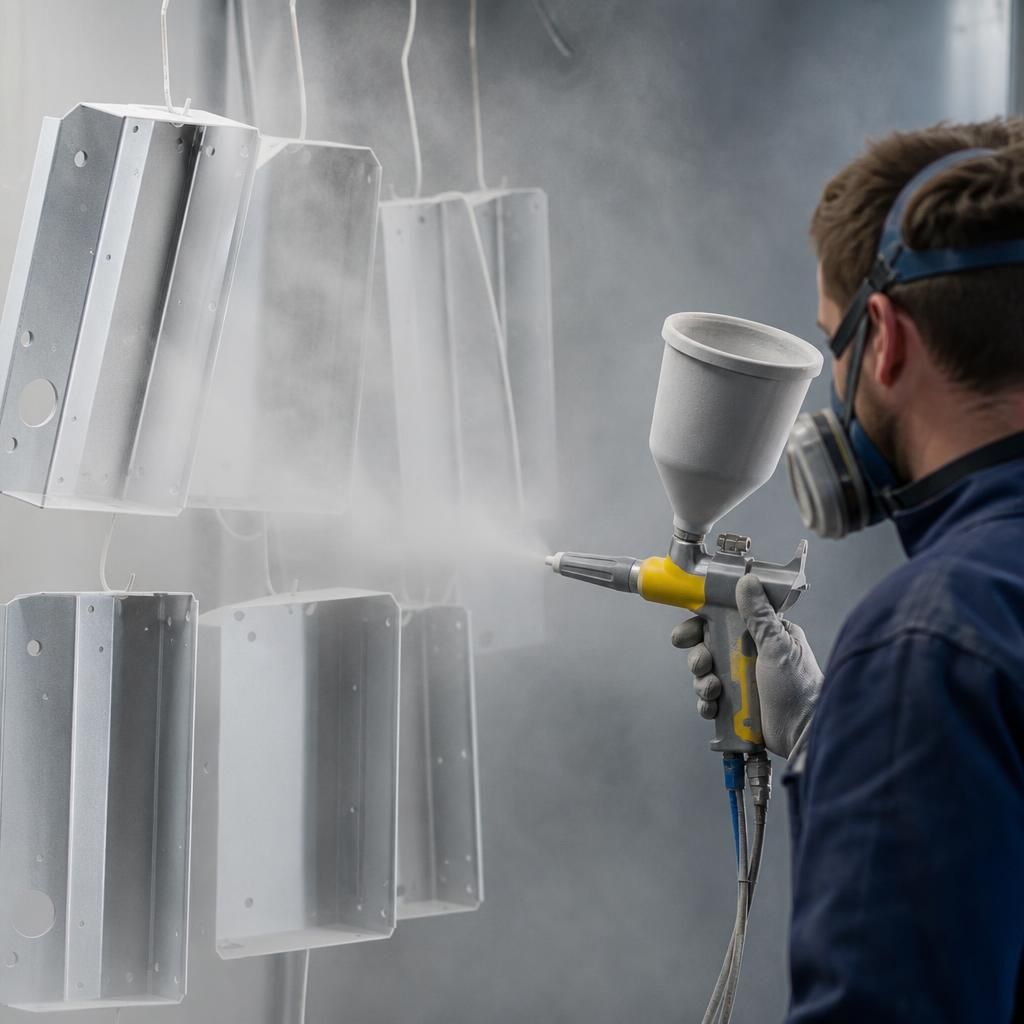
The powder’s physical characteristics also affect how evenly it deposits. A consistent particle-size distribution helps the material charge, travel through the spray cloud and settle into a coherent film. Excessive fines may become more easily carried into extraction, while agglomerated particles can produce a rough or irregular deposit. Powder should therefore be handled and prepared in line with the manufacturer’s specification, with material condition checked where application behaviour changes between batches.
This control is particularly important for aluminium components with demanding appearance requirements. Consistent powder properties give the electrostatic settings a predictable response, making it easier to maintain an even surface before the coating proceeds to curing.