

What measures do you take to ensure the nylon coating provides enduring protection against environmental and operational stressors?
Nylon coating protection is supported through careful metal preparation, controlled powder application and curing, and inspection of the finished coating for a consistent, defect-free finish. These measures help the coating withstand operational wear, impact, moisture and chemical exposure in demanding industrial environments.
Enduring nylon coating protection depends on matching the coating system to the conditions the metal component will experience, then preserving a continuous, correctly specified layer throughout its service life. Environmental exposure, mechanical loading, component geometry, chemical contact and maintenance requirements are considered together rather than treating nylon as a universal solution for every application.
Exposure conditions are established before the coating is specified. Relevant factors include moisture, intermittent or prolonged water contact, salt-laden atmospheres, ultraviolet exposure, temperature changes and contact with oils, fuels, cleaning agents or process chemicals. The concentration, temperature and duration of chemical contact can affect performance, so the expected operating environment should be provided when discussing the coating requirement. This allows the nylon formulation and finish to be considered against the actual duty of the component.
Nylon can absorb moisture, which may influence its dimensions and mechanical behaviour. For components used in humid environments or exposed to water, the design and coating specification therefore need to account for moisture uptake, drainage and the risk of water becoming trapped against the coated metal. Areas such as recesses, joints and enclosed sections require particular attention because retained moisture can create conditions that are more demanding than the surrounding atmosphere.
Mechanical stress is assessed alongside environmental exposure. Nylon coatings are commonly selected where resistance to abrasion, impact and repeated handling is important, but the expected type of wear still matters. Sliding contact, rubbing, vibration, edge impact and contact with sharp or abrasive materials impose different demands. Components subject to repeated movement or flexing also need sufficient clearance and a coating specification that will not be placed under unnecessary strain during operation.
Component design can materially affect long-term protection. Coating continuity is easier to maintain where edges, corners, holes and recessed features are suitable for the required finish. Interfaces such as threaded sections, bearing seats, mating faces and electrical contact points may need masking or allowance in the design so that the coating does not interfere with assembly or create excessive local stress. Drainage and access for cleaning should also be considered where parts are exposed to water, debris or process residues.
Dimensional requirements are checked as part of the specification. Nylon adds a layer to the original metal surface, so close-fitting components may require allowances at mating surfaces, bores, threads and locating features. The required finish must provide protection without preventing assembly or changing the function of the part. Where components experience temperature variation, the different expansion behaviour of metal and nylon should also be considered, particularly at tight interfaces or where movement is restricted.
For demanding applications, representative parts or test pieces can be used to confirm that the selected coating is suitable for the combination of exposure and operation. Assessment may consider adhesion, surface continuity, resistance to handling damage and compatibility with chemicals or cleaning methods used by the customer. Testing a representative configuration is more informative than relying solely on a general material description because geometry, contact conditions and operating temperatures can alter performance.
Protection also depends on how coated components are handled after processing. Metal-to-metal contact, dragging across hard surfaces, unsuitable packing materials and contact with aggressive substances can damage the finish before installation. Suitable separation, careful lifting and clean storage reduce the risk of scratches, chips and pressure marks. Any damage found before service should be assessed and rectified using a compatible repair approach rather than being left to expose the underlying metal.
Maintenance should use cleaning methods that are compatible with nylon. Non-abrasive tools and suitable detergents are preferable to aggressive solvents, harsh scouring materials or techniques that can erode the coating. Periodic checks are useful on components exposed to continuous abrasion, impact, chemicals or outdoor contamination. Particular attention should be given to edges, fixing points and areas where debris or moisture may collect.
No coating is unaffected by every chemical, temperature or mechanical condition. The most reliable approach is to define the service environment in detail, select nylon for that duty, accommodate the coating within the component design and control handling and maintenance after coating. These measures help retain the protective function of the finish when metal parts are exposed to sustained operational and environmental stress.
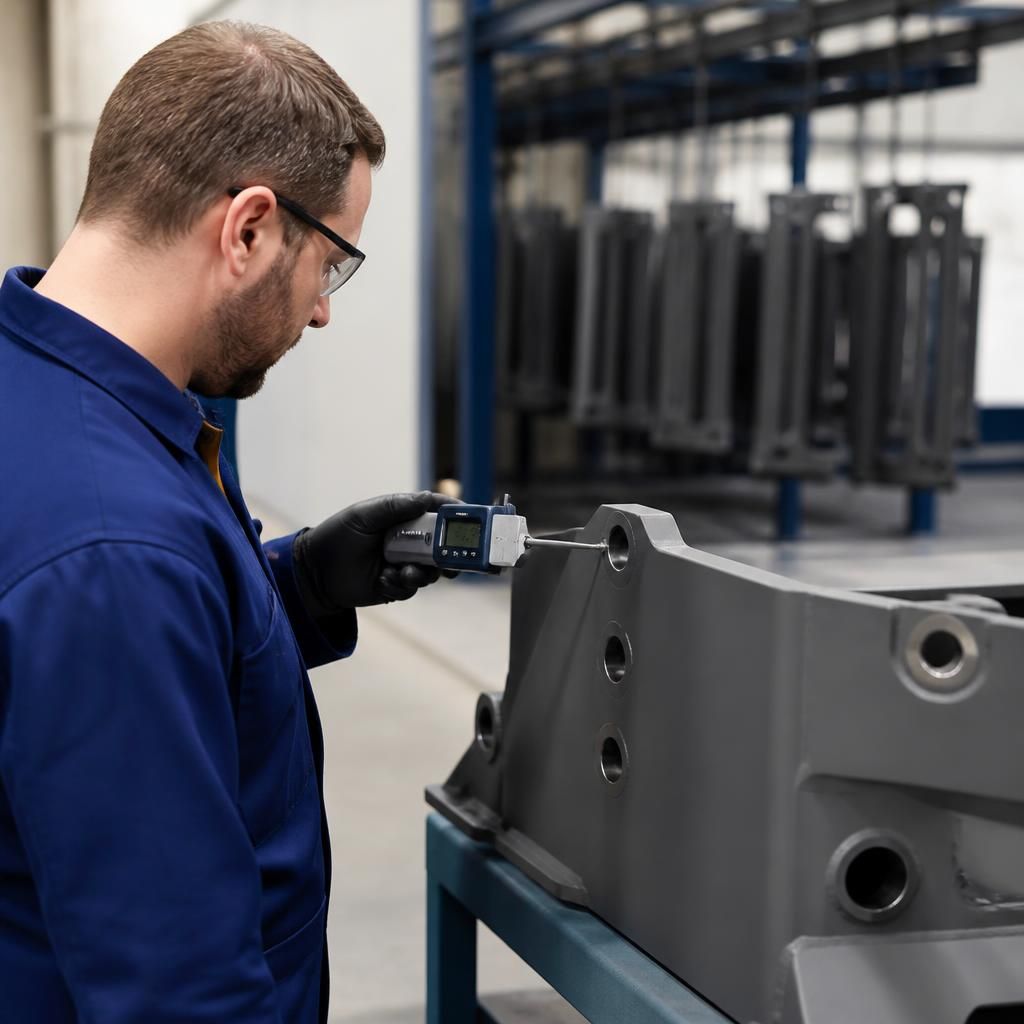
Consistent coating thickness is an important safeguard against environmental and operational damage. A film that is too thin may provide inadequate coverage, while excessive build can affect curing, dimensions and the fit of mating components. The required coating build is therefore considered alongside the component’s geometry, service conditions and dimensional tolerances.
Particular care is needed around edges, recesses, holes and other features where the coating can be more difficult to distribute evenly. Maintaining a continuous, suitably proportioned layer helps reduce weak points that could be exposed to moisture, abrasion or impact during service.