

What factors should be considered when choosing a provider for powder coating repair services?
When choosing a powder coating repair provider, assess its experience with your component type and existing finish, its ability to match the coating accurately, and the quality of its preparation and inspection processes. Also compare how it handles batch requirements, specialist coatings, collection and delivery, documentation, and communication about the proposed repair.
Choosing a provider for powder coating repair services requires more than comparing prices. The right provider should demonstrate that it can identify the cause and extent of the damage, recommend a technically suitable repair method, control the process consistently, and define how the finished component will be assessed. The decision should be based on technical suitability, risk control, communication and total project requirements.
Assess the proposed repair method. Ask whether the provider intends to carry out a local repair, prepare and recoat a section, or strip and refinish the complete component. A small scratch may be suitable for local treatment, but widespread loss of adhesion, corrosion beneath the coating, contamination or damage around complex edges may make a complete recoat more appropriate. The provider should explain the reasoning rather than automatically selecting the quickest or lowest-cost option.
Check how the underlying metal will be evaluated. Powder coating damage can expose steel or aluminium to moisture and contaminants, while bubbling or flaking may indicate a problem below the visible surface. A sound assessment should consider corrosion, dents, sharp edges, weld areas, oil residues and any previous treatments. If the substrate is not suitable for recoating, the provider should identify that limitation before work begins.
Consider the component’s operating conditions. The repaired finish needs to be appropriate for the environment in which the part will be used. Relevant factors may include outdoor exposure, moisture, chemicals, abrasion, impact, heat, cleaning methods and contact with other materials. A coating that is adequate for an indoor enclosure may be unsuitable for plant equipment, architectural metalwork or an automotive component. Give the provider the intended use and any known exposure conditions so the recommendation is based on service requirements.
Look for a controlled method of assessing compatibility. The new material must bond reliably to the prepared surface and should not introduce an adverse reaction with the existing coating, primer, pretreatment or substrate. This is particularly important where only part of an item is being repaired. A technically responsible provider may recommend a test area, sample panel or defined trial where the coating history is uncertain. Ask what will happen if the existing coating is found to be unsuitable for overcoating.
Review process control and equipment suitability. Repair quality depends on more than the powder itself. Preparation equipment, masking, fixturing, spray application, curing and cooling all affect the result. Ask how the provider controls the curing conditions for the component’s material and thickness, and how it avoids coating build-up on mating surfaces, threads, holes and moving interfaces. The provider should also be able to accommodate the physical dimensions, weight and geometry of the parts without creating handling damage.
Agree objective acceptance criteria before work starts. “Good finish” can mean different things to different parties. Confirm how the repaired coating will be checked for coverage, adhesion, visible defects, gloss, texture, colour consistency and coating build where those characteristics matter. Also establish which surfaces are critical and which areas will not be visible in service. A clear acceptance standard reduces disputes, particularly where a local repair cannot be made completely invisible against an older surrounding finish.
Examine the quotation for what it includes. A meaningful comparison should show whether the price covers inspection, masking, stripping, surface preparation, pretreatment, coating, curing, packing and any required rework. Check for exclusions such as removal of fittings, repair of damaged metal, specialist preparation or disposal of old coating. The cheapest quotation may not represent the lowest overall cost if additional preparation or corrective work is likely to be charged later.
Ask about handling and protection after coating. A correctly applied finish can still be damaged during unloading, stacking or installation. The provider should explain how parts will be separated, packed and protected, especially where edges, machined faces or decorative surfaces are vulnerable. Confirm any requirements for masking removal, transport orientation and inspection on receipt. This is particularly important for batches containing components with different shapes or delicate finished surfaces.
Consider traceability and communication. For repeat or safety-relevant work, it is useful to know which parts were processed together, what coating specification was used and whether any non-conformity was identified. Clear records can support future repairs and help establish whether a recurring failure originates in the coating, the substrate, assembly or service environment. Communication should cover assumptions, photographs or samples required, approval points, changes to scope and the procedure for dealing with a part that cannot be repaired as originally proposed.
Check the provider’s approach to failed or unsuitable parts. A responsible service should distinguish between coating repair and metalwork repair, and should not conceal damage by applying a new finish over an unstable surface. Ask how it handles unexpected corrosion, distortion, contamination or coating failure discovered after preparation. The answer should set out when work will pause for approval and how any revised cost or method will be agreed.
For a fair comparison, give each shortlisted provider the same component details, photographs, coating history, operating environment, required finish and acceptance criteria. Compare the technical recommendation, exclusions, inspection arrangements, handling controls and overall scope alongside the quoted price. This approach helps identify a provider whose repair method is suitable for the component and its service conditions, rather than simply selecting the lowest initial quotation.
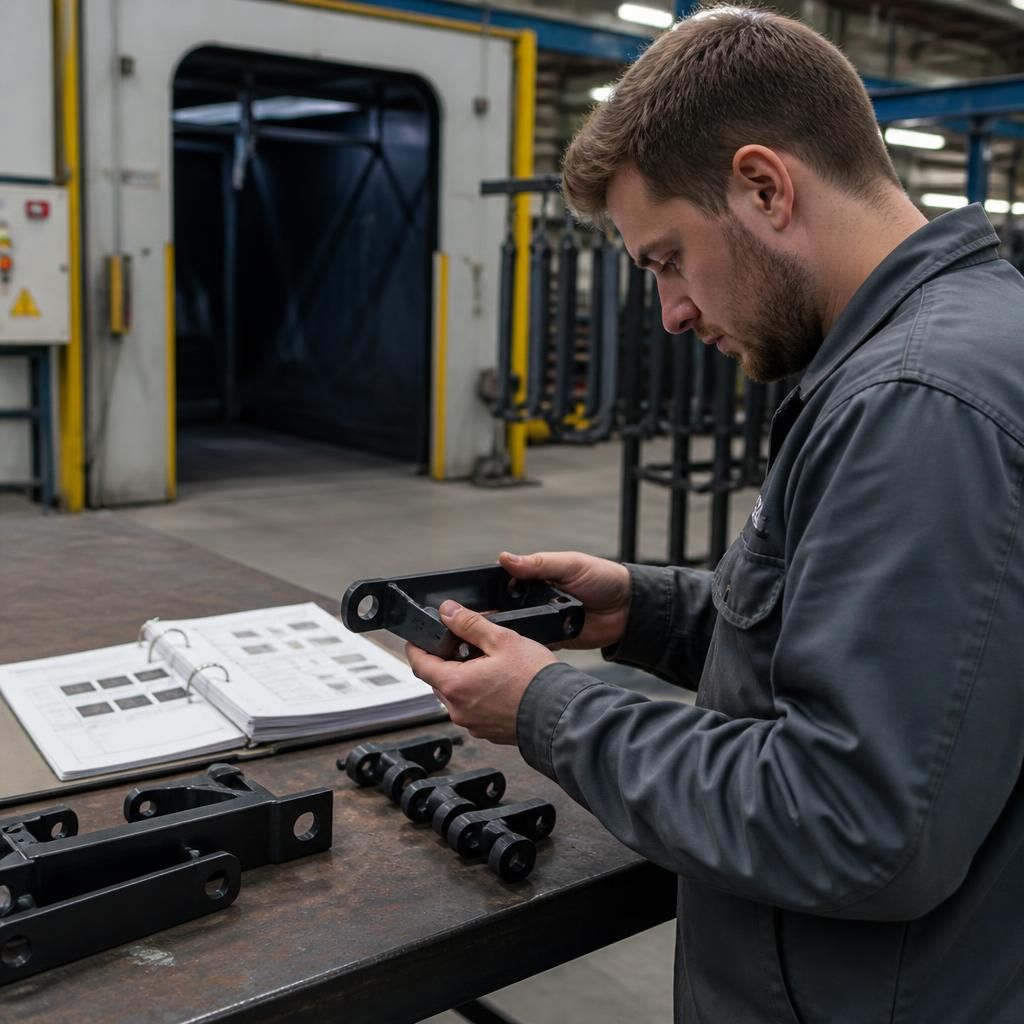
For repeat repairs, assess how the provider will maintain consistency between batches. A documented coating specification, approved reference sample and recorded process details can help compare later work with the original repair, particularly where colour, gloss or texture must remain consistent across separately processed components.
Ask how changes to the powder, substrate preparation or curing method will be identified before they affect a production batch. This is especially relevant when components are supplied at different times or when a repair becomes an ongoing requirement rather than a single isolated job.