

What are the potential challenges and solutions associated with powder coating over galvanised steel, and how can they be effectively managed to ensure a successful application?
Powder coating over galvanised steel can be affected by surface contamination, zinc surface variation, outgassing, poor adhesion and excessive film thickness. These risks are managed through suitable cleaning and profiling, controlled pre-treatment and curing, correct powder selection, and inspection of the finished coating for defects and adhesion.
Successful powder coating over galvanised steel depends on treating the zinc coating as a distinct substrate rather than as ordinary bare steel. The main risks are managed by agreeing the coating specification in advance, assessing the component’s condition and design, selecting compatible pre-treatment and powder, controlling the application process, and verifying the finished system before release.
Start with a clear specification. The required environment, appearance, service temperature, impact exposure and expected maintenance conditions should be established before processing. The specification should identify the galvanising standard or expected zinc condition, powder type, colour, gloss level, coating build, cure requirements and acceptance criteria. This prevents disagreements where a technically sound coating is rejected because of unrecorded visual expectations, such as complete uniformity across components with different galvanised surface textures.
Assess the parts before they enter production. Check for sharp edges, weld spatter, burrs, deep recesses, tight overlaps, threaded holes and areas that could retain rinse water. Galvanised fabrications may also include transport damage, handling marks or local repairs. These conditions should be resolved before coating where possible. A coating can follow the shape of a component, but it cannot reliably correct poor fabrication, inaccessible faces or joints that trap moisture.
Component design can determine the result. Hollow sections and enclosed fabrications need suitable venting and drainage to allow cleaning, rinsing and curing without trapped liquids or gases. Drainage holes should be positioned so that liquid does not remain inside the part or run across a visible face during processing. Enclosed areas that cannot be reached by the pre-treatment system may remain inadequately prepared, so the design should be reviewed before manufacture when a durable duplex finish is required.
Control masking and racking carefully. Threads, bearing faces, machined bores, electrical contact points and mating surfaces may need masking or other protection. Masking materials must tolerate the process temperature and should not leave residues on the zinc surface. Parts also need to be supported securely without creating excessive contact marks or shadowed areas. The rack position should expose the important faces to both spray pre-treatment and powder application, particularly where components have deep returns or complex profiles.
Manage heat-related risks separately from surface preparation. Galvanised steel and powder coatings respond to the curing cycle as a combined system. The relevant condition is the temperature reached by the metal, not simply the air temperature displayed by the oven. Heavy sections may heat more slowly than light sections, while thin sections can reach temperature quickly. Production controls should therefore account for component mass, loading pattern, oven airflow and the powder manufacturer’s curing window. Under-curing can reduce final performance; excessive heat can affect colour, gloss or the zinc layer.
Powder selection should reflect the intended use rather than colour alone. The product data should be checked for suitability over zinc-coated steel, curing requirements, outdoor exposure, chemical contact and expected mechanical service. Where appearance is critical, a representative sample or trial panel can help establish the achievable finish before a full batch is processed. This is particularly useful when parts combine different steel thicknesses, fabrication methods or galvanised finishes.
Use inspection at several stages rather than relying only on the final appearance.
- Before coating, confirm that the parts match the drawing or batch information and that protected areas are correctly identified.
- After pre-treatment, check that the surface is visibly suitable for powder application and that no rinse water or processing residue remains in recesses.
- During application, monitor coverage on edges, corners, returns and concealed faces, not just the broad visible surfaces.
- After curing, assess colour, gloss, continuity, inclusions, pinholes, craters, runs and visible contact marks.
- Where specified, use suitable coating-thickness and adhesion checks on representative areas, taking account of the geometry and the limitations of the test method.
Inspection results should be recorded against the batch, including the powder identification, application settings, curing conditions and any areas that required correction. Traceable records make it easier to distinguish a one-off handling issue from a repeated process problem and provide useful information for future work on similar fabrications.
Repair decisions should be made carefully. Minor damage after coating may be repairable with a compatible touch-up system, but a repair is not automatically equivalent to the original factory-applied finish. Large defects, exposed zinc or damage at edges may require controlled removal and reprocessing, subject to the condition of the galvanising and the agreed acceptance standard. Abrasive repair must not remove more zinc than necessary, and any repair method should be approved for the service environment.
Communication between the galvaniser, fabricator, coater and end user is one of the most effective ways to prevent avoidable failures. Information should cover the galvanising process, part orientation, masking requirements, handling restrictions, service conditions and visual tolerances. A trial run is appropriate where the component is unusually large, geometrically complex or important to the final installation. It allows the process to be assessed on the actual substrate and shape rather than on a generic test coupon.
For manufacturers and fabricators, the practical objective is a controlled sequence: design for processing, inspect the galvanised component, agree the finish, protect functional surfaces, apply a compatible system, cure according to the metal temperature and verify the result. This approach addresses process and design risks that cannot be solved by powder application alone and gives the finished galvanised-and-powder-coated system a more reliable basis for service.
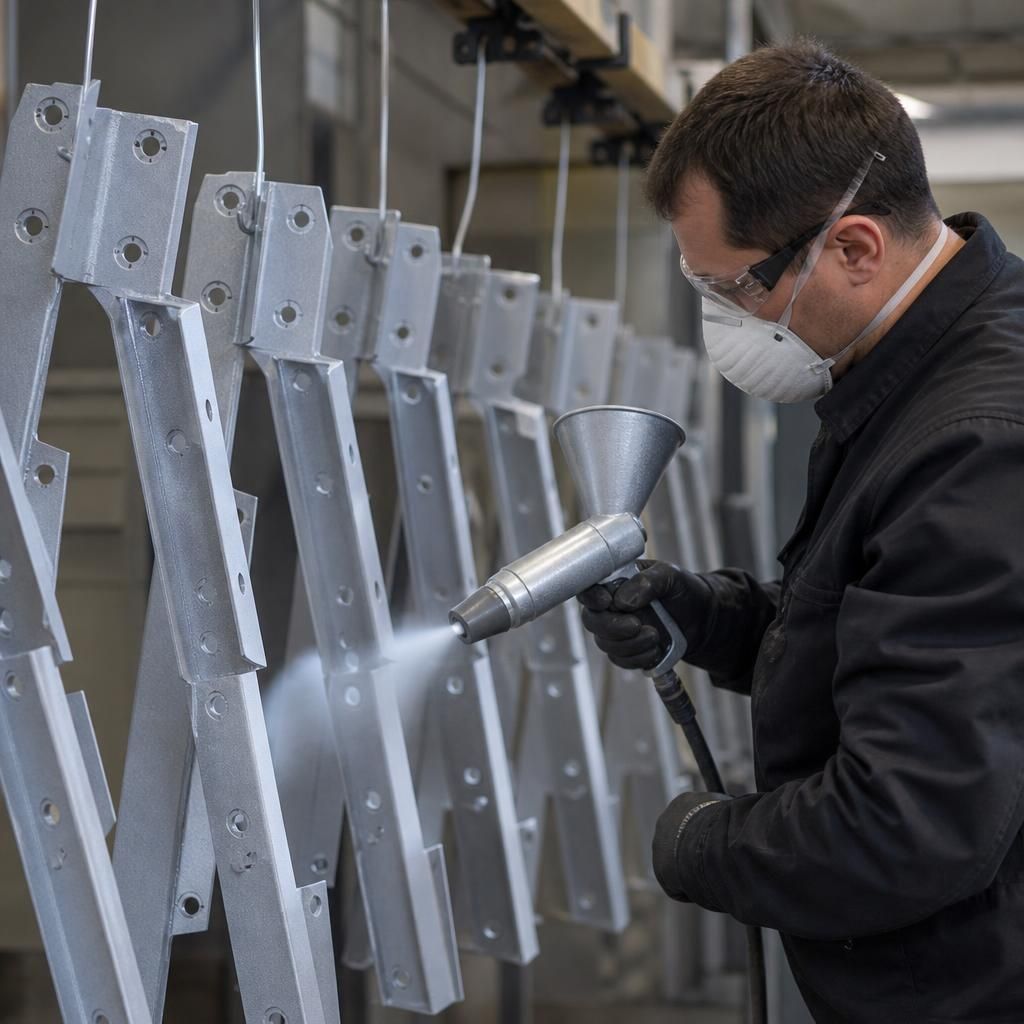
Outgassing is a common challenge when powder coating galvanised steel because heating can release trapped air, moisture or processing residues from the zinc surface and from pores in the coating. If these gases escape after the powder has begun to flow, they can create pinholes, bubbles or small blisters in the cured finish.
The risk can be reduced by ensuring the galvanised surface is clean and completely dry before powder application, then using a controlled preheating or degassing stage where the component and coating system permit it. Any resulting surface defects should be assessed before further coating: light pinholing may be treatable through suitable preparation and recoating, while widespread bubbling usually indicates that the preparation or heating cycle needs review. The process should be validated on representative galvanised parts, particularly where the substrate has a rough or porous appearance.