

What are the specific advantages of using Nylon & Rilsan powder coatings for components exposed to corrosive environments?
Nylon and Rilsan powder coatings create a tough, continuous barrier that limits contact between metal components and corrosive moisture, salts and chemicals. Their strong adhesion, impact resistance and resistance to abrasion help maintain that protection where parts face wear, handling or repeated exposure to aggressive environments.
Nylon and Rilsan powder coatings provide corrosion protection by separating the metal substrate from the conditions that cause oxidation, chemical attack and electrolytic damage. Their specific advantage in corrosive service is that they combine chemical resistance with a resilient, electrically insulating finish, helping the coating remain functional when components are exposed to moisture, salts, process chemicals and repeated handling.
Key advantages for corrosive environments include:
- Resistance to a broad range of chemicals: Nylon-based coatings can withstand contact with many oils, fuels, detergents, cleaning agents and industrial chemicals. This makes them suitable for components used near wash-down systems, chemical handling equipment and contaminated process areas, provided the coating is matched to the exact substances and concentrations involved.
- Reduced risk of electrolytic corrosion: The coating forms a non-conductive layer between the metal and its surroundings. This can reduce the possibility of corrosion driven by electrical current, salts or contact between dissimilar metals. It is particularly relevant where coated parts are exposed to damp, conductive deposits.
- Protection in wet and salt-laden conditions: A correctly applied, continuous coating limits the routes through which water and dissolved salts can reach the substrate. This is useful for parts used outdoors, in marine-influenced locations, in agricultural settings and in areas subject to frequent washing.
- Flexible protection around working components: Nylon and Rilsan finishes can accommodate a degree of flexing and deformation without behaving like a brittle surface film. This helps preserve the protective layer on components that experience movement or minor mechanical deflection, although the design and coating thickness still need to suit the application.
- Resistance to moisture-related degradation: Rilsan nylon 11 is valued for its balance of chemical resistance, flexibility and moisture performance. It can be considered where the coating must remain stable during repeated exposure to humidity, immersion or wet operating conditions.
- Lower surface friction: The naturally smooth finish of nylon coatings can reduce friction on suitable sliding, guiding or handling components. This does not directly stop corrosion, but it can reduce surface wear that might otherwise expose the substrate and create a starting point for corrosion.
- Coverage of complex metal parts: Powder coating can protect more than the broad faces of a component. With suitable preparation and application, it can cover profiles, formed sections and other geometries that would be difficult to protect consistently with a conventional liquid coating. Corners, recesses, apertures and edges still require particular attention because they are common weak points in any protective system.
These advantages are most useful where corrosion is combined with another source of service stress. For example, a fabricated part in a wash-down environment may face water, alkaline detergents, abrasion from handling and occasional impact. Nylon or Rilsan can provide a combination of chemical resistance, surface durability and flexibility rather than relying on corrosion resistance alone.
Coating selection should be based on the actual exposure rather than the word “corrosive” by itself. The assessment should consider the chemicals present, temperature, immersion or splash conditions, exposure duration, salt concentration, cleaning regime, ultraviolet exposure and the base metal. Nylon and Rilsan are not automatically suitable for every chemical or temperature range, so compatibility information and application-specific testing may be needed before specifying the finish.
Surface preparation remains critical. Oil, mill scale, rust, moisture and other contaminants can prevent the coating from bonding properly and may allow corrosion to develop beneath the film. The component should therefore be cleaned and prepared in a way that suits its substrate and service conditions. Welds, sharp edges, threaded areas and drainage points also need to be considered during design and preparation, as these areas can retain contamination or receive less consistent coverage.
For B2B components, the practical benefit is often a more durable corrosion-control system with fewer exposed metal surfaces requiring separate treatment. Nylon and Rilsan coatings are therefore considered for manufactured and fabricated parts where chemical contact, moisture, salt or electrically conductive contamination would make an unprotected metal surface vulnerable. A coating specialist can assess the component design, environment and preparation requirements before confirming whether a nylon-based system is appropriate.
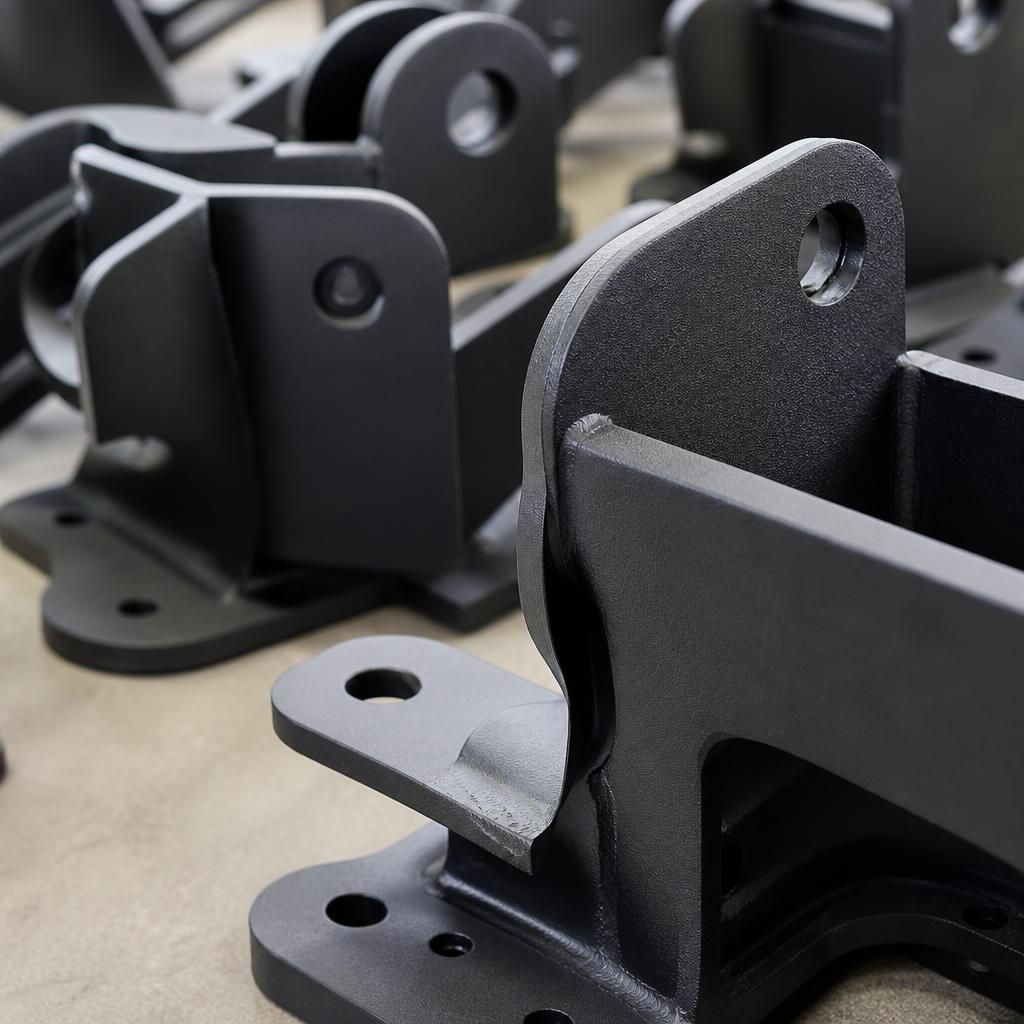
One important consideration is that Nylon and Rilsan coatings can alter the electrical behaviour of a metal component as well as protect its surface. Because the coating is electrically insulating, coated areas should not be relied upon for earthing, bonding or electrical contact. Designated contact points may need to remain uncoated, or be prepared after coating, so the finished part provides both corrosion protection and the required electrical continuity.