

How can variations in convection oven settings impact the curing process for different powder coatings?
Variations in convection oven temperature, airflow and dwell time alter how quickly a powder coating reaches and maintains its required curing conditions, so the same settings can under-cure one formulation and over-cure another. The coating’s specified cure schedule, the metal’s actual temperature and the oven’s heat distribution should therefore be checked together to achieve consistent film performance.
Convection oven settings affect powder coating by controlling the heat transferred to the coated component and the conditions in which the powder melts, flows and develops its final properties. A setting that is suitable for one powder formulation may produce poor flow, incomplete cross-linking or excessive thermal exposure in another, so the oven should be adjusted to the coating system, component and production load rather than treated as a universal process.
Temperature control is more than selecting a number on the oven display. The displayed air temperature and the temperature of the metal part can differ, particularly where components are thick, densely loaded or made from materials with high thermal mass. A light fabricated panel may reach the coating’s required condition quickly, while a heavy bracket or assembly takes longer to absorb heat. If the timer starts when the oven air reaches its set point instead of when the component has reached the relevant temperature, the effective cure may be shorter than intended.
Different formulations also respond differently to the same thermal input:
- Some powders are designed for relatively lower-temperature processing and can lose appearance or performance if held at excessive heat.
- Other systems require a higher thermal input or a longer period at temperature to achieve their intended hardness, adhesion and chemical resistance.
- Thermosetting powders must receive enough heat for the resin and cross-linking agents to react fully. Reaching a smooth appearance does not, by itself, prove that the coating is fully cured.
- Thermoplastic coatings, including nylon systems, behave differently because they melt and solidify rather than forming a conventional cross-linked film. Their heating, melting and cooling requirements must therefore be followed as a separate process.
Airflow settings determine how evenly heat reaches each surface. Strong, well-distributed circulation can reduce hot and cold zones, but excessive or poorly directed airflow may disturb freshly deposited powder before it has melted. This is particularly relevant to small parts, exposed edges and components suspended close to fans or duct outlets. Restricted circulation caused by tightly packed work, overlapping components or unsuitable racking can leave sheltered surfaces behind the main faces.
Oven loading changes the thermal response as well. A large batch of heavy steel parts absorbs more heat than a lightly loaded batch, which can affect recovery after the doors are closed and alter the time needed for the parts to reach their processing condition. Parts should be arranged with sufficient space for air to circulate around coated surfaces. Racking should support the component without creating large masked areas or contact points that prevent an even finish.
Dwell time and ramp rate influence the sequence of melting, flow and final film development. If powder is exposed to intense heat too quickly, the surface may melt before air or moisture has escaped from the film, increasing the risk of pinholes, bubbling or other surface defects. A controlled heat-up can be important for complex fabrications, porous castings and parts with enclosed sections. Conversely, an excessively slow heat-up may leave the coating in a partially melted state for too long or reduce production consistency without adding useful cure.
The required setting is also affected by film thickness. A heavy film may need enough time and heat for its full depth to develop the intended properties, while excessive build can contribute to sagging, entrapped gases or uneven appearance. Thin areas, sharp edges and corners may heat differently from broad flat faces, so visual inspection should be supported by process checks rather than used as the only acceptance method.
Oven operation should be verified at the component, not just at the control panel. Practical checks can include:
- confirming the powder supplier’s stated cure schedule and whether it is based on part temperature;
- mapping the oven to identify temperature variation between working positions;
- using suitable temperature-recording equipment on representative heavy and light components;
- checking airflow paths and avoiding loads that obstruct recirculation;
- recording the load configuration, rack position and process settings when a finish is approved; and
- checking film thickness, adhesion, hardness and appearance where the specification requires it.
Signs of an unsuitable setting depend on the failure mode. Under-processing can result in reduced hardness, poor adhesion, weak chemical resistance or a film that remains more susceptible to marking. Excessive heat or exposure can cause yellowing, gloss change, brittleness, loss of appearance or degradation of the resin. Uneven airflow and heating can produce differences in gloss or texture across the same batch even when all components pass through the oven together.
For a new coating or component, the process should therefore be established by combining the coating’s technical data with trials on the actual substrate, geometry, film build and loading pattern. Settings should be changed in a controlled way, with one variable assessed at a time where possible. This makes it easier to distinguish an oven problem from issues such as contamination, incorrect powder application, substrate outgassing or inadequate preparation. Once the process is established, changes to powder type, component thickness, batch size, racking or oven layout should trigger a review rather than an assumption that the existing settings remain suitable.
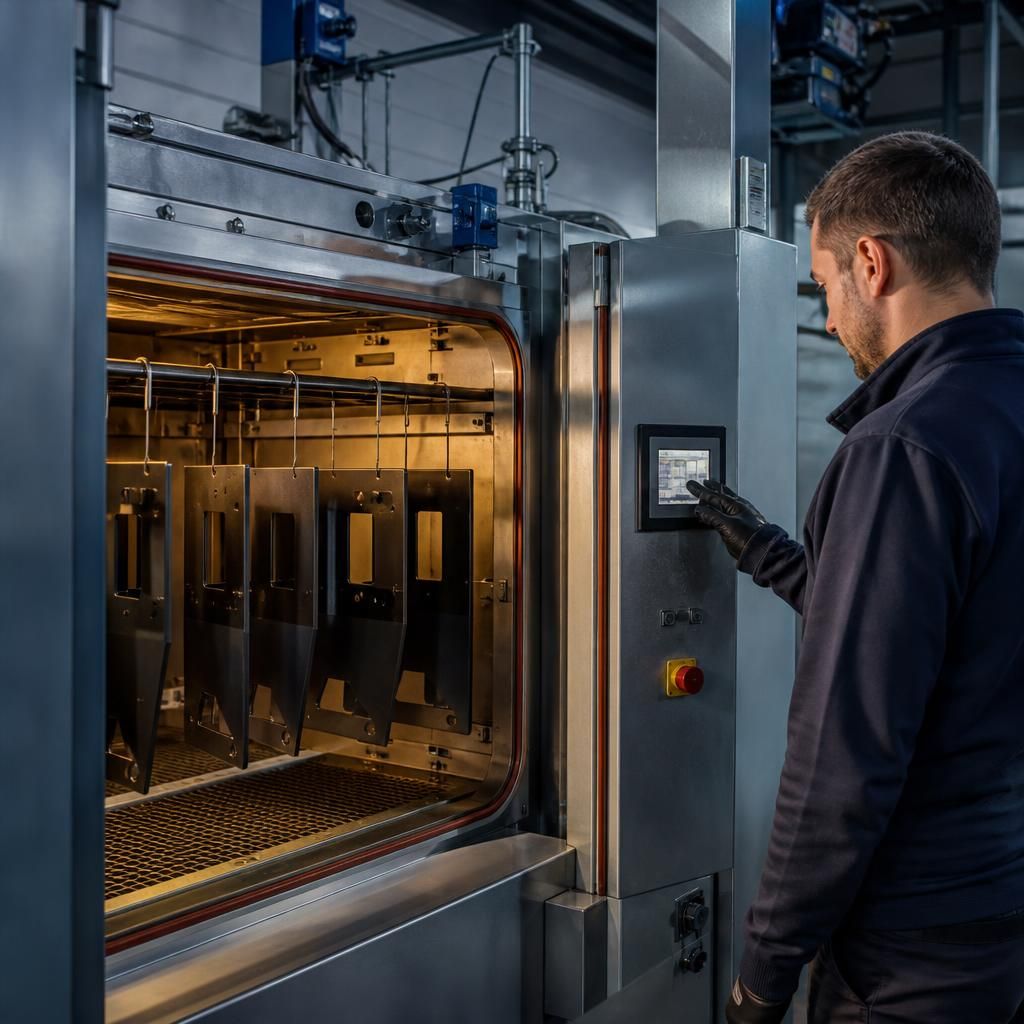
Powder coating cure schedules are not always interchangeable. A formulation may allow several time-and-temperature combinations, but a longer dwell at a lower temperature should only be used where the supplier’s technical data confirms that option. Increasing the temperature is not automatically equivalent to extending the bake, because the coating’s flow, cross-linking and resistance to thermal damage may respond differently across the permitted cure range.