

What maintenance processes are necessary to ensure optimal performance of high temp powder coating ovens?
Maintaining a high-temperature powder coating oven requires planned inspection, cleaning, calibration and servicing of its heating, airflow, conveyor and safety systems. Regularly removing powder residue, checking components for wear and verifying temperature uniformity helps preserve curing performance and consistent coating quality.
Optimal performance in a high-temperature powder coating oven depends on a documented preventative maintenance programme, not simply repairing faults when they occur. The process should combine planned servicing, condition monitoring, cure verification, safe isolation procedures and accurate maintenance records so that changes in oven performance are identified before they affect production.
Establish a maintenance schedule
Divide maintenance tasks according to their frequency and risk. Operators can complete basic condition checks as part of routine production control, while competent engineering personnel should carry out work on combustion, electrical, gas, control and safety systems. The oven manufacturer’s maintenance instructions should determine the required intervals, access procedures and replacement parts.
- Record the date, person responsible, observations and corrective action for each task.
- Separate operator checks from work requiring electrical, gas or combustion-system competence.
- Set inspection intervals according to oven usage, operating temperature, production load and the consequences of a failure.
- Review the schedule after breakdowns, process changes or repeated coating defects.
A written schedule also prevents important tasks from being overlooked when production priorities change. It should cover the oven itself, associated loading and unloading equipment, control devices, extraction arrangements and any ancillary equipment that affects the curing process.
Verify the heating and control system as a complete process
Temperature control should be assessed as a complete chain: the set point, sensor input, controller response, heat source and actual workpiece temperature must agree closely enough for the specified powder system. A displayed oven temperature alone does not confirm that parts have received the required cure.
Maintenance should therefore include checking sensor positioning, controller indications, alarm functions and the response of the system when the set point changes. Any sensor showing unstable readings, unusual drift or a slow response should be investigated rather than adjusted without identifying the cause. Where the oven uses gas or other combustion equipment, authorised personnel should assess ignition, flame supervision, fuel supply integrity and combustion performance in accordance with the equipment requirements.
Check thermal performance under representative conditions
After significant maintenance, control changes or suspected performance problems, carry out a temperature survey using suitable calibrated measuring equipment. The survey should reflect normal production: the same loading pattern, conveyor speed, part mass and temperature programme should be used where practical.
This process can identify cold areas, excessive variation between zones, heat recovery problems and differences between the air temperature and the temperature reached by the metal component. Results should be compared with the curing requirements of the powder being used and retained as part of the oven record. A new baseline is useful after major work, because it provides a reference for future troubleshooting.
Maintain airflow and heat distribution
Uniform heat depends on the oven’s airflow pattern as well as its heat source. Maintenance personnel should assess whether circulation fans, dampers, ducting and seals continue to operate in their intended positions. Abnormal vibration, noise, reduced airflow or a change in pressure may indicate a developing mechanical or balance problem.
Airflow checks should consider the production load. Large or densely packed components can restrict circulation and create temperature differences that are not present when the oven is empty. If the loading arrangement changes, the thermal survey and operating procedure should be reviewed rather than assuming that the previous settings remain suitable.
Protect the oven structure and thermal efficiency
Inspect the oven enclosure, access doors, seals and insulation for damage, distortion or deterioration. Poorly fitting doors and damaged insulation can allow heat loss, increase demand on the heating system and make temperature control less stable. Structural defects may also expose personnel to hot surfaces or allow contaminants to enter areas where they should not be present.
Repairs should use materials suitable for the oven’s operating temperature and environment. Temporary fixes that alter clearances, obstruct circulation or interfere with access panels should not be treated as permanent maintenance.
Service moving and loading equipment
Where the oven uses a conveyor, inspect the drive arrangement, bearings, guides, chain or belt, supports and load points for wear and alignment. The conveyor must move at a consistent rate so that parts receive a repeatable exposure time. Slipping, surging or unplanned stops can produce under-cured or overexposed work and may place excessive load on the drive system.
Loading fixtures also require attention. Warped, damaged or poorly balanced fixtures can affect part spacing, airflow and conveyor loading. Replace or repair them when they no longer hold components securely or maintain the intended clearance from the oven interior.
Test protective and emergency functions
Safety devices should be tested at planned intervals and after relevant maintenance. Depending on the oven design, this may include emergency stops, over-temperature protection, door interlocks, flame-failure protection, ventilation interlocks and alarms. A safety device should never be bypassed to keep production running.
Use a controlled isolation procedure before maintenance begins. Isolate electrical and fuel supplies as applicable, allow hot equipment to reach a safe condition, prevent unexpected start-up and confirm that stored energy has been controlled. Only authorised and suitably competent personnel should work on safety-critical, electrical or fuel systems.
Use coating results as maintenance evidence
Maintenance records should be reviewed alongside coating inspection results. Changes such as incomplete cure, loss of gloss, poor adhesion, colour variation, bubbling or inconsistent film performance may indicate a thermal, airflow, loading or control issue rather than a powder problem alone.
When a defect appears, record the part position, load arrangement, oven settings, cure conditions and any recent maintenance. This evidence helps distinguish an isolated application issue from a developing oven fault. Corrective action should be verified with a representative production load before the oven is returned to normal use.
Keep records audit-ready
A complete maintenance file should include service reports, temperature-survey results, calibration evidence for measuring equipment, alarm and interlock test results, component replacements and details of unresolved defects. Records should identify who completed the work and whether the oven was released for production afterwards.
This approach turns maintenance into a controlled process: prevent predictable failures, detect performance drift, confirm that repairs have worked and retain evidence that the oven remains suitable for the required curing operation.
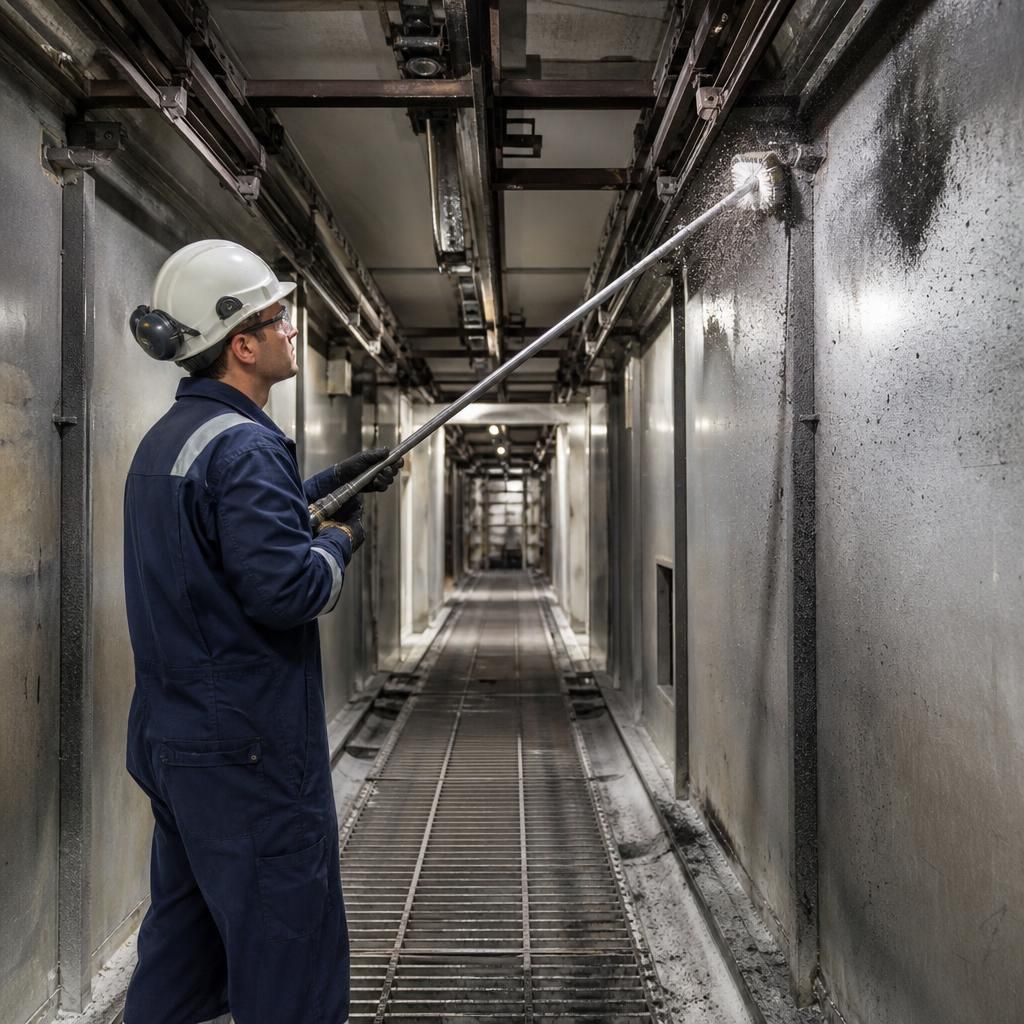
Regular cleaning of the oven interior and exhaust paths prevents accumulated powder residue from affecting coating quality and equipment operation. Inspect floors, walls, rails, ducting and accessible fan areas for deposits, particularly around loading points and locations where overspray can settle. Remove residue using methods suitable for the oven construction and powder system, avoiding actions that spread dust into burners, sensors or moving parts.
Cleaning should also include extraction components, filters and collection points where fitted. Record the areas cleaned, the condition of removed residue and any unusual contamination, such as oil, scale or flaking insulation. A sudden increase in deposits can indicate an application, airflow or housekeeping problem that needs investigating rather than simply increasing the cleaning frequency.
Plan Your High Temp Powder Coating Oven Maintenance Programme
If oven performance issues are affecting finished parts, speak to a powder-coating specialist about the coating specification, cure evidence and production requirements before changing process settings. Powder-coatings.co.uk supports manufacturers and fabricators with specialist powder coating for metal components, including protective coating applications.