

What factors should be considered when selecting a thermoset powder coating provider to ensure both quality and compliance with specific industry standards?
Select a thermoset powder coating provider by assessing its control of surface preparation, powder application and curing, along with inspection and batch traceability procedures. The provider should also be able to identify suitable coating systems, supply relevant technical documentation and demonstrate that its processes and finished components meet the standards required for your industry and application.
The right thermoset powder coating provider is one that can match the coating system and production method to the component’s service conditions, dimensional requirements and applicable industry rules. Quality and compliance depend on more than the appearance of the finished surface. The provider should understand the part’s substrate, geometry, end use, exposure conditions and acceptance criteria, then establish a clear specification that can be checked throughout the order.
Assess technical suitability for the component
Start by checking whether the provider regularly handles the type, size, weight and quantity of components involved. Large fabrications, intricate brackets, tubular sections and small precision parts can require different racking, masking, spraying and handling arrangements. Ask how the provider will deal with:
- recesses, apertures, sharp edges and internal faces;
- threaded holes, bearing seats, mating surfaces and close-tolerance areas;
- welds, casting imperfections, joints and areas prone to coating build-up;
- parts that need masking, plugs or temporary fixtures; and
- components that must be protected from damage during movement and packing.
A technically suitable provider should identify potential problems before production rather than treating every component as a standard flat surface. Thermoset powder forms a crosslinked film during curing, so errors in film build, masking or coverage cannot simply be corrected by melting the coating back into a usable state.
Match performance to the operating environment
The required finish should be selected according to how the coated part will be used. Indoor equipment, external architectural components, agricultural machinery and automotive parts may face very different combinations of moisture, sunlight, abrasion, cleaning chemicals, heat and impact. A provider should be able to discuss whether the proposed system is appropriate for the expected exposure, including:
- corrosion risk and the type of environment;
- ultraviolet exposure and colour retention;
- contact with oils, fuels, solvents or cleaning products;
- repeated handling, friction or impact; and
- operating temperatures and temperature changes.
The required colour, gloss level, texture and visual tolerance should also be recorded. A decorative finish may have different priorities from a protective industrial coating, while a component that will be assembled against another part may need controlled coating thickness on particular surfaces.
Check production control and repeatability
For batch work, ask how the provider maintains consistency between runs and manages changes in powder, colour, component design or order quantity. Useful points to clarify include powder storage, identification of materials, equipment cleaning between colours, rack loading, handling of repeat work and the method used to deal with non-conforming parts. These controls help reduce variation in appearance and performance without relying solely on a final visual check.
Capacity should be considered in practical terms rather than by headline equipment size. Confirm that the provider can accommodate the largest component, the required batch profile, the loading method and any special handling needs. It is also sensible to discuss sample approval or a first-article review where the finish, masking and coverage need to be agreed before a larger production run.
Examine the specification and records supplied
A quotation should identify more than a colour reference. The written scope should make clear the substrate, preparation assumptions, coating type, finish, masking requirements, critical dimensions, inspection criteria, packaging expectations and any testing required by the customer or end user. Ambiguity at this stage can lead to disagreement over whether a part is acceptable.
For regulated or contract-sensitive work, ask what records can accompany the order. Depending on the application, these may include product technical information, safety information, coating identification, cure-related records, inspection results and details of any approved deviation or rework. The records should be sufficiently clear for the buyer to show that the supplied finish corresponds with the agreed specification.
Verify relevant industry requirements
“Compliant” is not a single universal condition. The applicable requirements may come from a recognised standard, a sector-specific scheme, a customer specification, a drawing, a construction project requirement or an internal quality procedure. Identify which requirements apply before requesting a quotation, and ask the provider to state exactly what it can support and what evidence is available.
Do not assume that a general powder coating capability demonstrates compliance with a particular architectural, automotive, construction or engineering requirement. Check the scope of any claimed certification or approval, the conditions under which it applies and whether it covers the coating system, substrate and process required for the project. Where a standard calls for particular tests or acceptance limits, these should be agreed in advance rather than introduced after production.
Consider communication, packaging and responsibility
Reliable technical communication is an important selection factor. The provider should be willing to review drawings and samples, identify information gaps, record agreed changes and explain any limitations. Establish who is responsible for coating-related design decisions, masking dimensions, protection of machined surfaces and approval of the final appearance.
Packaging and return transport also affect quality. Parts should be protected from rubbing, impact, contamination and moisture after coating. For larger or delicate components, agree suitable separators, contact points and loading arrangements. A provider offering collection and delivery can be useful for Midlands manufacturers and fabricators, but the transport method still needs to suit the size, finish and handling sensitivity of the components.
Use a structured comparison
When comparing providers, assess technical fit, relevant experience, process control, evidence of compliance, handling capability, communication and the clarity of the quotation together. The lowest price may not represent the lowest overall risk if unclear assumptions lead to rework, rejected parts or an unsuitable finish. A well-defined specification and documented approval process make it easier to select a thermoset powder coating provider that can deliver a finish appropriate for the application and demonstrate conformity with the requirements that matter to the finished product.
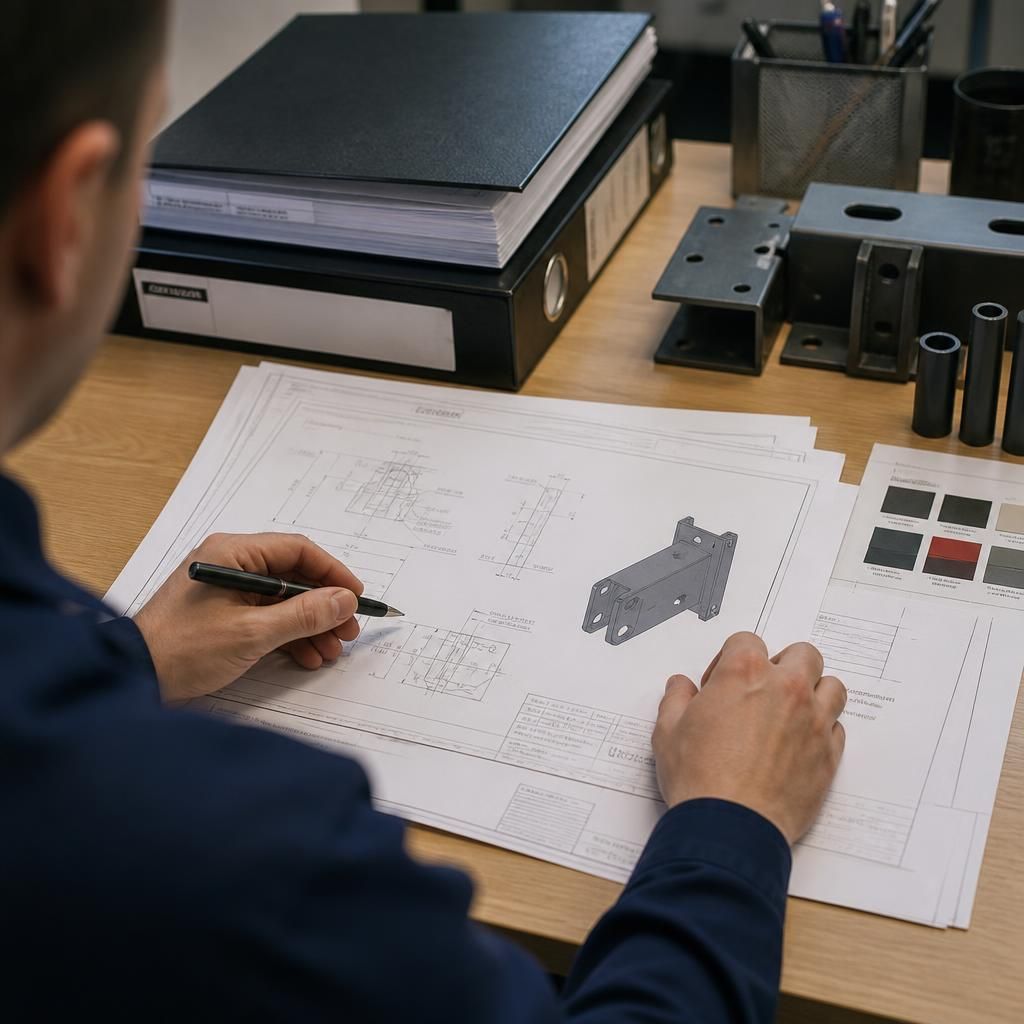
Document control is an important factor when selecting a thermoset powder coating provider, particularly where components are made to customer drawings or project specifications. The provider should work from the current revision of each drawing, coating requirement and inspection document, with a clear record of which version was approved for production.
It is also useful to establish which requirement takes precedence if a customer drawing, sector standard, coating specification or purchase order gives different instructions. Changes to colour, gloss, film thickness, masking or acceptance criteria should be reviewed and approved before they reach the production line. This controlled approach reduces the risk of coating parts to an obsolete instruction and gives both parties a clear basis for assessing conformity.