

What considerations should be made when selecting polyester powder coating for different industrial applications?
Select polyester powder coating by assessing the application’s exposure conditions, required durability, substrate and preparation needs, colour and finish, dimensional tolerances, and production requirements. Outdoor components typically require a weather-resistant grade, while indoor or less demanding parts may be specified around appearance, chemical resistance, impact performance and cost.
Choosing polyester powder coating for an industrial application involves matching the coating specification to the component’s service conditions, design, manufacturing process and required service life. The correct choice is not determined by colour alone: the powder chemistry, performance classification, film build, curing requirements and inspection criteria all need to be suitable for the finished part.
Define the performance requirement. Start with the failure modes that would make the component unacceptable. These may include loss of adhesion, corrosion at damaged areas, cracking during forming, chipping from handling, contamination from chemicals or deterioration of the surface appearance. A guard, enclosure, bracket, architectural component and automotive part may all use polyester powder, but they may require different grades and levels of performance.
Consider the polyester formulation. Polyester powders are available in different chemistries and performance classes. Common distinctions include TGIC-containing and TGIC-free systems, as well as standard and enhanced exterior formulations. The choice can affect cure behaviour, mechanical properties, weathering performance and the documentation required for the project. The powder manufacturer’s technical data should be checked rather than assuming that every polyester product has the same characteristics.
Match the coating to the environment. Atmospheric exposure should be assessed in practical terms, including moisture, condensation, salt, industrial pollutants, cleaning agents and ultraviolet radiation. A component installed beneath cover may not need the same specification as one exposed to rain and sunlight. Similarly, an item used near roads, coastal locations, production chemicals or wash-down areas may need a more carefully defined system than a component used in a dry internal environment.
Where corrosion protection is important, the polyester layer should be considered as part of a complete system. The substrate condition, pretreatment, primer requirement, edge coverage and likely damage during transport or installation can be as important as the topcoat itself. A specification should state whether a single-coat finish is adequate or whether a primer and polyester topcoat are needed.
Assess the component’s geometry. Deep recesses, sharp edges, folded returns, welds, perforations and enclosed sections can create uneven powder deposition or make cleaning and curing more difficult. Air entrapment in hollow components can also affect application and finish quality. Design details should therefore be reviewed before coating, particularly where the part will be suspended, masked or assembled on a production line.
Masking requirements deserve specific attention. Threads, bearing seats, electrical contact points, press-fit areas and close-tolerance faces may need to remain free from powder. The specification should identify these areas and allow for the thickness of the coating around them. If a component is assembled after coating, check that the coating will not interfere with fasteners, hinges, sliding parts or other interfaces.
Check dimensional and assembly requirements. Powder coating adds a measurable film to the surface, so the permitted build must be compatible with holes, slots, mating faces and moving parts. Tolerances should be agreed before production rather than corrected after coating. For precision components, it may be necessary to mask selected surfaces, machine them after coating or use a different finishing approach for specific contact areas.
Specify curing around the actual metal part. Powder is cured by bringing the component itself to the required metal temperature for the stated time; the oven air temperature alone does not confirm that the coating has cured correctly. Part mass, thickness, shape, loading and oven airflow can all influence the result. A heavy steel assembly and a light-gauge panel may need different line settings even when the same powder is used. Under-curing can affect adhesion and mechanical performance, while excessive heat exposure can alter the finish or damage the substrate.
Production trials are useful where components vary significantly in thickness or are being transferred to a new coating line. They can confirm that the chosen powder reaches the required cure window across the part, including difficult areas. The powder supplier’s technical data sheet should be used as the starting point for cure conditions, with the actual process verified on representative components.
Review handling and use after coating. Some parts face repeated impact, vibration, abrasion or contact with tools during installation. Others may be stored outdoors before assembly or cleaned regularly with detergents. These factors should be included in the specification because a coating that performs well in static service may require additional consideration where the component is frequently handled or rubbed.
Cleaning instructions are also relevant. Strong solvents, abrasive methods and unsuitable pressure-washing practices can affect the coating, particularly if the surface has already been damaged. For equipment used in hygiene-sensitive or process environments, confirm that the selected coating is compatible with the cleaning chemicals and disinfection regime involved.
Agree inspection and acceptance criteria. A useful specification defines how the finished parts will be assessed. Depending on the application, this may include visual uniformity, coating thickness, adhesion, cure, surface defects, masking accuracy and corrosion performance. Inspection should take account of the viewing distance and function of the component: a visible architectural panel may require tighter appearance control than a concealed structural bracket, while a functional part may place greater emphasis on dimensional accuracy.
It is also important to agree how weld spatter, sharp edges, pinholes, inclusions, craters and local variations will be treated. Clear acceptance criteria reduce disputes and help distinguish a genuine performance issue from an imperfection that has no practical effect on the component.
Consider batch control and traceability. Large or repeated production runs benefit from consistent powder supply, controlled storage and recorded process settings. Powder should be stored in accordance with the supplier’s instructions, and reclaimed material should only be used where the process and specification permit it. Batch identification, cure records and inspection results can be valuable when components form part of a regulated, safety-related or long-life installation.
Compare whole-life cost rather than powder price alone. The lowest material cost may not represent the most economical specification if it leads to additional masking, rejects, rework, premature maintenance or difficult installation. Conversely, an unnecessarily high-performance grade can add cost without providing a useful benefit. The most appropriate polyester powder coating is the one that satisfies the real service, production and compliance requirements without over-specifying the component.
For a sound selection, provide the coater with the substrate, component drawings, service environment, expected handling, masking points, dimensional tolerances, cure limitations and any relevant project standard. That information allows the coating system and process to be assessed together, rather than choosing a powder in isolation from the way the part will be manufactured and used.
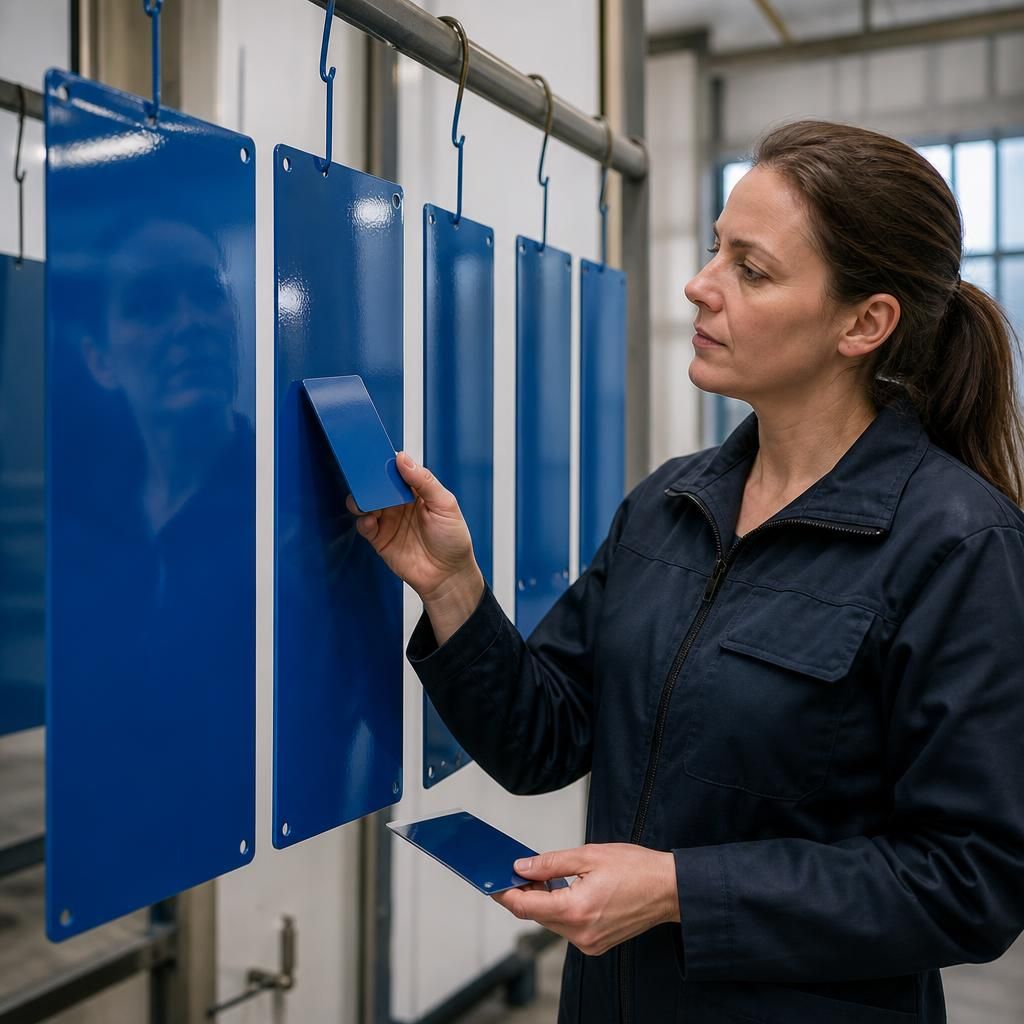
Appearance should be specified as carefully as protection. Define the required colour, gloss level and surface texture, then approve a representative sample before production. A smooth, high-gloss finish will present differently from a matt or textured finish, while the same colour can appear to vary under different lighting conditions.
Where parts are visible or installed alongside existing components, assess the sample on the intended substrate and at the expected viewing distance. Record the agreed colour reference, gloss, texture and acceptable visual variation so that production batches can be assessed consistently. This is particularly important for projects involving replacement parts, repeated deliveries or components that will be seen together.