

What specific considerations should be made when selecting between flat and textured black powder coat finishes for components exposed to environmental elements?
When selecting between flat and textured black powder coat for components exposed to environmental elements, consider the required appearance, the visibility of surface imperfections, and how readily dirt, moisture and contaminants can be removed. Flat finishes provide a smoother, more uniform appearance, while textured finishes can disguise minor surface irregularities and offer a more tactile surface; however, outdoor durability depends primarily on suitable pretreatment, powder specification and application quality rather than texture alone.
The choice between a flat and textured black powder coat for outdoor components should be based on the severity of exposure, the specified coating system, the component’s design and the way it will be handled and maintained. Texture alone does not determine weather resistance: a suitable exterior-grade powder, correctly prepared substrate and controlled application are more important than whether the surface is flat or textured.
Assess the environmental exposure first. Components exposed to direct sunlight need a formulation with appropriate resistance to ultraviolet degradation, including unwanted colour change, chalking and loss of surface properties. Coastal locations, roads treated with de-icing salts, industrial atmospheres and areas with persistent condensation introduce greater corrosion risks than sheltered urban installations. Where exposure is severe, the specification should identify the expected corrosivity conditions and require a coating system tested or selected for that environment, rather than relying on the colour or texture description alone.
Rainwater is not usually harmful to an intact coating by itself, but repeated wetting and drying can expose weaknesses at cut edges, joints, fasteners and damaged areas. Components should therefore be designed and finished so that water does not remain trapped in crevices or collect around unsealed interfaces. Drainage holes, suitable joint details and attention to end faces can be as important as the visible black finish when long-term outdoor service is the objective.
Consider the component’s geometry. Flat black powder coat may be the more straightforward option for panels, covers and profiles with broad, accessible faces. Textured powder can be appropriate for components where a more substantial surface is required, but the geometry still needs to allow consistent coverage. Deep recesses, sharp internal corners, perforations and narrow returns can create areas of uneven film build if the parts are not suitably prepared, hung and coated. The selected finish should be confirmed against drawings or representative samples where the component has complex features.
Edges deserve particular attention. Powder coating tends to provide less protection at very sharp edges than on broad faces, and corrosion can begin at an edge after impact or prolonged environmental exposure. Specifying radiused edges where practical, ensuring adequate pretreatment and checking coverage at vulnerable locations will generally have a greater effect on service performance than changing from flat to textured black.
Match the finish to mechanical use as well as weather. Outdoor components may be exposed to contact from tools, pallets, vehicles, footwear or adjacent metalwork. A textured surface can alter the way contact is distributed and may be suitable where the part requires a more pronounced tactile finish, but it should not be assumed to be universally more impact- or abrasion-resistant. The powder specification, cured film properties, substrate and actual contact conditions must be considered together.
Where parts are assembled after coating, allow for damage caused by fasteners, clamps and sliding interfaces. A finish that is satisfactory on an exposed face may not remain intact where components rub together or where a fastener cuts through the film. If the coating is breached, the repair method should be agreed in advance, particularly for black finishes where differences in sheen or texture can be noticeable across the repaired area.
Check application and curing requirements. Flat and textured powders can respond differently to application settings, film thickness and curing conditions. Textured finishes depend on the coating being applied and cured within the supplier’s specified parameters so that the intended texture develops consistently. Excessive or insufficient film build can affect appearance and may also create problems around edges, recesses and mating surfaces. Parts should be assessed as a complete coating system, including pretreatment, powder selection, application and cure, rather than judged by the finish name alone.
For large or batch-manufactured components, agree how consistency will be assessed. The reference should cover colour, degree of texture, sheen, coverage and acceptable variation under suitable lighting. This is particularly useful when components are produced in separate batches or by different processes, because a nominally identical black finish can appear different if the powder, substrate preparation or curing conditions change.
Include inspection and maintenance in the decision. Outdoor parts should be inspected periodically for impact damage, corrosion at joints and edges, cracking, blistering or changes associated with ultraviolet exposure. The inspection method should be practical for the installation: a component that cannot be accessed easily may justify a more conservative specification than one that can be examined and repaired routinely.
Maintenance instructions should identify suitable cleaning materials and prohibit methods that could abrade the coating or leave aggressive residues. Any damage should be dealt with before corrosion spreads beneath the surrounding film. For textured finishes, repairs may require greater care to reproduce the original surface profile; for either finish, a small approved repair area should be checked before wider work is carried out.
In practice, select the finish by documenting the exposure, substrate, component geometry, expected contact and repair requirements, then confirm that the proposed black powder coating is intended for that service environment. A coating specialist can use drawings, substrate details and the intended installation conditions to determine whether a flat or textured system is the more appropriate specification.
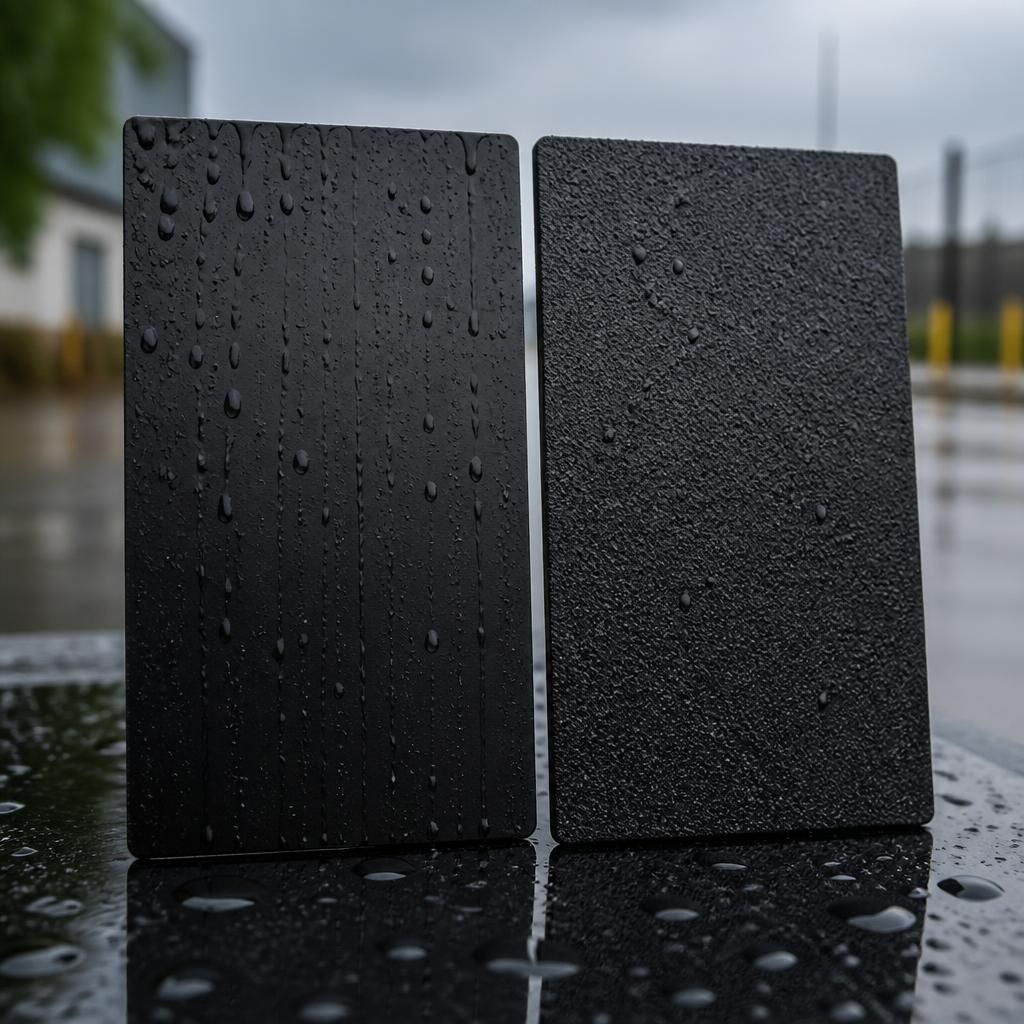
Outdoor lighting and surface wetting can change how a black finish is perceived. A flat coating produces a more continuous visual field, so variations in sheen, water marks and local surface defects may be easier to notice. A textured coating scatters reflected light and can make minor visual variation less apparent, but its appearance may change more noticeably with viewing angle. For prominent components, assess representative samples in the expected orientation and under both dry and wet conditions before approving the finish.
Discuss Your Flat or Textured Black Powder Coat Requirements
Discuss your component drawings, substrate and installation conditions with Powder-coatings.co.uk to assess whether a flat or textured black powder coat is the more suitable specification. Representative samples can also help confirm the required appearance before production.