

How do zinc and fusion bonded coatings perform under extreme temperature fluctuations, and what precautions should be taken to ensure durability in such conditions?
Zinc and fusion bonded coatings can withstand substantial temperature fluctuations when correctly specified and applied, but repeated expansion and contraction may stress the coating and substrate. Durability depends on selecting a suitable coating system, preparing the metal thoroughly, controlling application and curing conditions, and allowing for service temperatures, thermal cycling and possible moisture ingress.
Zinc and fusion bonded epoxy (FBE) coatings can remain effective through substantial temperature variation, but their performance depends on the difference between a short-term temperature excursion and prolonged exposure at an elevated or very low service temperature. Zinc protects steel primarily through a sacrificial electrochemical action, while FBE forms a sealed barrier over the substrate. Both systems can be affected by repeated dimensional movement, changes in coating flexibility and moisture entering defects or interfaces.
How temperature affects zinc coatings: Zinc has useful resistance to thermal cycling because it remains closely bonded to the steel and can tolerate normal expansion and contraction of the substrate. However, sustained heat can accelerate oxidation and reduce the coating’s remaining thickness over time, particularly where moisture, pollutants or salts are present. At low temperatures, zinc itself does not normally become a flexible polymer coating; the greater concern is movement in the steel, joint design and any additional coating applied over the zinc.
Temperature changes can also affect the electrochemical protection provided by zinc. The rate of corrosion reactions generally changes with temperature, and condensation during cooling can create an electrolyte on exposed or damaged areas. If the component repeatedly passes through the dew point, water may form on the surface even where no rain is present. This makes drainage, sealing and protection of cut edges important parts of the design.
How temperature affects FBE: FBE is a thermoset coating, so it does not simply melt and resolidify when heated. Nevertheless, its flexibility, hardness and resistance to impact vary with temperature. Prolonged exposure near the upper service limit can cause softening, loss of mechanical strength or accelerated ageing. At low temperatures, the coating can become less flexible and more vulnerable to impact, bending or cracking if the metal underneath moves.
Repeated movement is often more significant than the highest temperature reached. A coating may tolerate an isolated hot or cold event but gradually develop fine cracking, loss of adhesion or damage at edges after many heating and cooling cycles. The risk increases where a thin component changes temperature quickly while a thicker bracket, weld, fastener or attached structure remains at a different temperature. These differential movements place extra stress on the coating film.
Key precautions for temperature-variable service include:
- Define the complete service range, including normal operating temperature, short-term excursions, start-up and shutdown conditions, storage temperatures and the number and frequency of expected cycles.
- Distinguish between the temperature of the surrounding air and the actual temperature of the coated steel. Pipes, housings and components exposed to process heat can have substantially different surface temperatures from the surrounding environment.
- Select a coating system whose documented service limits cover both the temperature range and the expected mechanical conditions. The highest temperature alone is not enough; cycling rate, immersion, abrasion, flexibility and chemical exposure must also be considered.
- Account for thermal expansion in the component design. Long sections, restrained assemblies, sharp transitions, welds, holes and connections can concentrate stress as the metal expands and contracts.
- Use suitable edge treatment and avoid abrupt coating thickness changes. Edges and corners are more likely to receive a thinner film and are common starting points for damage during thermal movement.
- Prevent water from being trapped against the coating or inside hollow sections. Drainage, sealed joints where appropriate and correctly designed vents reduce the risk of condensation, freeze-thaw damage and corrosion beneath a defect.
- Pay particular attention to welds, threaded areas, cut ends and handling damage. These locations may have different surface characteristics from the main steel and can become failure points during temperature cycling.
Where zinc is used beneath or alongside another protective layer, compatibility is important. The two layers must remain bonded while the substrate changes dimension. A topcoat that is too rigid, poorly bonded or unsuitable for the zinc surface can crack or detach even if the zinc remains protective. Conversely, damage to an FBE barrier may expose the steel locally, making the condition and continuity of any zinc layer beneath it significant.
Preparation and application controls remain relevant specifically because thermal cycling exposes weak areas. Contamination, inadequate surface profile, trapped moisture, uneven film thickness and insufficiently cured material can all reduce resistance to expansion and contraction. These defects may not be obvious immediately after coating but can develop into blistering, delamination or corrosion paths when the component repeatedly changes temperature.
Inspection should reflect the intended service: visual examination should be combined with appropriate checks for continuity, adhesion or film condition where the risk justifies them. Particular attention should be given to pinholes, inclusions, thin areas, impact marks and coating holidays. For critical applications, representative coated samples or test sections can be exposed to thermal cycling, followed by inspection for cracking, blistering, adhesion loss and corrosion at artificial defects. The test programme should reproduce the relevant temperature transitions rather than relying only on a single high-temperature exposure.
During transport, installation and maintenance, avoid subjecting a cold or hot coating to sudden impact, bending or abrasion. If a repair is needed, the damaged area should be cleaned back to sound material, assessed for any corrosion beneath the coating and repaired with a compatible system suitable for the service temperature. Repairs should not merely cover visible damage while leaving moisture or corrosion trapped underneath.
In practical terms, zinc is often valuable where sacrificial protection and tolerance of minor surface damage are important, while FBE is valuable where a continuous barrier and resistance to a defined chemical or immersion environment are required. Neither should be judged by temperature alone. The reliable choice is the system that matches the metal, joint design, thermal cycle, moisture conditions, mechanical loading and maintenance arrangements of the finished component.
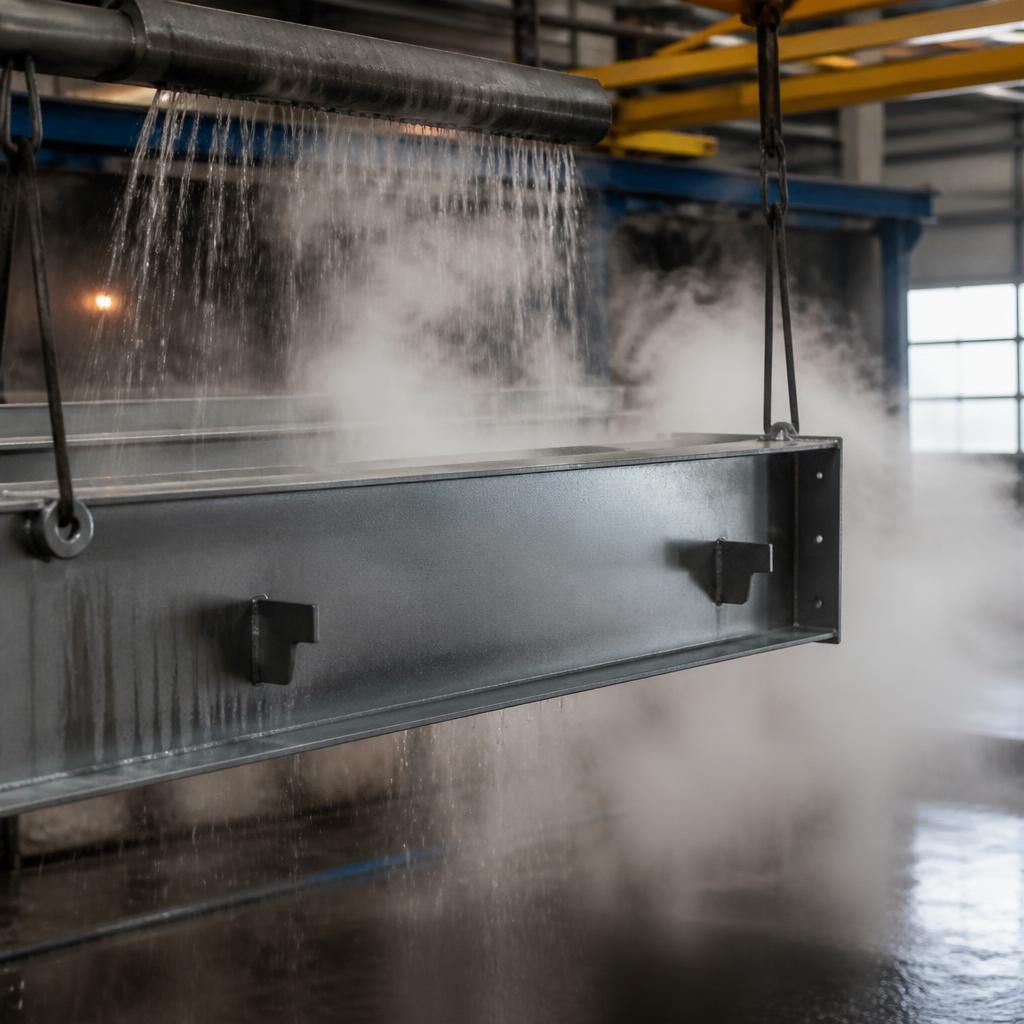
Thermal shock is a separate risk from simply reaching a high or low temperature. It occurs when the surface of a coated component changes temperature faster than the underlying metal, creating a temporary temperature gradient through the coating and substrate. That uneven movement can increase stress at welds, edges, joints and areas where the component changes thickness.
Where operating conditions allow, control the rate of heating and cooling rather than exposing the component to abrupt transitions. Avoid applying cold water to a hot coated surface, moving a chilled component directly into a heated process, or subjecting a recently heated coating to impact before temperatures have equalised. Operating procedures should also identify washdown, steam cleaning, process changes and shutdowns as potential thermal-shock events. Recording these conditions helps determine whether the coating system is being exposed to a more severe duty cycle than its nominal service temperature suggests.