

What is the impact of surface profile and cleanliness level on powder coating adhesion and durability?
Surface profile and cleanliness directly affect how well powder coating bonds to metal and how long that bond remains intact. A suitable profile provides a consistent key for the coating, while removing rust, scale, oil, dust and other contaminants prevents weak spots, blistering, peeling and premature corrosion.
Surface preparation determines both the mechanical key available to a powder coating and the chemical condition of the metal beneath it. The correct result is not simply the roughest or brightest surface possible: it is a consistent, suitably textured substrate that is free from substances capable of interfering with wetting, curing or corrosion protection.
Surface profile describes the peaks and valleys created by abrasive blasting. These irregularities increase the effective area available for the coating to grip and can improve resistance to mechanical damage when the profile is appropriate for the coating system and the component. A profile that is too shallow may provide insufficient anchorage, particularly where the part will experience abrasion, impact or outdoor exposure. A profile that is too deep can also be detrimental because the powder may not fully cover the valleys, leaving thin areas at the base of the profile and creating locations where corrosion can begin.
Uniformity matters as much as average roughness. A part with heavily blasted areas alongside smooth areas may receive the same powder film but develop different levels of adhesion and protection. Coating thickness can vary across sharp peaks, recesses, welds and edges, so localised defects may occur even when the overall surface appears acceptable. The selected abrasive, air pressure, nozzle distance, angle and dwell time should therefore be controlled to produce a consistent finish rather than an unnecessarily aggressive one.
Cleanliness level concerns the removal of materials that remain on, or react with, the substrate. These may include rust, mill scale, old coatings, abrasive residue, oil, grease, cutting fluids, dust, welding residues and soluble salts. Some contaminants are visible, while others form a thin film that may not be detected by appearance alone. A surface can look clean after blasting yet still contain oil or salts that reduce adhesion and promote corrosion beneath the coating.
Contamination affects the coating in several ways:
- Oil and grease can prevent the powder from wetting the metal evenly, causing craters, fisheyes or areas of poor bonding.
- Dust and loose abrasive particles can become trapped between the substrate and the coating, creating weak interfaces and rough blemishes.
- Rust and mill scale may detach after coating, taking the powder film with them or leaving corrosion cells beneath it.
- Soluble salts can attract moisture through the coating and contribute to osmotic blistering, underfilm corrosion and eventual delamination.
- Welding residues, heat tint and spatter can produce local differences in surface chemistry and profile, particularly around joints.
The required cleanliness level depends on the original condition of the metal, the intended environment and the performance demanded from the finished component. An internal part exposed to limited handling may not require the same preparation standard as structural steel, outdoor equipment or a component exposed to moisture, road contaminants or industrial chemicals. The specification should identify the preparation grade, acceptable profile range and inspection method rather than relying on descriptions such as “well blasted” or “clean to view”.
Preparation must also account for the substrate itself. Steel, galvanised steel, aluminium and previously coated metal respond differently to blasting. Excessive treatment can distort thin sections, round edges, embed abrasive or damage a protective zinc layer. Aluminium may require a gentler approach to avoid an uneven or overly pronounced profile, while galvanised surfaces need preparation that supports adhesion without unnecessarily removing the zinc protection. Previously coated components require particular care because any remaining coating must be firmly bonded and compatible with the proposed system.
Edges, corners, holes and welds often determine whether preparation has been successful. Sharp edges can receive a thinner powder film than broad faces, while recessed areas may not be reached evenly by the abrasive stream. Weld spatter, sharp projections and porous welds can cause pinholes, contamination or local coating failure. Deburring, removing spatter and checking weld quality before blasting helps create a more consistent surface for powder application. Drainage and vent holes may also be needed on fabricated hollow sections so that pretreatment materials do not become trapped.
A practical preparation and coating sequence usually includes the following controls:
- Inspect the incoming component for rust, mill scale, oil, previous coatings, damage, weld defects and areas that may be difficult to access.
- Remove heavy contamination before blasting so that grease and other substances are not spread across the surface or driven into the substrate.
- Select an abrasive and blasting method suitable for the metal, the required profile and the intended coating service.
- Check the blasted surface for remaining contamination, embedded media, uneven preparation and areas that have been missed.
- Measure or verify the profile using an appropriate comparison method or instrument where the specification requires objective control.
- Protect the prepared surface from handling contamination and apply the powder within the permitted preparation window for the coating system.
Inspection should consider more than visual brightness. A visual assessment can identify remaining rust, scale, old coating and obvious dust, but it cannot reliably confirm the absence of invisible salts or establish the actual profile depth. Depending on the component and specification, checks may include surface-profile measurements, dust assessments, soluble-salt testing, solvent checks for oily contamination and inspection under suitable lighting. The prepared surface should also be assessed after handling, because fingerprints, workshop dust and contact with dirty lifting equipment can reintroduce contamination.
Overblasting is not a substitute for cleanliness. It may remove visible scale while creating excessive roughness, thinning a component or embedding abrasive particles. Similarly, a highly polished surface is not automatically better: if it has been produced without removing corrosion products or has become contaminated afterwards, the apparent finish can conceal a poor bonding surface. The objective is controlled preparation matched to the powder coating and the service conditions.
When adhesion problems arise, the failure pattern can help identify the preparation issue. Peeling that follows rusted areas may indicate remaining corrosion or inadequate removal of scale. Localised craters may point to oil, grease or silicone contamination. Blistering can be associated with trapped moisture or soluble salts, while thin, prematurely corroded lines may correspond to deep blast valleys or sharp edges. Adhesion testing of a representative coated area can provide useful evidence, but it should be interpreted alongside preparation records, coating thickness checks and an examination of the failed interface.
For industrial components, the most reliable approach is to agree the preparation standard before work begins and to relate it to the metal type, coating specification and operating environment. Powder-coating specialists serving manufacturers, fabricators, construction firms and automotive businesses can assess the component condition, recommend suitable blasting controls and identify design features that may affect preparation and coating coverage. This is particularly important for batch work, large fabricated parts and components requiring specialist protective finishes.
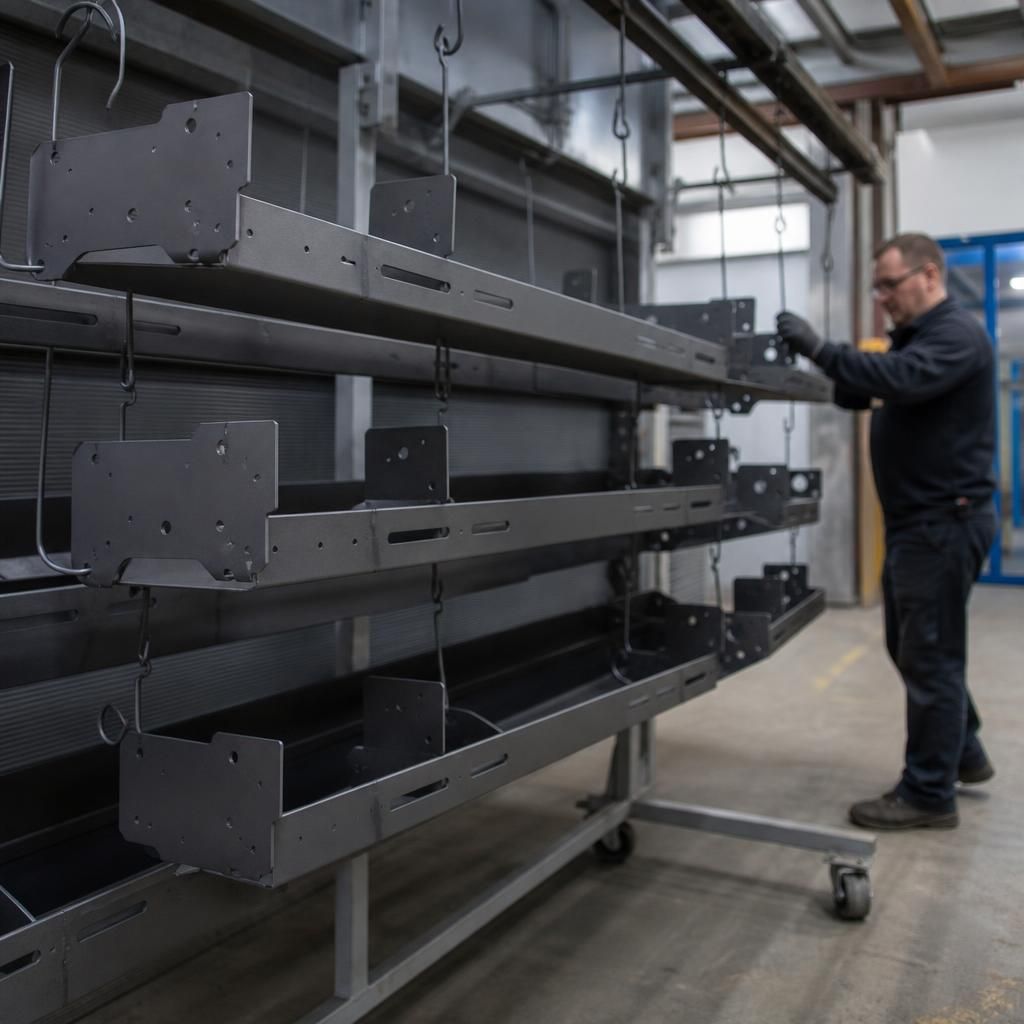
The interval between blasting and powder application can affect the achieved cleanliness level. Bare steel exposed to humid air may develop flash rust or a thin layer of condensation before coating, even when the surface was properly prepared initially. This can weaken the coating interface and reduce corrosion protection.
Prepared components should therefore be kept dry, handled with clean equipment and protected from conditions that allow moisture to form on the metal. If visible rust, condensation or other contamination appears before coating, the affected area should be reassessed and prepared again rather than coated over. Controlling this transition from blasting to application helps preserve the surface condition on which adhesion depends.