

What technologies and equipment are used in industrial powder coating to ensure consistent, high-quality finishes?
Industrial powder coating uses controlled pretreatment systems, electrostatic spray equipment, curing ovens and inspection tools to produce repeatable finishes. Powder delivery, gun settings, film-thickness checks and oven temperature control are monitored so coatings achieve consistent coverage, adhesion and curing across individual parts and production batches.
Consistent industrial powder coating depends on an integrated production system rather than a single machine. The key technologies include automated material handling, booth airflow management, electrostatic application controls, controlled curing, component fixturing and process data recording. Together, these systems help maintain an even coating on complex metal parts, repeat results between batches and reduce defects caused by contamination, poor grounding or inconsistent handling.
Material handling and line design
Conveyor systems, lifting equipment and purpose-built loading stations move components through each stage without unnecessary contact with prepared surfaces. The handling method must suit the size, weight and geometry of the work. Large fabrications may require overhead conveyors, lifting frames or mobile fixtures, while smaller batch components can be mounted on removable racks or hanging bars.
Good line design also separates dirty and clean operations. This reduces the risk of dust, oil or overspray reaching prepared components. Racks and hooks are selected to provide stable support while leaving sufficient exposed surface for coating. Contact points are positioned carefully because they can interrupt electrical continuity or leave small uncoated areas that need attention after processing.
Booths, airflow and recovery systems
The spray booth provides an enclosed environment in which airborne powder can be controlled. Extraction units create a planned airflow that draws excess powder away from the operator and the component without disturbing the deposited coating. Filters, ducting and extraction performance therefore have a direct effect on cleanliness, visibility and powder containment.
Many industrial systems also include powder recovery equipment. Recovered material may be filtered and handled separately from unused powder, subject to the coating specification and colour-management requirements. Effective recovery reduces contamination between colours and helps prevent overspray from accumulating on booth surfaces, filters or nearby equipment. Booth construction and cleaning procedures are particularly important when several colours or coating types are processed.
Automated application equipment
Reciprocators and multi-gun arrangements can provide more uniform coverage than relying solely on manual movement, particularly when components are repeated in a production batch. Automatic gun paths can be adjusted for component height, width and profile, while manual application remains useful for recesses, edges, internal surfaces and irregular fabrications.
The most suitable system often combines automation with skilled operator control. Operators assess areas that are difficult for fixed gun positions to reach and adjust the sequence or application method accordingly. This is important for frames, enclosures, brackets, fabricated assemblies and parts with deep channels, where line-of-sight limitations can produce thin areas or excessive build-up.
Electrical control and grounding
Electrostatic application relies on a reliable electrical path between the component and the equipment. Earthing points, hanging fixtures and contact surfaces must remain clean enough to maintain continuity. Poor grounding can reduce transfer efficiency and cause uneven deposition, while unsuitable hooks can leave inconsistent contact marks.
Modern control systems allow application parameters to be set according to the powder specification, component geometry and production method. Repeatable programmes are useful for recurring work because they reduce variation when the same part is processed again. They do not remove the need for checks: the selected settings still have to be suitable for the substrate, shape and required finish.
Oven technology and heat distribution
Curing equipment must deliver sufficient heat to the metal part, not merely warm the surrounding air. Industrial ovens therefore use designed airflow patterns, insulated chambers and controlled heating zones to produce a stable thermal environment. The oven arrangement may use convection, infrared assistance or a combination of methods, depending on the component mass, geometry and coating system.
Heavy fabrications and thin sheet components respond differently to heat. A thick section takes longer to reach the required metal temperature, whereas a thin section can heat rapidly. Oven design and conveyor settings must account for this difference so that the coating develops its intended properties without under-curing or excessive heat exposure. Data logging can provide a record of the thermal cycle for repeat production and process investigation.
Masking, fixturing and edge protection
Silicone plugs, caps, tapes and purpose-made masks protect threads, bores, electrical contact points and close-tolerance faces from unwanted powder. Their temperature resistance and positioning must be compatible with the curing process. Poorly fitted masking can allow powder into protected areas or create sharp transitions at the coating edge.
Fixtures also influence the final appearance. They should support the component without obstructing important faces and should allow powder to reach edges and recessed features. For complex parts, a fixture may be designed specifically to control orientation during spraying and curing. This is an equipment decision as much as a preparation decision, because the wrong orientation can encourage runs, uneven deposition or trapped powder.
Process monitoring and traceability
Industrial coating operations commonly use control records to link a batch to its powder specification, preparation route, equipment settings and curing cycle. Recording this information makes it easier to investigate variation and reproduce an approved finish on subsequent work. Some systems connect sensors and controllers to a central interface, allowing alarms or deviations to be identified before a full batch is completed.
Quality assessment can include visual comparison under consistent lighting, adhesion checks, cure-related tests and dimensional checks on masked or close-tolerance areas. The appropriate combination depends on the component’s function and the purchaser’s specification. Inspection is most effective when it is supported by stable equipment settings and disciplined handling rather than used only to find defects at the end.
For large or varied metal components, the best equipment configuration balances automation with flexibility. A specialist industrial powder coating facility can select conveyors, fixtures, booth arrangements and curing methods around the part design, batch size and required performance. This approach is more dependable than applying one fixed setup to every component, particularly where manufacturers, fabricators, construction firms and automotive businesses send different forms of metalwork for processing.
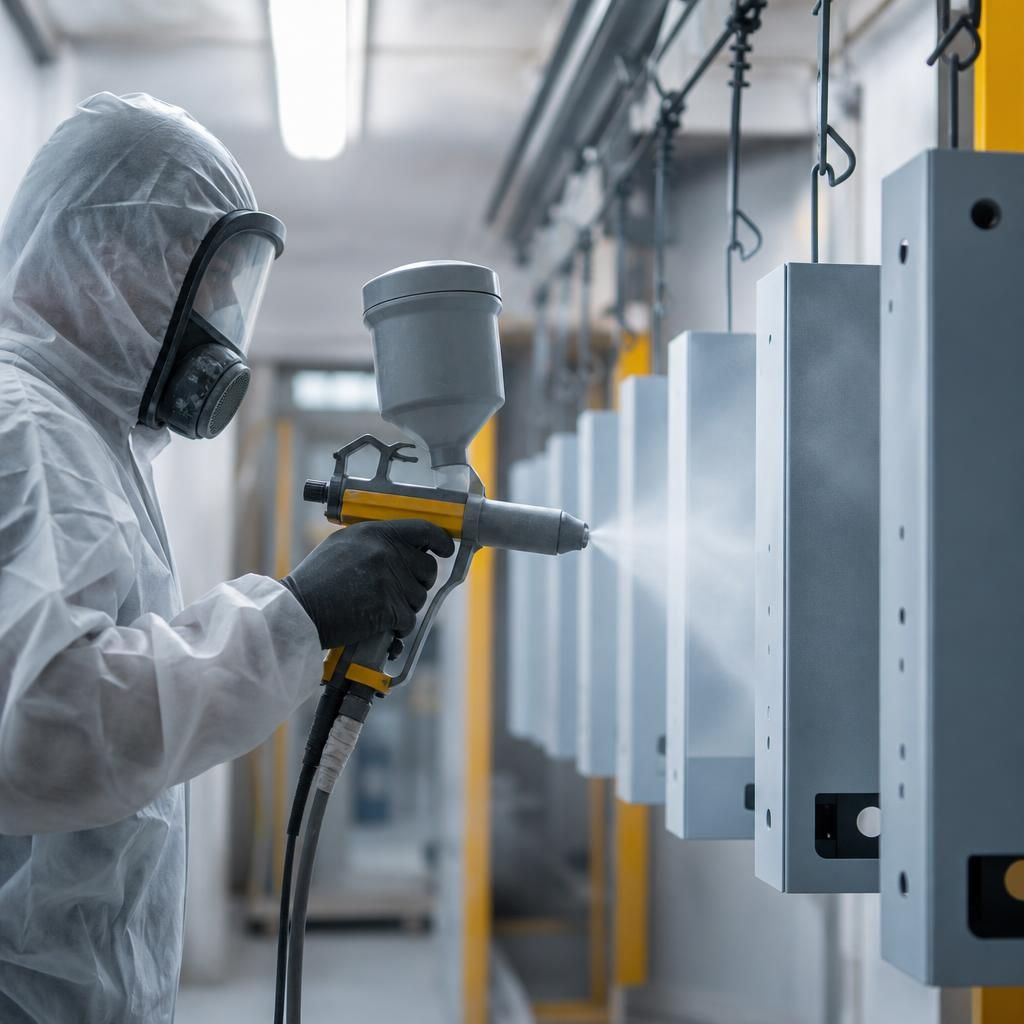
Electrostatic powder application technology gives powder particles an electrical charge so they are attracted to the earthed metal component. Industrial spray guns may use corona charging, in which a high-voltage electrode transfers charge to the powder, or triboelectric charging, in which friction within the gun creates the charge. The appropriate method depends on the powder formulation, component geometry and finish requirements.
Application controls can regulate voltage, current and powder delivery so the operator can match the charge to the part. Settings may need adjustment for recessed areas, thin edges and complex profiles, where excessive charge can limit penetration or encourage uneven build-up. Correctly selected charging equipment helps produce stable deposition and supports consistent coverage across repeat batches.