

How does the surface texture achieved during abrasion impact the adhesion of nylon powder coating?
The abrasion texture directly affects nylon powder coating adhesion by creating a clean mechanical key for the coating to grip. A surface that is too smooth may provide insufficient purchase, while excessive roughness can leave peaks, valleys or trapped debris that interfere with even coverage and reduce adhesion.
A controlled, uniform abrasion texture generally produces the most reliable adhesion for nylon powder coating. The objective is not to make the metal as rough as possible, but to create a consistent surface profile that the molten nylon can wet and lock into without leaving uncoated recesses, loose particles or unstable edges.
Texture affects adhesion through several related factors:
- Mechanical interlocking: the coating flows around the fine irregularities created by abrasion and forms a physical key as it cools.
- Effective contact area: a suitably developed profile gives the coating more metal surface to contact than an unprepared, smooth surface.
- Surface energy and wettability: abrasion removes some surface contamination and exposes fresh metal, allowing the coating to spread more consistently during application and heating.
- Stress distribution: a uniform profile helps distribute stresses through the coating interface. Isolated sharp peaks or deep grooves can create local weak points as the coating contracts during cooling or experiences service loads.
The shape of the profile is as important as its apparent depth. Fine, closely spaced irregularities usually provide a more dependable key than a surface marked by random gouges. Deep, narrow scratches can be difficult for nylon powder to fill completely, particularly where the applied film is relatively thin. This can leave air pockets, uncoated recesses or areas with reduced effective contact. Conversely, broad, shallow marks may alter the appearance without providing a sufficiently stable mechanical key.
Abrasion can also cause problems when it changes the metal rather than simply preparing it. Excessive pressure from abrasive tools may smear softer metals across the surface, close the openings between surface irregularities or create raised burrs. Aggressive blasting can embed abrasive particles, fracture brittle edges or produce a profile that varies significantly from one area to another. These defects may not be obvious under casual inspection, but they can interfere with coating wetting and become initiation points for lifting or corrosion beneath the coating.
The preparation method should therefore suit the substrate, component geometry and required finish. Abrasive media and pressure need to be selected so that they remove oxides, mill scale or existing surface residues without distorting thin sections or damaging machined features. Flat faces, internal corners, welds and recessed areas should receive particular attention because the abrasive action may be weaker or more concentrated in these locations. A component that appears consistently rough overall can still have local areas with a materially different profile.
Cleanliness must be controlled before and after abrasion. Oils, grease and processing residues should be removed before abrasive work so they are not spread across the metal or driven into the surface. After abrasion, loose dust, spent media and any newly exposed residue need to be removed using a method that does not re-contaminate the part. Handling should also avoid transferring skin oils or workshop dirt onto the prepared surface. If the metal is left exposed after preparation, oxidation or moisture contamination can change the interface before nylon powder is applied.
A practical preparation check should consider uniformity rather than relying only on touch. Suitable checks may include:
- visual examination under consistent lighting for bare areas, polishing, embedded media, burrs and deep isolated scratches;
- inspection of edges, welds, corners and recesses where the abrasion pattern may differ;
- use of an appropriate surface-profile comparator or measurement method where the specification requires a defined profile;
- confirmation that dust and loose particles have been removed;
- verification that the prepared metal has not been exposed to renewed oil, moisture or other contamination before coating.
There is no single texture that suits every nylon powder coating job. The appropriate profile depends on the metal, the abrasive process, the coating formulation, the expected film build and the service conditions. The coater should work to the relevant coating specification and confirm that the selected preparation method produces a repeatable result on the actual component, rather than transferring a setting from a different substrate or part design.
Adhesion should be assessed after the complete coating process, not inferred from roughness alone. Nylon must be applied and fused correctly, and the finished coating should be checked using a suitable inspection or adhesion test where required. If adhesion is inconsistent, possible causes include non-uniform abrasion, embedded contamination, inadequate cleaning, unsuitable profile geometry, incorrect film build or an issue with the heating cycle. Examining these factors together gives a more accurate diagnosis than simply increasing abrasion intensity.
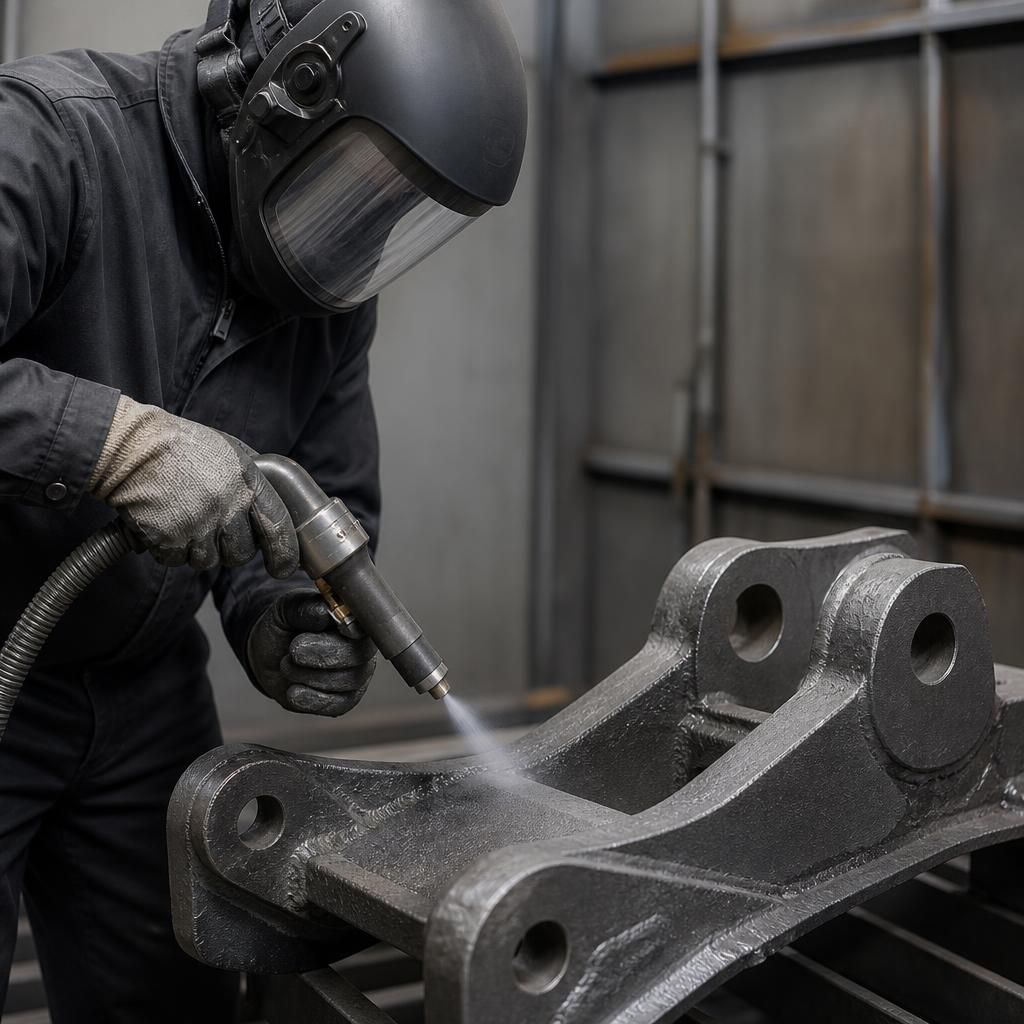
Surface texture affects adhesion not only through its depth, but also through the way its irregularities are distributed in relation to service loads. A pattern made up of short, varied features gives the nylon coating multiple points of resistance when the component is subjected to handling, vibration or movement. By contrast, long, continuous grooves can create preferential paths where moisture or contaminants may travel if the coating is damaged. Abrasion should therefore produce an even, broken-up profile rather than pronounced lines or tool marks concentrated in one direction.