

How can small powder coating machines be optimised for different substrate materials to ensure consistent finish quality?
Small powder coating machines are optimised for different substrates by adjusting pretreatment, grounding, powder application settings and curing conditions to suit the metal’s composition, thickness and heat response. Consistent finish quality is maintained by using a defined process for each substrate, checking film thickness and cure, and validating settings on test pieces before batch production.
Optimising a small powder coating machine for different substrates means creating a controlled process around each material rather than relying on one universal machine setting. The operator should classify the substrate, account for its geometry and thermal behaviour, then standardise the relevant application, handling and inspection steps for that material.
Start with a substrate profile
Before coating, record the characteristics that affect application and curing. These include the base metal, surface condition, component size, wall thickness, shape, welds, apertures and any areas that must remain uncoated. Steel, galvanised steel, aluminium and other conductive metals can respond differently to charging, heating and cooling. A thin aluminium panel, for example, may reach process temperature differently from a heavy steel bracket, even when both are placed in the same oven.
A useful profile should also identify whether the component contains mixed thicknesses, folded sections, enclosed areas or dissimilar metals. These features can create local differences in heat transfer and powder deposition. Keeping this information with the job specification helps operators reproduce a suitable process when the same parts return for later batches.
Adapt racking and part presentation
Consistent presentation is particularly important on small systems, where limited booth space can encourage parts to be placed too closely together. Racks should support components securely without obstructing the faces being coated. Contact points need to be kept clean and positioned in areas where a small uncoated mark is acceptable or can be concealed during assembly.
Parts should be oriented to reduce powder shadowing and allow the spray to reach recesses, edges and internal faces. Complex items may need more than one orientation or a defined sequence of passes. The operator should avoid allowing parts to touch, swing excessively or shield one another. For repeat work, dedicated hooks, fixtures or rack positions can make the presentation more consistent than ad hoc hanging.
Control electrostatic application around the geometry
Machine optimisation is not simply a matter of increasing powder output. Application settings should be selected to suit the part’s size, shape and electrical behaviour. Large flat faces may accept a different spray approach from narrow edges, deep recesses or enclosed profiles. Faraday-cage areas, such as internal corners and box sections, often require careful gun positioning, reduced aggression at the opening and controlled overlapping passes rather than excessive powder.
Gun distance, travel speed, angle and pass sequence should be repeatable. The operator should keep the gun moving smoothly and avoid dwelling on corners or edges, where excess build can occur. For complicated components, a defined manual technique is often more reliable than trying to correct poor access by increasing output. Where the equipment allows adjustment, application settings should be locked or recorded for each established job rather than changed informally between operators.
Separate material handling from application faults
Powder condition can affect consistency independently of the machine. Store powder in its specified conditions, protect it from contamination and use clean, dry equipment for transfer. Reclaimed powder, where used, should be managed according to the coating supplier’s process requirements; variation in reclaimed-to-virgin material can alter colour, texture or application behaviour.
Different coating types and colours should not be treated as interchangeable. Changes in particle characteristics, finish, colour or intended film build may require a separate job profile and thorough cleaning between products. A small machine is easier to control when powder changes, hopper condition and cleaning points are included in the written procedure.
Match oven loading to thermal mass
The oven process should be based on the temperature reached by the component, not solely on the air temperature shown by the controller. Part thickness, rack loading, metal type and the amount of exposed surface can all affect the time required for the coating to cure correctly. A heavy assembly may behave differently from a light panel, while a densely loaded rack can restrict heat circulation.
For each substrate and component family, establish a repeatable loading pattern. Avoid treating a lightly loaded oven and a heavily loaded oven as identical processes. Temperature monitoring equipment can help verify the part’s thermal profile during process development and when the load configuration changes. This is especially useful for mixed batches containing thin and thick sections.
Use masking and edge control deliberately
Masking materials must tolerate the process temperature and provide a clean boundary. Masking design should allow for coating thickness at holes, threads, mating faces and electrical contact points. Poorly positioned plugs or tapes can create build-up, interfere with assembly or leave contamination on the finished surface.
Edges deserve particular attention because powder can accumulate on sharp corners or withdraw from them during curing. Where the design permits, a suitable edge radius gives a more uniform coating transition than a knife edge. If the part cannot be modified, the spray path, gun angle and inspection criteria should account for the edge geometry.
Build inspection into the machine set-up
Inspection should confirm more than appearance. Check for coverage in recesses and on edges, unwanted inclusions, pinholes, runs, excessive texture and areas affected by poor contact or masking. Film thickness checks should be taken at representative locations rather than only on the easiest flat face. Cure verification and adhesion checks should be carried out using an agreed method suitable for the coating and substrate.
Keep a process record linking the substrate, coating material, rack arrangement, application settings, oven conditions and inspection results. If a defect appears, change one controllable factor at a time where practical. This makes it easier to distinguish a machine setting issue from contamination, poor preparation, unsuitable masking, incorrect loading or a substrate defect.
Small powder coating machines achieve the most consistent results when each material and component family has its own documented job profile. The profile should cover part presentation, gun technique, powder handling, oven loading, masking and inspection. Once validated on representative parts, that profile provides a repeatable baseline while still allowing controlled adjustment for changes in geometry, coating specification or batch composition.
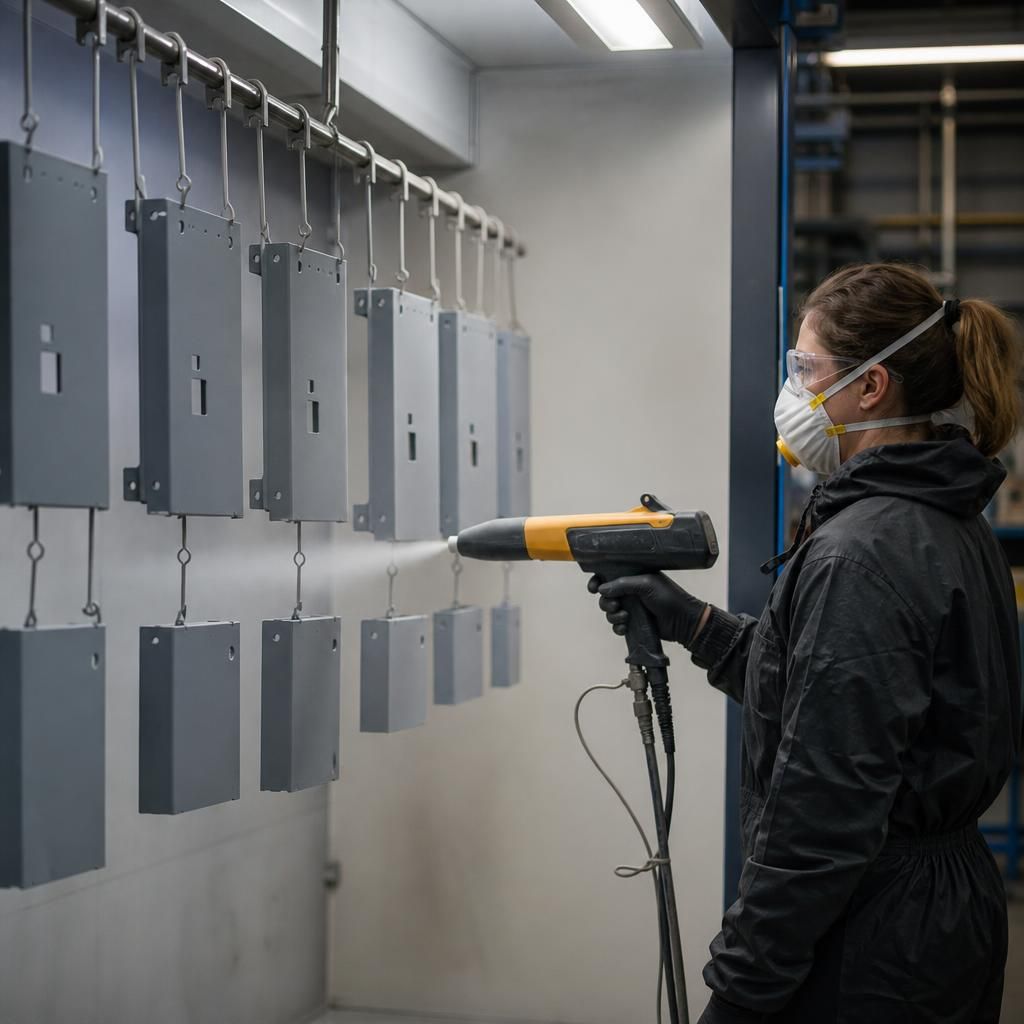
Consistent powder coating begins with substrate preparation, because a small machine cannot compensate for oil, corrosion, moisture or unstable surface chemistry. The preparation method should be matched to the metal and the coating specification before application settings are adjusted.
- Steel: remove mill scale, rust and contaminants, then use the specified conversion or protective treatment where required.
- Galvanised steel: check for passivation, white corrosion products and surface residues. The surface may require an approved preparation process to promote adhesion and reduce coating defects.
- Aluminium: remove oxide contamination and handling residues without damaging the surface. Clean gloves and controlled handling help prevent recontamination before spraying.
- Cast or porous components: consider whether absorbed oils or trapped gases could create pinholes or bubbling during heating. Trial preparation and curing on representative parts can identify this risk before production.
Preparation should be checked by appearance, cleanliness and, where appropriate, adhesion testing. Record the preparation route alongside the machine settings, since changing the substrate treatment can alter adhesion and surface appearance even when the powder application process remains unchanged.
Discuss Your Substrate-Specific Powder Coating Requirements
Discuss your substrate-specific powder coating requirements with our Midlands team, including the metal type, component geometry and coating specification. We can help identify the process considerations that should be assessed before production.