

How does choosing the right degreasing method impact the quality and efficiency of the powder coating process?
Choosing the right degreasing method removes oils, grease and other residues without damaging the metal surface, creating a cleaner base for consistent powder adhesion. This improves finish quality and helps process efficiency by reducing coating defects, rework and avoidable delays.
Choosing the right degreasing method determines how reliably a metal component can be prepared for powder coating, because the method must remove the specific contamination present while preserving the substrate and leaving no residue. The best choice therefore balances cleaning power, substrate compatibility, production volume, rinsing and drying requirements, operator control and environmental considerations.
Match the method to the contamination. Oils, machining lubricants, stamping compounds, fingerprints, waxes and silicone-based residues do not all respond in the same way. A mild alkaline cleaner may be suitable for general oils and workshop handling marks, while heavier lubricants may require a more concentrated formulation, a longer controlled contact time or a separate pre-cleaning stage. Solvent-based methods can be effective against particular organic residues, but they must be assessed for compatibility with the metal, subsequent treatment stages and site controls. Selecting a method without identifying the contaminant can leave a visually clean surface that still contains a thin film capable of affecting coating performance.
Consider the substrate and its condition. Steel, galvanised steel, aluminium and other alloys can react differently to alkaline, acidic or solvent cleaning systems. An overly aggressive treatment may etch the surface, attack a protective zinc layer, create staining or alter the appearance of aluminium. Conversely, a method that is too gentle may not remove embedded oils or residues. The condition of the component also matters: intricate profiles, threaded holes, folded sections and weld areas may retain contamination or cleaning solution more readily than flat surfaces. A suitable process cleans these areas without causing avoidable surface damage.
Mechanical action affects consistency. Immersion, spray washing, pressure application and manual wiping each provide different levels of contact. Immersion can give a uniform treatment to batches when the solution is properly maintained, whereas spray systems can provide controlled coverage across a continuous production process. Manual cleaning may be appropriate for isolated parts or localised contamination, but it depends more heavily on technique and access to every surface. Agitation, spray pressure, temperature and contact time all influence the result, so the cleaning method should be assessed as a complete process rather than by chemical selection alone.
Rinsing and drying are part of degreasing performance. Cleaner residues, dissolved contamination and process water must be removed before powder application. Inadequate rinsing can leave an alkaline or acidic film, while poor drying can allow moisture to remain in recesses, joints and hollow sections. These residues can interfere with subsequent pretreatment or curing and may contribute to surface blemishes, bubbling or premature coating failure. The chosen method should therefore include a practical way to rinse, drain and dry the component fully, particularly where the geometry makes liquid retention likely.
Process efficiency depends on control, not simply speed. A fast method is not necessarily the most efficient if it creates inconsistent results, requires repeated handling or produces additional inspection and rework. In a batch operation, a stable immersion or spray process may offer better repeatability than ad hoc manual cleaning. For variable components, a more flexible method may reduce preparation changes between jobs. Monitoring solution strength, temperature, contamination loading and contact time helps maintain consistent cleaning as the process continues. When those conditions fall outside the intended range, cleaning quality can decline even though the same product is still being used.
Use practical verification before coating. Inspection should be based on the type of contamination and the substrate rather than appearance alone. A surface may look bright and uniform while retaining an invisible organic film. Suitable checks can include visual examination under appropriate lighting, water-break observation, surface-wipe checks or other controls established for the coating process. Test pieces or representative components are useful when introducing a new cleaner, changing the substrate or dealing with an unfamiliar lubricant. These checks help confirm that the method is both effective and compatible before it is applied across a larger batch.
The right method reduces handling and process variation. If a degreasing system requires several manual interventions, difficult-to-control dwell times or extensive post-cleaning correction, its apparent simplicity may create inefficiency elsewhere. A method that integrates with the component’s size, geometry and production route can make loading, treatment, rinsing and drying more repeatable. For large or complex metal parts, access and drainage may be more important than the nominal strength of the cleaning agent. Process planning should also account for how cleaned components are handled afterwards, since contact with dirty gloves, tools or unsuitable packaging can reintroduce contamination.
In practice, method selection should follow a documented assessment of the contaminant, metal type, component design, batch size, required finish and available washing, rinsing and drying equipment. The most effective process is not the harshest or quickest option; it is the one that provides controlled, repeatable preparation without damaging the substrate or introducing new residues. That approach supports consistent powder coating quality while using labour, chemicals, water and production capacity more efficiently.
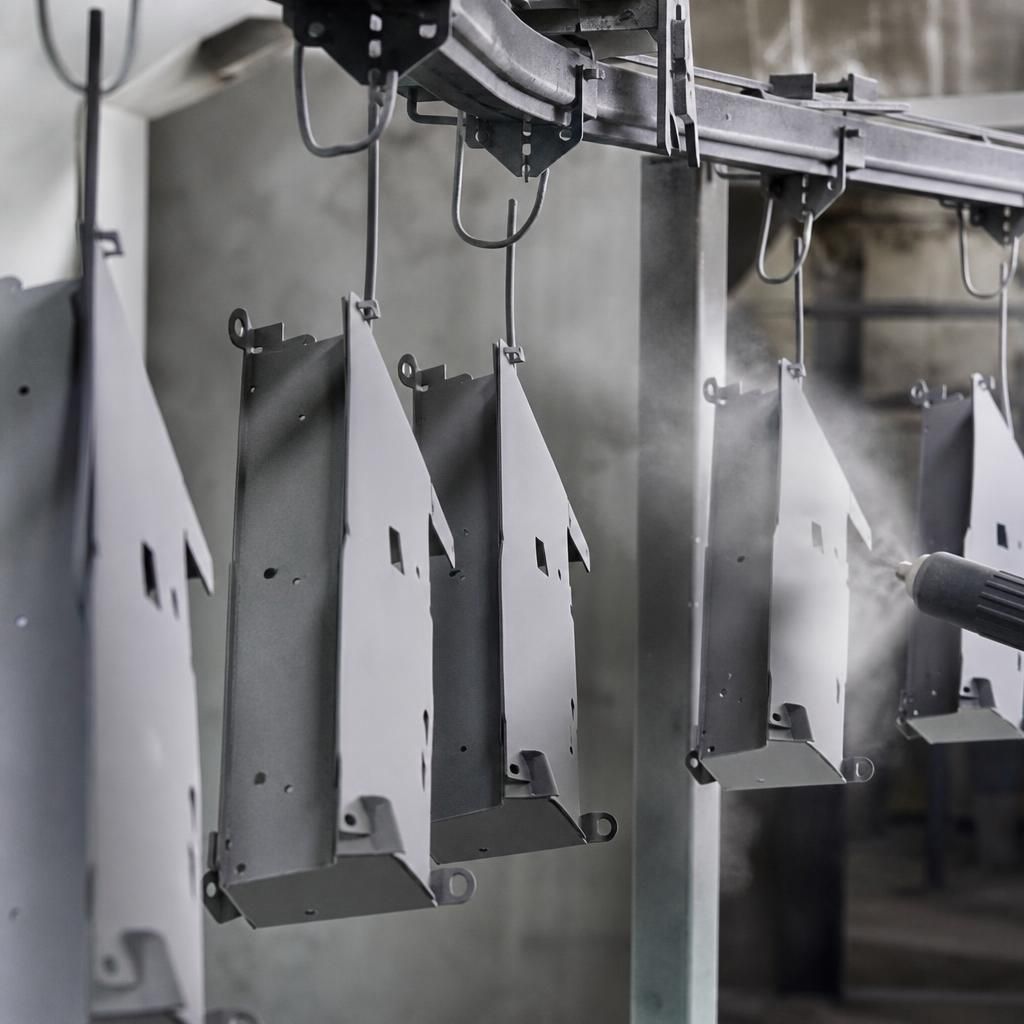
Degreasing also affects how efficiently powder is deposited during electrostatic application. An invisible film of oil or cleaner residue can interfere with reliable electrical contact between the component and its hanger, reducing powder attraction or contributing to uneven coverage. This is particularly relevant at suspension points, edges and recessed areas where consistent deposition can already be more difficult.
For that reason, the degreasing method should be assessed alongside the hanging and application arrangements. Components need clean contact areas, complete drainage and a surface free from residues before powder is applied. This helps limit thin spots, excess overspray and touch-up work, making the coating stage more consistent without relying on heavier powder application to compensate for poor preparation.
Discuss the right degreasing method for your powder coating process
Discuss your metal components, contaminants and production requirements with the Powder-coatings.co.uk team to identify a suitable degreasing approach before coating. Collection and delivery options are available for businesses across the Midlands and surrounding areas.