

How do I ensure maximum adhesion and corrosion resistance when using epoxy primer for metal?
To maximise adhesion and corrosion resistance with epoxy primer for metal, remove oil, rust, mill scale and other contaminants, create a suitable surface profile, and ensure the prepared metal is clean and dry before application. Select a primer compatible with the substrate and final coating, then apply the specified film thickness and allow it to cure fully under the manufacturer’s recommended conditions.
Maximum adhesion and corrosion resistance come from treating epoxy primer as one part of a controlled coating system. The primer must form a continuous, well-bonded film, remain chemically compatible with the subsequent finish, and provide particular protection at edges, welds, joints and other areas where corrosion commonly begins.
Match the primer system to the metal and service conditions. Carbon steel, galvanised steel, aluminium and previously coated surfaces present different bonding challenges. For example, zinc-coated metal may require a pretreatment suitable for the zinc layer, while aluminium’s naturally formed oxide layer must be addressed through an appropriate preparation and primer specification. The selected epoxy should also suit the component’s exposure to moisture, chemicals, abrasion, immersion or cyclic outdoor conditions. A product intended for a general industrial environment may not provide the necessary performance in a highly corrosive or chemically aggressive setting.
Give special attention to vulnerable geometry. Sharp edges tend to receive less coating than flat faces, while weld toes, cut ends, bolt holes, corners and recessed areas can retain moisture or develop local film weaknesses. Where the specification permits, edges should be rounded or otherwise designed to support consistent coverage. A stripe coat or targeted additional application may be appropriate on difficult details before the main coat, provided it is allowed for by the coating system and does not create excessive film build.
Control application technique as carefully as the product selection. Spray equipment must be set up to produce a stable, properly atomised pattern, with consistent gun distance, travel speed and overlap. Excessive atomisation or spraying from too far away can produce dry spray and a porous surface; excessive application can cause runs, solvent retention or curing defects. Components should be positioned so that faces, edges and recesses can be reached without overspray masking uncoated areas. For complex fabrications, an agreed application sequence helps prevent shadowing and missed sections.
Manage the coating environment. Temperature and relative humidity affect viscosity, wetting, solvent release and reaction between the resin and hardener. The metal temperature should remain safely above the dew point throughout application and early curing so that condensation does not form at the interface. Sudden temperature changes, high humidity and airborne dust can undermine an otherwise well-prepared coating. In a production setting, recording these conditions alongside batch and application details makes it easier to investigate any later defect.
Respect mixing and recoat requirements. Two-component epoxy primers depend on the correct resin-to-hardener ratio. Components should be mixed using the manufacturer’s specified method, with attention to induction time where one is required and to the usable pot life after mixing. The next coating should be applied within the stated recoat window. If that window is exceeded, the surface may need an approved keying or other treatment before recoating; simply applying another layer over a fully aged, glossy film can weaken intercoat adhesion.
When epoxy primer is used beneath a powder-coated finish, the primer and powder system must be assessed as a complete combination. Their chemistry, application sequence and curing schedules need to work together. Excessive heat or an unsuitable primer can cause bubbling, loss of adhesion or other defects, whereas an appropriate system can provide a continuous barrier beneath the powder layer. Areas damaged during handling, fabrication or assembly should be repaired with a compatible procedure before the final coating is applied.
Verify the finished film rather than relying on appearance alone. A visual check can identify misses, runs, pinholes, craters and uneven coverage, but it cannot confirm film thickness or bond strength. Suitable quality checks may include:
- dry-film thickness measurements taken across representative flat areas and vulnerable details;
- inspection of edges, welds, recesses, holes and the reverse side of components;
- adhesion testing at an agreed stage, using a method appropriate to the coating system and substrate;
- holiday or discontinuity testing where the specification and coating thickness make it suitable; and
- records of preparation, environmental conditions, product batch, application details and curing status.
Testing should be carried out without unnecessarily damaging production parts, and any test areas should be repaired using an approved method. Defects should be corrected before the component enters service, because corrosion under a sound-looking topcoat can be difficult to detect and repair.
Finally, design and handling decisions have a direct bearing on long-term protection. Avoiding water traps, allowing drainage, isolating incompatible metals where necessary and preventing coating damage during lifting or transport all help preserve the primer barrier. For industrial components, the most reliable approach is therefore a documented coating specification covering substrate, preparation standard, primer system, application controls, recoat limits, inspection criteria and repair procedure.
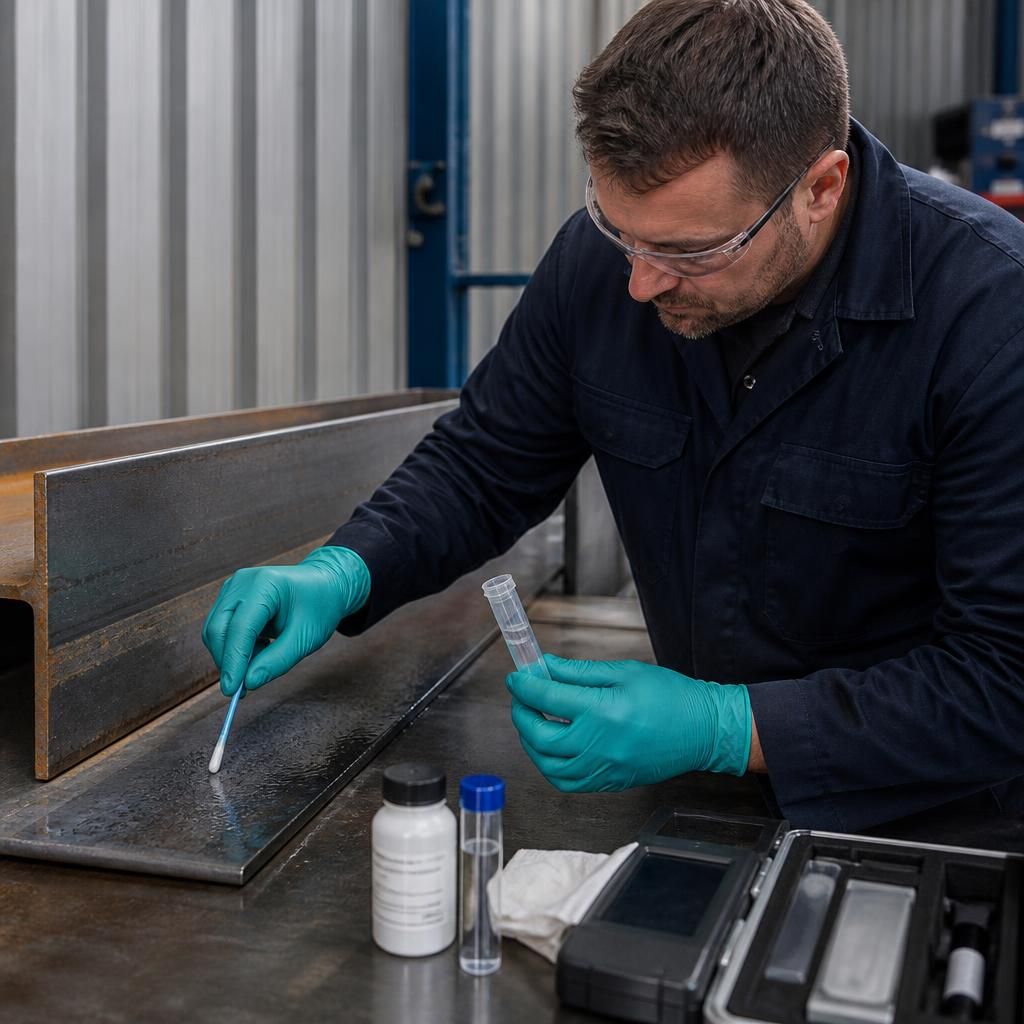
Soluble salts are an easily missed threat to epoxy primer adhesion and corrosion resistance. Chloride and sulphate residues can remain on apparently clean steel, attract moisture through the coating and contribute to blistering or corrosion beneath the film. Where components have been exposed to marine air, de-icing materials, process chemicals or contaminated handling environments, test for surface salts as part of the preparation check rather than relying on visual inspection.
If contamination is detected, remove it using a cleaning method compatible with the substrate and coating specification, then allow the metal to dry fully before priming. Check for flash rust after cleaning or blasting, particularly on carbon steel. Do not apply epoxy over visible rust or residue unless the selected system specifically permits it; re-cleaning and reassessing the surface is more reliable than attempting to seal contamination beneath the primer.