

How do you ensure that different blasting media used in your powder coating facilities do not affect the quality of the finish?
We control the effect of different blasting media by matching the abrasive to the metal substrate, required surface profile and coating specification, then keeping media types segregated and monitoring their condition. Prepared surfaces are checked for cleanliness, texture and consistency before powder application so the blasting process supports reliable adhesion and an even finish.
Different blasting media are prevented from affecting finish quality through controlled process settings, separation of media streams, equipment checks and documented inspection. The objective is not simply to remove contamination, but to produce a repeatable surface condition that is suitable for the specified powder coating and metal component.
Media is assessed for its effect on the substrate. Abrasive shape, hardness and particle size influence the way a surface is cleaned and textured. Angular media can create a more pronounced mechanical key, while rounded media may produce a less aggressive surface effect. A medium that is unsuitable for a particular metal can cause excessive roughness, distortion of fine details or insufficient preparation. The selected process therefore takes account of the substrate, component thickness, existing corrosion or coating, the required appearance and the performance expected from the finished coating.
Blasting parameters are controlled as well as the media itself. Air pressure, nozzle distance, angle of impact, traverse speed and exposure time all affect the result. These settings are adjusted to avoid overworking edges, recesses and thin sections while still reaching the required areas of the component. This is particularly important for fabricated parts with welds, folded sections, holes or changes in thickness, where the same abrasive can have a different effect across the component.
Media streams are kept under control to reduce cross-contamination. Equipment, storage arrangements and handling procedures are managed so that one abrasive does not unintentionally enter another process. This matters because even a small change in particle type or size can alter the surface profile and may introduce unwanted residues. Where abrasive is recovered for further use, it is assessed for breakdown, foreign material and changes in performance before being allowed back into the process. Media that no longer performs consistently is removed rather than used simply because it remains physically available.
Contamination control also covers the blasting equipment. Hoses, nozzles, pots, recovery systems and work areas can all transfer dust or remnants of a previous abrasive. Cleaning and changeover checks help prevent this, particularly when components with different coating requirements pass through the same facility. Dust extraction is controlled to support clear working conditions and to limit the movement of airborne particles back towards prepared components.
Process checks focus on the condition that the coating will receive. Inspection is used to identify issues such as uneven impact, excessive roughness, embedded particles, residual dust or missed areas. Depending on the component and specification, checks may include visual examination, surface-profile assessment and confirmation that the preparation is consistent across representative areas. Components with complex geometry receive particular attention because corners, internal faces and sheltered sections can respond differently from broad, accessible surfaces.
Traceability provides an additional safeguard when different blasting media are used. The work can be linked to the relevant job information, substrate, preparation method and coating requirement. If an inspection identifies a variation, this makes it easier to determine whether the cause relates to media condition, equipment settings, component geometry or handling between preparation and powder application. Corrective action can then address the process rather than relying on cosmetic inspection alone.
The prepared component is also protected after blasting. Handling, storage and transfer procedures help prevent fingerprints, workshop dust, moisture or other contaminants from changing the surface before powder is applied. This is important because a correctly blasted surface can still lose performance if it is subsequently contaminated or allowed to deteriorate.
These controls allow different blasting media to be used for appropriate applications without treating them as interchangeable. Each medium has to be managed according to its effect on the metal, the required surface condition and the powder coating specification. The result is a preparation process that supports dependable adhesion, an even appearance and durable performance across batches of metal components.
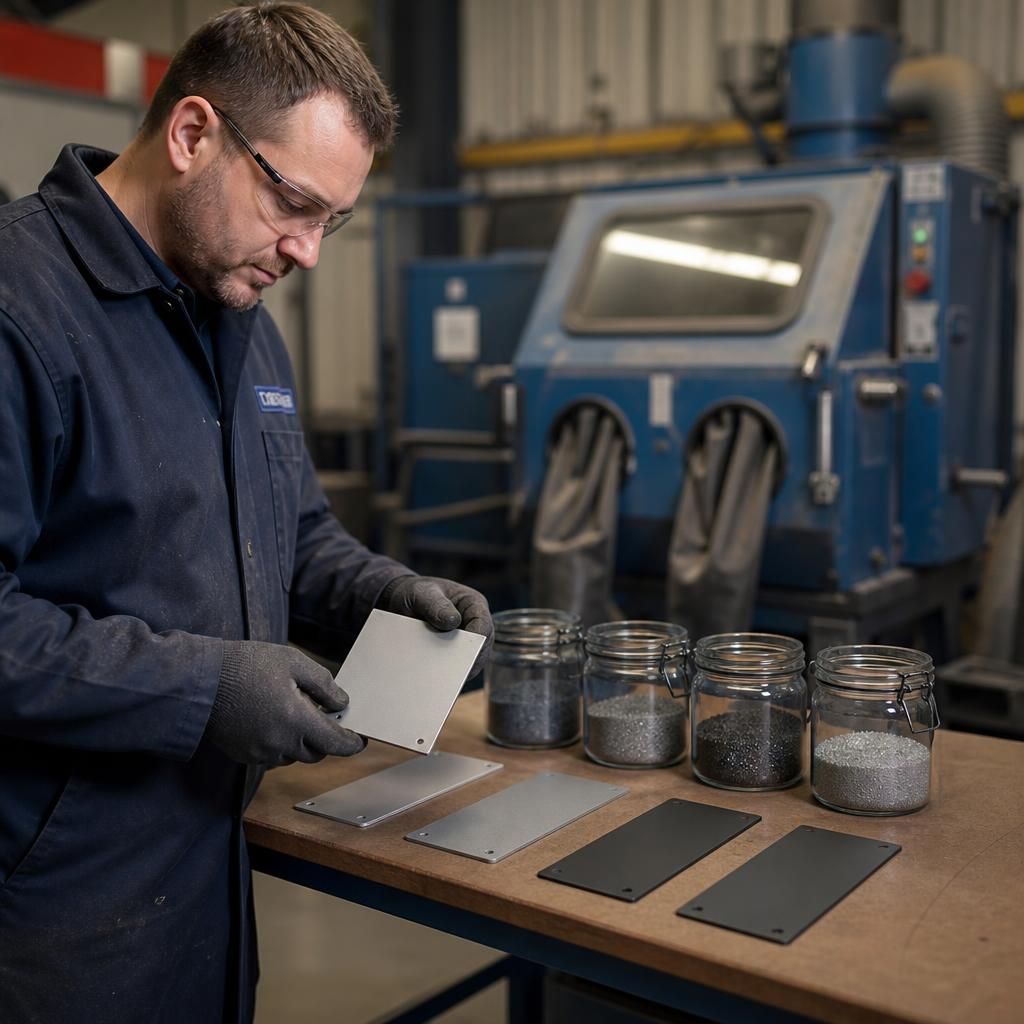
Different blasting media are controlled through comparative validation before they are used on production components. Rather than assuming that two abrasives will produce the same result, each media and process combination is assessed against the required preparation standard for the specific metal and powder coating system.
Where a media change is proposed, representative parts or test panels can be prepared and reviewed for cleanliness, texture, detail retention and coating appearance after powder application. The results provide a practical reference for confirming that the alternative abrasive does not alter adhesion or the visual finish. This approach is particularly useful when a component includes thin sections, fine edges or formed details that may respond differently to abrasive impact.
Approval is based on repeatable results, not simply on whether the surface looks clean immediately after blasting. Any variation identified during the comparison can be addressed by refining the preparation method before the media is introduced into routine production.