

How does the durability and recyclability of stainless steel shot influence operational efficiency and cost savings in large-scale powder coating projects?
Stainless steel shot supports operational efficiency because its durability allows repeated use with less breakdown, helping maintain consistent surface preparation and reducing media replacement and disposal requirements. Its recyclability can lower consumable and waste-handling costs in large-scale powder coating projects, provided the shot is correctly recovered, cleaned and maintained.
Stainless steel shot influences the economics of large-scale powder coating through its whole operating life, not simply its purchase price. Its high resistance to fracture and oxidation helps keep blasting conditions more predictable, while its metallic composition allows it to be separated, reclaimed and returned to the process when suitable recovery equipment and controls are in place. The resulting effect is usually seen in process control, labour use, quality costs and waste management as well as abrasive consumption.
More predictable blasting conditions
Shot that retains its shape produces a more stable impact profile than an abrasive that rapidly changes size or generates a high proportion of fines. This helps operators manage key variables such as surface profile, cleaning intensity and blast duration. Stable preparation reduces the need to compensate for changing media behaviour by repeatedly adjusting machine settings, checking test panels or extending processing times.
For a high-volume line, this matters because small interruptions or adjustments can accumulate across many batches. A consistent media condition can make production planning easier, particularly where components differ in size, geometry or coating requirements. It also supports more repeatable handover between blasting and powder application, provided the equipment, work instructions and inspection regime are properly controlled.
Where efficiency gains arise
- Reduced process interruptions: A durable abrasive is less likely to require frequent correction of blast settings caused by rapid changes in particle condition.
- Less handling of consumables: Reclaiming usable shot can reduce the frequency of deliveries, storage movements and manual replenishment compared with a process dependent on frequent disposal and replacement.
- Improved equipment utilisation: Efficient recovery can reduce the time spent clearing spent media from the work area, although reclaimers, separators and dust extraction systems still need planned servicing.
- Lower inspection and rework exposure: When surface preparation remains within the required specification, there is less risk that poor adhesion, contamination or an unsuitable profile will be discovered after powder application. Any reduction in rework depends on correct blasting parameters and inspection rather than the abrasive alone.
How recyclability affects cost
The recyclable nature of stainless steel shot changes the cost model from a simple buy-and-dispose cycle to a managed recovery cycle. The relevant calculation should include the initial media cost, collection efficiency, separator performance, labour, electricity, maintenance, waste handling and the value of material that can be returned to the blast system. A higher-priced medium may be economically appropriate when its usable life and recovery rate offset the cost of frequent replacement, but this should be demonstrated using the site’s own operating records.
Recovery is not the same as indefinite reuse. Shot can become unsuitable through gradual size reduction, contamination, mixing with another abrasive or accumulation of fines. A controlled bleed-off is often needed so that degraded material does not dilute blasting performance. The removed fraction must then be classified and handled according to its contamination and waste status. Treating all recovered material as automatically reusable can create quality and housekeeping problems.
Quality costs are part of the calculation
Surface preparation is a foundation stage for powder coating. If the blast process leaves embedded contamination, an inconsistent profile or residual dust, later stages may involve additional cleaning, sorting, stripping or recoating. These activities consume labour and production capacity and can disrupt delivery planning. Stainless steel shot can help reduce variation in the preparation stage, particularly where cross-contamination from carbon-steel abrasive would be unacceptable, but it does not remove the need to control oil, moisture, dust, salts and residues on incoming components.
Its suitability also depends on the substrate and specification. Shot size, hardness, machine settings, nozzle or wheel configuration and exposure time must be selected to clean the component without causing unacceptable deformation, excessive roughness or damage to edges. Using an unsuitable grade or size can cancel out the financial benefit of a durable medium by increasing inspection failures or slowing production.
Controls required to realise the benefit
- Define the required cleanliness and surface profile for each component family before setting the blast process.
- Keep stainless steel shot segregated from other media and prevent oil, moisture, scale and loose coating debris entering the recovery loop.
- Use separators and screens to remove fines and foreign material, checking that the recovered fraction remains within the agreed operating range.
- Monitor blast results, media condition, replenishment, waste output and downtime rather than judging performance by abrasive purchase cost alone.
- Record when shot is added, removed or downgraded so that abnormal consumption and contamination sources can be investigated.
- Maintain blast wheels, liners, reclaim systems, extraction and filters, since poor equipment condition can increase wear and reduce recovery efficiency.
Assessing the overall return
A practical assessment compares the complete cost per coated batch or component before and after introducing stainless steel shot. Useful measures include media purchased, material recovered, waste removed, labour devoted to media handling, blasting time, unplanned stoppages, inspection failures and rework. This approach separates genuine operational improvement from apparent savings caused by transferring cost to maintenance or waste treatment.
For large-scale projects, stainless steel shot is therefore most valuable when it is treated as part of an engineered preparation system. Durability can support stable production, while recyclability can reduce the volume of new abrasive and waste requiring movement through the site. The financial outcome depends on matching the shot to the substrate and equipment, maintaining effective separation and recovery, and using process data to confirm that the lifecycle cost is lower than the available alternatives.
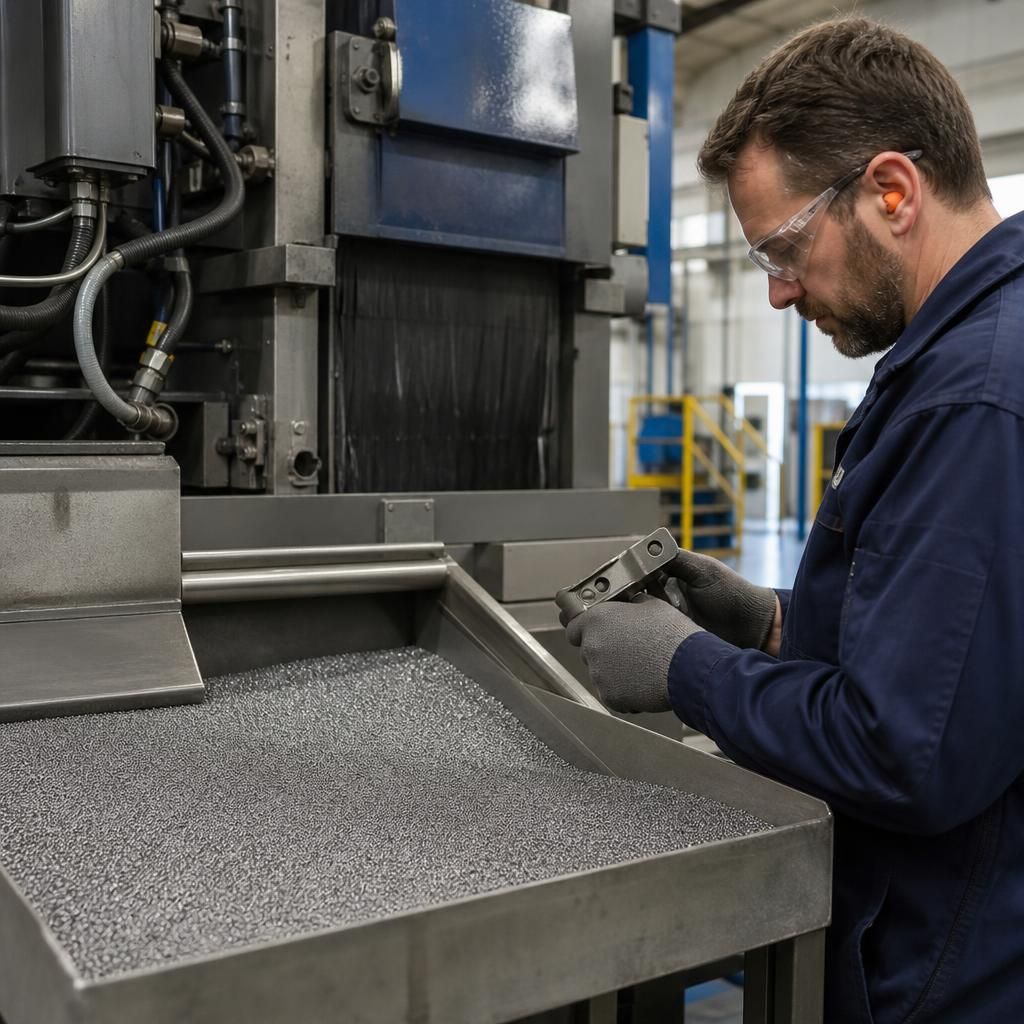
Stainless steel shot delivers an operational benefit only when its durability is matched to the blasting equipment and process settings. Its density, hardness and retained particle shape affect impact energy, wheel or nozzle performance and wear on liners and other working parts. Incorrect settings can increase equipment maintenance, energy use or component damage, offsetting the saving from longer-lasting, recyclable media.
For a large-scale project, assess the complete operating effect rather than measuring abrasive consumption alone. Compare media life with wear-part replacement, equipment servicing, energy demand and usable throughput. Monitoring these factors helps establish whether stainless steel shot is improving the total cost of surface preparation for the specific machine, substrate and finish specification.