

How does the choice of shot blasting sand affect the longevity and quality of powder coatings on different metal substrates?
The shot blasting sand or abrasive determines the surface profile, cleanliness and potential distortion of the metal, all of which affect powder adhesion and coating life. Selecting a suitable grade for each substrate—using a controlled, even profile without embedding contaminants or excessively eroding the surface—helps produce a more consistent and durable finish.
The choice of shot blasting sand or abrasive affects powder coating performance by determining how the substrate is prepared for pretreatment and curing. The correct media depends on the metal’s hardness, thickness, geometry, previous finish and required appearance; a medium suitable for structural steel may be unsuitable for aluminium, galvanised steel or thin fabricated parts.
Steel and cast iron. Carbon steel and cast iron generally tolerate relatively aggressive angular abrasives, including steel grit, aluminium oxide or suitably graded mineral media. These can remove mill scale, rust, weld discolouration and old coatings effectively. Steel grit is often selected where a pronounced mechanical key is required, while steel shot can be useful for removing loose scale and general surface contamination without cutting as deeply. The choice must still account for the component’s thickness and shape: excessive impact can round sharp details, expose casting defects or alter small features that need to locate accurately during assembly.
Cast iron requires particular care because its porous structure can retain oil, foundry residue and blasting dust. Abrasive cleaning alone may expose contamination rather than remove it. Degreasing, suitable drying and inspection after blasting are important before any chemical pretreatment or powder application. If residue remains in pores, it can contribute to pinholes, bubbling or localised coating failure during curing.
Aluminium. Aluminium is softer than steel, so a media and pressure combination intended for ferrous components can cut too deeply, smear the surface or distort thin sections. A fine, non-ferrous or carefully controlled abrasive is commonly more appropriate. Glass bead can produce a uniform matt appearance with comparatively limited cutting action, while fine aluminium oxide or mineral abrasive can provide more aggressive cleaning where oxidation or an existing coating needs to be removed.
Blasting aluminium with previously used ferrous media can transfer iron particles to the surface. Those particles may later oxidise or create points of corrosion beneath the powder coating. Separate media, clean equipment and controlled abrasive handling are therefore important when aluminium and steel are processed in the same facility. The prepared surface should also move promptly into the next stage of treatment so that handling contamination and surface oxidation do not compromise the finish.
Galvanised and zinc-coated steel. Zinc coatings provide corrosion protection, but they are softer and more easily damaged than the underlying steel. An abrasive that is too coarse or delivered at excessive pressure can remove zinc unevenly, particularly from edges, corners and exposed areas. This creates variations in the protective system and can make the powder coating’s long-term performance less uniform.
For galvanised work, the objective is usually to clean and condition the surface without stripping away more zinc than necessary. The blasting approach may therefore use a less aggressive abrasive, lower energy or a shorter treatment cycle than would be used for heavily scaled carbon steel. Zinc surfaces can also release gases during powder curing if moisture, treatment residues or porosity are present. Thorough cleaning, drying and a compatible pretreatment system are essential; blasting media cannot compensate for trapped moisture or unsuitable curing conditions.
Stainless steel. Stainless steel should be treated with media that will not introduce ferrous contamination. Carbon-steel shot or grit used inappropriately can leave particles that rust on the surface, creating staining that may be mistaken for a failure of the stainless substrate. Dedicated non-ferrous media or carefully controlled mineral abrasives are preferable where corrosion appearance and cleanliness are important.
The required finish also matters. A blasting process that creates a coarse, uneven texture may remain visible through a thin powder coating, especially with low-gloss or lightly pigmented finishes. Conversely, a very rounded or polished result may not provide the surface condition required by the selected pretreatment. The abrasive should therefore be chosen alongside the powder specification, coating thickness and visual standard rather than in isolation.
How abrasive characteristics change the result
- Angular media cuts into contamination and produces a more pronounced texture. It is useful for removing tenacious coatings and corrosion, but can be unnecessarily severe for thin or detailed components.
- Spherical media tends to peen or clean the surface with less cutting. It can be suitable for robust parts where dimensional control is important, although it may not remove tightly bonded scale as efficiently as an angular abrasive.
- Fine media provides greater control on small features and softer metals, but may take longer to remove heavy contamination.
- Coarse media can shorten the cleaning cycle on durable steel, yet may leave a texture that affects appearance or requires a greater powder film to cover consistently.
- Mineral and non-ferrous abrasives reduce the risk of iron transfer on aluminium, stainless steel and other non-ferrous substrates, provided the media is clean and suitable for the process.
The term “shot blasting sand” covers several different abrasive choices, and ordinary silica sand should not be treated as an interchangeable option. Respirable crystalline silica presents a serious health hazard when silica-containing abrasive is used in blasting, so abrasive selection must comply with applicable workplace controls and the equipment’s approved operating requirements. Abrasive cleanliness, extraction, ventilation and personal protective equipment are part of the process decision, not separate considerations.
Media condition is as important as media type. Reused abrasive changes as it breaks down. Fine particles can alter the cutting action, clog extraction systems and leave dust on the component, while worn media may no longer deliver a consistent finish. Contaminated abrasive can transfer oil, previous coating residues or incompatible metal particles. Regular checks of media size distribution, cleanliness and equipment settings help keep results repeatable across a batch.
Consistency also depends on nozzle distance, angle, pressure, traverse speed and coverage. A suitable abrasive can still produce variable coating results if one area receives substantially more impact than another. Complex fabrications, folded sections and recessed features may need a process designed to reach all relevant surfaces without overworking exposed edges. Inspection should include visual cleanliness, surface texture, dust removal and evidence of contamination before pretreatment begins.
For a new component or an unfamiliar substrate, the most reliable approach is a controlled trial using the intended abrasive and coating system. The trial should assess appearance, dimensional impact, edge condition, residue, pretreatment response and the cured powder finish. Adhesion testing and corrosion evaluation may also be appropriate where the component faces demanding service conditions. This establishes whether the media is merely removing contamination or is also producing a repeatable substrate condition for the complete coating system.
In practical terms, the best abrasive is the least aggressive option that removes the existing contamination and leaves the substrate in a condition compatible with its pretreatment and powder specification. Selecting media by metal type alone is not sufficient: thickness, geometry, existing corrosion, coating history, required appearance, contamination risk and production controls all influence the eventual quality and durability of the powder-coated finish.
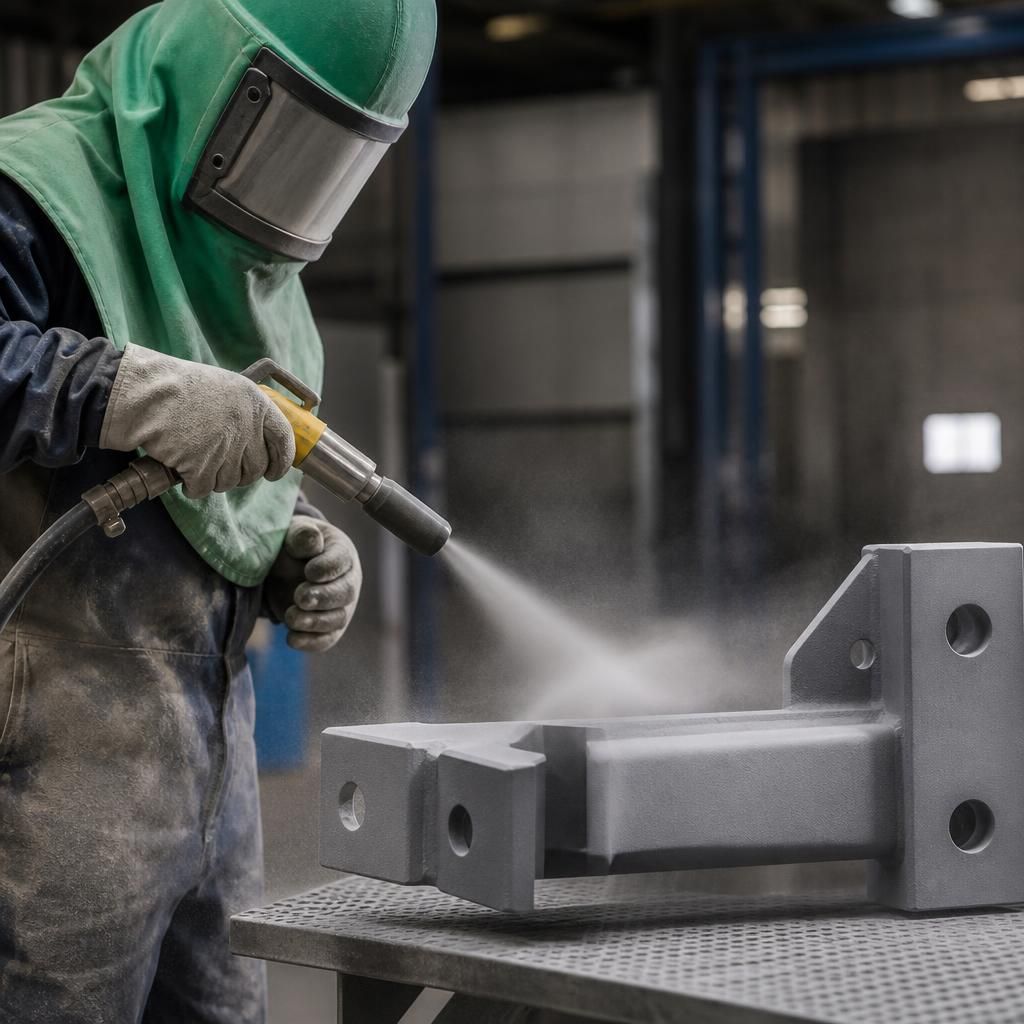
The blast profile must be proportionate to the powder film thickness. If the abrasive creates peaks that are too pronounced, the coating may leave thinly covered areas on the profile’s high points, while deep valleys can retain dust or moisture. These local weaknesses may become early sites for underfilm corrosion, edge breakdown or reduced adhesion, particularly where the component is exposed to abrasion, chemicals or outdoor weather.
For this reason, profile assessment should form part of the coating specification rather than being judged by appearance alone. A prepared surface that looks uniformly matt may still have excessive roughness, embedded abrasive or inconsistent coverage between exposed faces and recessed areas. Matching the blast profile to the metal substrate, powder type and intended film build helps the cured coating form a continuous protective layer without relying on excessive powder thickness to mask preparation defects.