

How does the surface profiling technique used impact the adhesion quality of the powder coating on steel?
The surface profiling technique directly affects powder coating adhesion by creating the texture needed for the coating to key into the steel. A controlled, uniform profile supports consistent adhesion, while an insufficient, uneven or overly aggressive profile can leave weakly bonded areas, affect coverage and reduce the coating’s protective performance.
Surface profiling affects adhesion by changing the physical condition of the steel-to-coating interface. The technique used determines the shape, depth and consistency of the surface texture, as well as how effectively it removes mill scale, rust, previous coatings and other materials that could separate the powder coating from the steel. The resulting profile must therefore suit the steel substrate, the powder coating system and the required coating thickness.
Abrasive blasting usually produces the most useful profile for industrial powder coating because it both cleans the steel and creates a fresh, textured surface. The abrasive type, size, hardness, impact angle and blasting pressure all influence the result:
- Angular abrasive produces sharper peaks and valleys, which can provide strong mechanical keying but may require careful control to avoid an excessively aggressive surface.
- Spherical shot tends to produce a different, more rounded texture and may be appropriate where a particular finish or substrate condition requires it.
- Fine abrasive can produce a relatively shallow texture, while coarser abrasive can create a deeper pattern and remove more tenacious scale or existing coatings.
- Incorrect blasting settings can leave areas insufficiently prepared, distort thin sections or create an unnecessarily rough surface.
The profile is not judged by roughness alone. A surface can appear visibly textured yet still contain tightly bonded mill scale, embedded abrasive, dust or corrosion products. These materials can act as weak boundary layers. Conversely, a heavily blasted surface may be clean but unsuitable if the resulting peaks are too sharp or the valleys are too deep for the selected powder coating to cover consistently.
Shot blasting and grit blasting therefore affect adhesion in different ways. Shot blasting generally peens and textures the surface with rounded media, whereas grit blasting uses sharper particles that tend to cut into the steel and form a more angular anchor pattern. The better option depends on the condition and geometry of the component. Large fabricated parts, welded areas, edges and recessed sections may not receive the same abrasive impact as exposed flat faces, so the technique must be assessed across the complete component rather than on one convenient area.
Mechanical abrasion, using tools such as abrasive discs or power brushes, can improve adhesion locally but is more dependent on operator technique. It may leave directional scratch patterns, polished areas or untreated edges. A power brush can remove loose material without creating the same profile as abrasive blasting, while an abrasive disc can cut more deeply in one area than another. These variations may produce different bonding conditions across a single part, particularly where large surfaces or complex fabrications are involved.
Surface profiling also affects the amount of powder coating needed to achieve continuous coverage. The coating has to flow over the peaks and fill the valleys. If the profile is too deep for the specified film build, the tops of the peaks may receive less effective coverage while the valleys require more material. This can reduce the protective continuity of the finish, especially at edges, welds and areas exposed to moisture or corrosive conditions. A controlled profile gives the coating process a more predictable surface to cover.
The steel itself influences how a profiling technique behaves. Hard mill scale, heat-affected weld zones, cast surfaces, sharp edges and areas with existing corrosion do not respond identically to abrasion. Fabrications can also contain weld spatter, slag, laminations or residues from cutting and forming. If these features remain, the profile measurement may suggest adequate roughness even though the interface contains defects. Preparation should therefore remove surface contamination and correct physical defects before the final profile is assessed.
Chemical pretreatment does not normally replace the need for a suitable abrasive or mechanical profile where a textured steel surface is specified. It can, however, modify the interface by removing residues and forming a conversion layer that supports coating adhesion and corrosion protection. Its effectiveness depends on the cleanliness and condition of the profiled steel. Applying chemical treatment over dust, grease or loosely attached corrosion products cannot compensate for an unsuitable underlying surface.
Profile verification should consider more than visual appearance. Suitable checks may include:
- examining the entire component for consistent preparation, including edges, welds, corners and recessed areas;
- checking that blasting or abrasion has removed scale, rust, old coating and visible contaminants;
- measuring or comparing the surface profile using an appropriate inspection method;
- confirming that abrasive residue and dust have been removed before coating;
- checking for flash rust or renewed contamination before powder application; and
- relating the measured profile to the powder manufacturer’s coating system and specified film build.
In practice, the strongest adhesion comes from matching the profiling technique to the component rather than applying one preparation method to every job. A robust fabricated steel part with tenacious scale may require a more aggressive abrasive approach than a thin, delicate section. Components with local repairs may need controlled mechanical preparation, while large production batches benefit from a repeatable blasting process and inspection routine. The key consideration is whether the finished profile provides a clean, stable and appropriately textured interface for the powder coating to cure against.
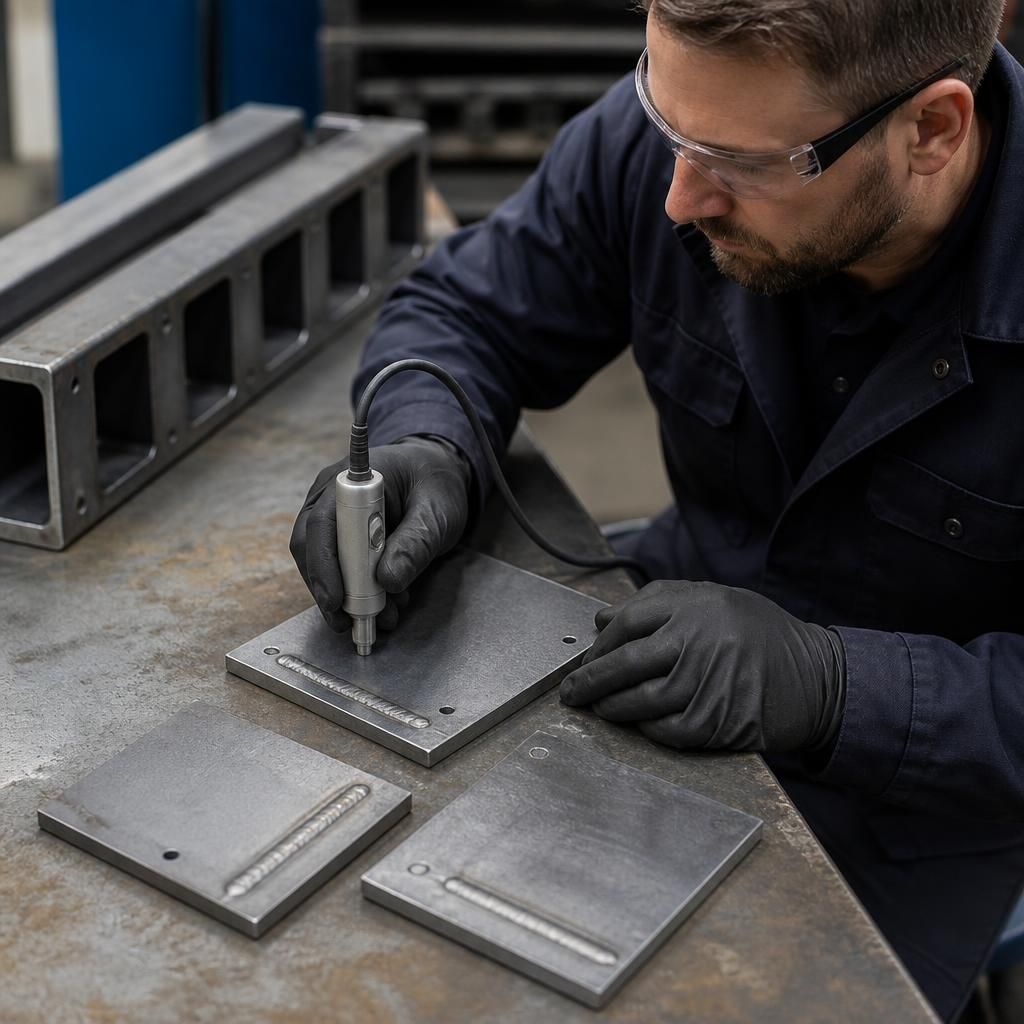
The effect of a profiling technique is best confirmed on a representative sample before processing a full production batch. A test piece made from the same steel, with comparable welds, edges and surface condition, can be prepared using the proposed abrasive or mechanical method and then coated. This helps establish whether the resulting profile is suitable for the powder system without relying solely on visual texture.
For repeat work, the preparation method should remain controlled when abrasive type, equipment settings or steel supply changes. Comparing inspection results and cured coating adhesion from representative samples can identify whether a weakness originates from the profile, contamination or the coating process. This qualification approach is particularly useful for fabricated components with variable surface conditions, where a method that performs well on a flat test panel may not produce the same adhesion across the finished steelwork.
Discuss the right surface profiling method for your steel
Discuss the steel component, existing surface condition and intended powder coating system with the powder-coating.co.uk team to identify a suitable profiling approach. Collection and delivery options are available for businesses across the Midlands and surrounding areas.