

How does the shotblasting technique contribute to the sustainability and environmental responsibility of the powder coating process?
Shotblasting supports a more sustainable powder coating process by mechanically removing rust, scale and existing residues, reducing reliance on chemical cleaning agents before coating. By creating a consistent surface for powder adhesion, it can also reduce coating defects, rework and material waste, while suitable abrasive media may be recovered and reused within the blasting system.
Shotblasting contributes to the environmental responsibility of powder coating by preparing metal through controlled mechanical impact, while supporting a durable finish that can extend the useful life of the coated component. Its sustainability benefit depends on how the process is specified, operated and managed: abrasive selection, dust control, media recovery, energy use and waste handling all affect the overall environmental outcome.
Durability is an important part of the assessment. A powder-coated component that remains well protected for longer may need less frequent recoating, replacement or remedial work. Shotblasting helps establish a suitable profile and removes tightly bonded surface contamination, giving the coating system a sound basis for long-term performance. The environmental benefit is therefore not limited to the preparation stage; it can extend across the service life of items such as fabricated parts, structural components, machinery housings and automotive metalwork.
The process can also support more responsible use of abrasive media. In suitable blasting equipment, reusable media are separated from removed contamination and returned to circulation. This reduces the need to treat every blast cycle as a fresh-material operation. However, media cannot be reused indefinitely. Particles break down through repeated impact, and their performance changes as they become smaller or contaminated. Responsible operation therefore involves monitoring media condition, removing unsuitable material and replenishing the system only when required.
Waste control is another significant consideration. Shotblasting produces a mixture of spent abrasive, removed rust, mill scale, old coating and other surface residues. These materials should be collected rather than allowed to spread into the surrounding work area, then assessed and handled according to their composition. Existing coatings may contain substances requiring specific controls, so waste should not automatically be treated as ordinary metal residue. Segregated collection makes correct disposal or recycling routes easier to identify.
Dust extraction supports both environmental control and process quality. Enclosed blasting equipment and suitable filtration help contain fine particles generated when the abrasive strikes the surface. Extraction systems should be maintained so that filters remain effective and airflow is appropriate for the equipment. This limits the release of airborne dust and helps prevent contamination of adjacent coating operations, where settled particles could affect the finish.
Energy use should be considered alongside material efficiency. Compressed-air blasting can require substantial electrical power, particularly where large components or high production volumes are involved. Efficient nozzle selection, suitable air pressure, maintained blast equipment and correctly loaded batches can help avoid unnecessary energy demand. Blasting more aggressively than the substrate requires is not inherently more sustainable: it can consume additional power and abrasive while risking unwanted surface damage.
Good specification is therefore central to responsible shotblasting. The operator should match the abrasive type, particle size, blast intensity and preparation standard to the metal and the intended powder coating system. A controlled process removes what needs to be removed without unnecessarily altering the substrate. It also avoids repeating work caused by unsuitable settings, poor workholding or inadequate inspection.
- Select the process to suit the substrate: different metals and component geometries need different levels of impact and care.
- Use recoverable media where technically appropriate: maintain separation between usable abrasive and contaminated or degraded material.
- Control dust at source: use enclosed equipment and properly maintained extraction and filtration.
- Inspect incoming components: identify old coatings, residues or contamination that may affect waste classification and process planning.
- Optimise batch loading: process compatible parts together where practical, without compromising access or finish requirements.
- Record and review process issues: recurring rework, excessive media consumption or repeated blasting may indicate incorrect settings or handling.
Shotblasting is not automatically environmentally preferable in every situation. Its equipment consumes energy, abrasive eventually becomes waste, and contaminated surfaces may require additional controls. The strongest environmental case is made when the operation is accurately targeted, media and residues are managed responsibly, extraction is effective and the resulting coating provides durable protection. For businesses commissioning powder coating, useful questions include how spent media are handled, how dust is contained, whether abrasive is recovered within the system and how the process is adjusted for different components.
In this context, sustainability means assessing the complete preparation and coating chain rather than focusing on one operation in isolation. Properly controlled shotblasting can form a responsible part of that chain by supporting long-lasting powder-coated products, limiting avoidable process inputs and enabling more disciplined management of abrasive and surface residues.
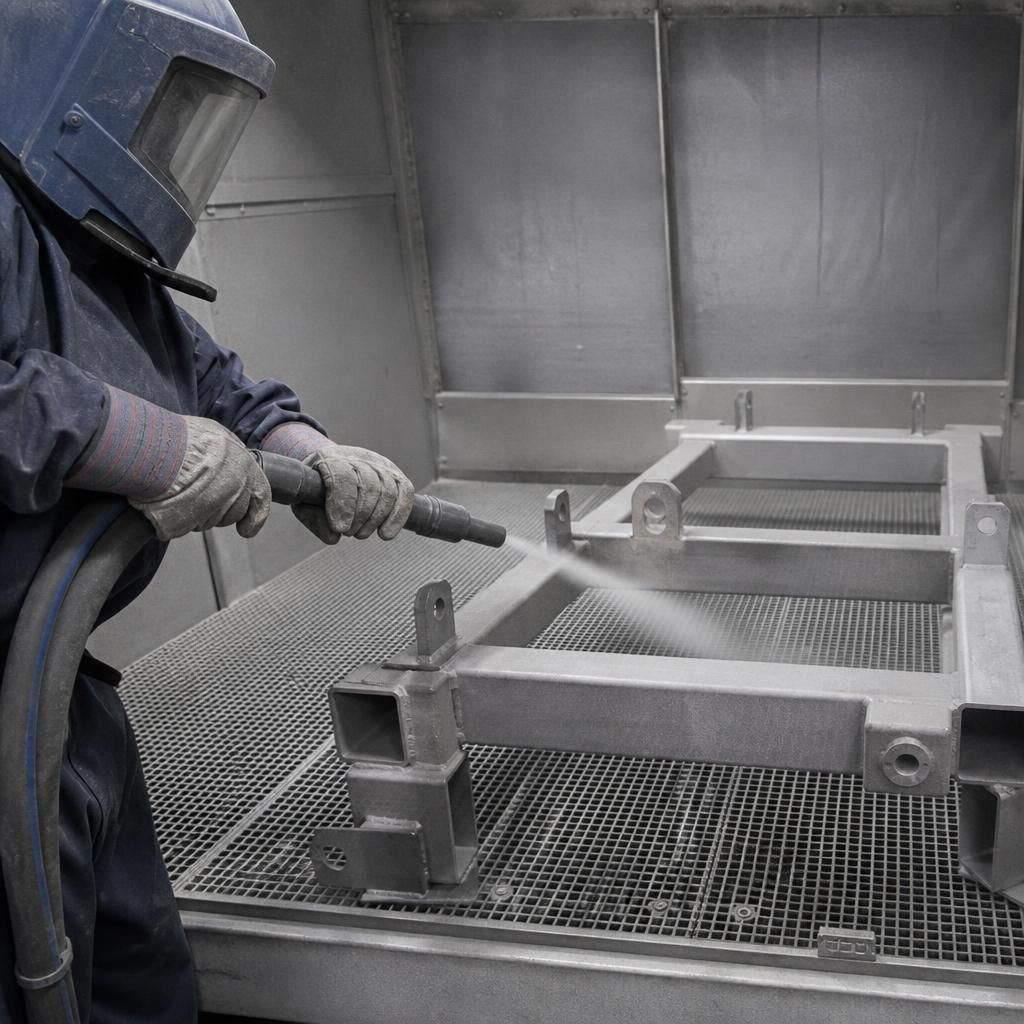
Shotblasting can support environmental responsibility by providing a dry preparation route for suitable metal components. Unlike wet cleaning or chemical treatment, it does not inherently require process water, rinsing stages or the management of contaminated wash water. This can simplify the preparation chain and reduce the risk of transferring dissolved residues into wastewater.
This advantage depends on the component and the required preparation standard. Shotblasting is not a universal replacement for every cleaning method, particularly where oils or other contaminants need separate treatment. The environmental assessment should therefore consider the complete sequence: any pre-cleaning, blasting, powder application and waste handling. Where dry mechanical preparation is appropriate, avoiding an unnecessary wet stage can be a useful part of a lower-impact process.